+86 18560646018

Views: 299 Author: Focus Color Publish Time: 2026-11-03 Origin: Site


Content Menu
● Thermometer Card vs. Wall Thermometer: Quick Comparison
● Understanding Baby Nursery Room Micro-Climates
>> Room Air Temperature Is Not Surface Temperature
>> What Temperature Should a Baby's Room Be?
● How a Liquid Crystal Thermometer Card Works
>> Advantages of a Nursery Thermometer Card
>> Accuracy, Resolution, and Range Are Different
● How a Wall Thermometer Works
>> Advantages of a Nursery Wall Thermometer
>> Limitations of Fixed Monitoring
● Which Is More Accurate: Thermometer Card or Wall Thermometer?
● A Practical Nursery Micro-Climate Mapping Procedure
>> 1. Establish a Consistent Monitoring Position
>> 2. Compare Instruments Side by Side
>> 3. Check Several Locations and Times
>> 4. Investigate Before Acting on a Small Difference
● An Illustrative Comparison: The Sunny Window Problem
● Choosing the Right Format for Different Nursery Needs
>> For Simple Checks and Travel
>> For Temperature and Humidity Together
>> For Complementary Monitoring
● OEM/ODM Insights: Designing a More Useful Nursery Thermometer Card
>> Prioritize Usability Before Decoration
>> Validate the Finished Design
● Discuss Your Custom Nursery Thermometer Project
>> Can a thermometer card replace a medical thermometer?
>> Is a digital wall thermometer always more accurate?
>> Where should I put a nursery thermometer?
>> Why do two nursery thermometers show different readings?
>> Can a thermometer prevent overheating?
>> Do liquid crystal thermometer cards need batteries?
Choosing a thermometer card vs. wall thermometer for a baby nursery is not simply a question of appearance. A thermometer card offers portable, battery-free temperature checks, while a wall thermometer provides a consistent monitoring point. For nursery room micro-climates—the localized conditions around windows, heaters, and sleeping areas—placement and verified performance matter more than format alone.
From a manufacturing and product-selection perspective, my starting point is straightforward: placement comes before features. Even a well-specified thermometer can mislead caregivers if sunlight heats its casing or a cold wall influences its sensor.
This guide compares both options, explains their limitations, and provides a practical approach for parents, nursery-product brands, and distributors.

Here, "thermometer card" means a room-temperature card incorporating a reversible liquid crystal indicator—not a forehead strip or medical thermometer. "Wall thermometer" describes a mounting format that may use a liquid-filled tube, mechanical sensor, or electronic sensor.
The categories can overlap: a thermometer card can also be wall-mounted.
| Comparison point | Liquid crystal thermometer card | Wall thermometer |
|---|---|---|
| Temperature display | Color-changing segments or numbers | Analog scale or digital display |
| Power | No battery needed for the indicator | Passive models need none; digital models usually need power |
| Main advantage | Portable, simple visual checks | Consistent monitoring location |
| Accuracy | Depends on the finished product's specification | Depends on sensor, construction, and specification |
| Reading in darkness | Usually requires external light | Backlit digital models may be easier to read |
| Temperature history | A standard card does not record history | Available on selected digital models |
| Humidity measurement | Requires a separate humidity indicator or sensor | Available on selected combination models |
| Customization | Suitable for printed branding and instructions | Depends on housing and display design |
| Important limitation | Color interpretation and mounting conditions | Fixed placement may miss conditions elsewhere |
Neither format measures a baby's body temperature or guarantees a safe sleep environment.
A nursery does not necessarily have one uniform temperature. Conditions near a sunny window can differ from those beside an internal wall. Heating cycles, open doors, curtains, and ventilation can also change the temperature at a particular monitoring point.
A reading from the opposite side of the room therefore may not represent conditions near the cot.
A thermometer responds to the thermal conditions affecting its sensing element. If a card is pressed against cold glass, its reading may be influenced by that surface rather than room air alone.
Wall-mounted instruments can face similar problems when their housings contact unusually warm or cold surfaces.
The practical lesson is to choose a representative position and follow the mounting instructions. Do not attach an ordinary room thermometer to a window and assume it measures the nursery's general air temperature.
The Lullaby Trust recommends a room temperature of 16–20°C, approximately 61–68°F, as a guide, together with suitable sleep clothing or a lightweight, well-fitting sleep bag.
This is guidance, not a universal guarantee of comfort. The organization also advises checking the baby's chest or the back of the neck for overheating.
U.S. Safe to Sleep guidance emphasizes avoiding overheating, using clothing appropriate for room conditions, and keeping the baby's head uncovered. Follow local safer-sleep advice and any individualized instructions from your healthcare professional.
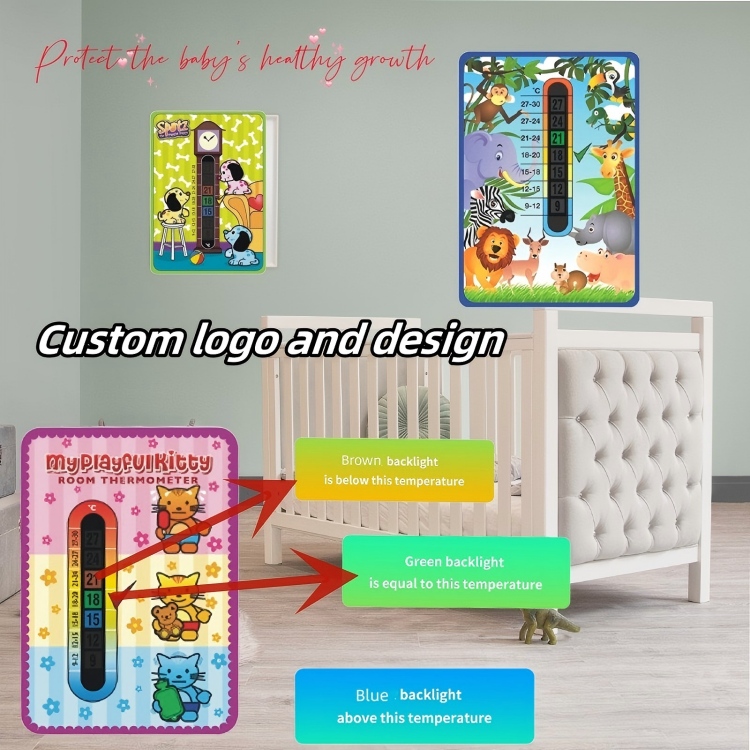
Liquid crystal thermometer cards contain temperature-sensitive materials that change their reflected color as temperature changes.
In many segmented designs, the green segment indicates the current temperature. However, caregivers must follow the specific product's reading instructions because indicator designs differ.
The change is reversible: the display responds again as conditions become warmer or cooler.
A properly designed card offers several practical benefits:
- Battery-free temperature indication.
- Lightweight construction for travel.
- Printed instructions beside the display.
- Space for multilingual guidance.
- Custom shapes, graphics, and packaging.
For nursery-product brands, this combination makes a card useful as both a temperature indicator and an educational accessory.
However, design simplicity should not be confused with unlimited performance. A passive indicator needs sufficient light for interpretation and does not automatically provide alarms, overnight records, or humidity readings.
These three specifications should be evaluated separately:
- Accuracy describes how closely the reading agrees with a reference.
- Resolution describes the smallest displayed increment.
- Range describes the temperatures the product can indicate.
A card with 1°C increments is not automatically accurate to ±1°C.
Published technical specifications show that some commercial liquid crystal thermometer products offer ±1°C accuracy across ranges covering nursery temperatures. That figure belongs to those specified products; it should not be transferred to every card or custom design.
Ask for finished-product performance data rather than relying only on the sensing material's capabilities.
A wall thermometer may use different sensing technologies. A liquid-filled model relies on the expansion of its indicating fluid. An electronic model uses a temperature sensor and display circuitry.
Consequently, "wall thermometer" does not automatically mean digital, more accurate, or more sophisticated.
The strongest benefit is consistency. A dedicated location encourages caregivers to check the same point repeatedly.
Depending on the model, additional features may include:
- Larger numerals.
- Backlighting.
- Minimum and maximum readings.
- Humidity measurement.
- Temperature alerts or recording.
Check the actual specification: these are optional features, not standard characteristics of all wall thermometers.
A wall thermometer measures conditions at its location. It cannot reveal every warm or cool area in the nursery.
Installation also matters. Direct sunlight, nearby heaters, and drafts can distort the usefulness of the reading.
For electronic models, consider battery access and maintenance. Any device, loose component, cable, or fastening should remain outside the baby's reach and outside the sleep space.
There is no defensible category-wide winner.
For example, a published specification for an ETI spirit-filled wall thermometer states ±1°C accuracy. Published specifications for certain liquid crystal indicators also state ±1°C within their relevant operating ranges.
Those examples demonstrate why the purchasing decision should compare individual products rather than assume one format is superior.
| Evaluation question | Why it matters |
|---|---|
| Is accuracy stated across the intended room-temperature range? | Performance outside that range may not be relevant |
| Is the specification for the finished product? | Packaging and mounting can affect use |
| Are response and stabilization instructions provided? | Readings taken too early can mislead |
| Is the display understandable under normal lighting? | Interpretation affects practical reliability |
| Are storage conditions and service-life guidance available? | Handling and aging require consideration |
My product-selection rule is to prioritize documented performance and clear instructions over extra decimal places or decorative presentation.
The following is a suggested household comparison procedure, not a clinical protocol or laboratory calibration method.
Choose a secure location near the sleeping area that remains outside the baby's reach.
Avoid direct sunlight, heaters, windows, and strong drafts. Do not put the thermometer inside the cot or attach it to bedding.
Follow the manufacturer's mounting instructions, especially where surface contact could influence the sensor.
Before interpreting differences across the room, place the card and comparison thermometer near each other under similar conditions.
Allow both to stabilize according to their instructions. Avoid holding the sensing area immediately before reading it.
This step helps distinguish instrument disagreement from a genuine location difference. It does not establish traceable calibration.
Use a portable instrument to compare safe monitoring points around the nursery.
Record conditions:
- Before bedtime.
- After the heating has operated.
- During the warmest part of the day.
- During an overnight check, when practical.
Note whether windows, curtains, doors, or heating settings changed.
Suppose one device shows 19°C and another shows 20°C. That difference may reflect display increments or stated measurement uncertainty rather than a meaningful temperature gradient.
For two instruments each specified at ±1°C, readings up to 2°C apart can theoretically occur within their combined stated limits under comparable conditions.
Look for repeatable patterns before concluding that one location is consistently warmer.
Consider a hypothetical nursery with a wall thermometer on a shaded internal wall and a thermometer card attached to a sunlit window.
The wall instrument reads 20°C, while the card indicates a higher temperature.
This does not establish that either device is faulty. The card may be responding to the heated window and direct radiation.
A better investigation is to relocate the card to a shaded, representative position, allow it to stabilize, and compare again.
The broader lesson is important for both consumers and brands: a prominently printed temperature range cannot compensate for unclear positioning instructions.
This example is illustrative, not a customer case study or reported product test.
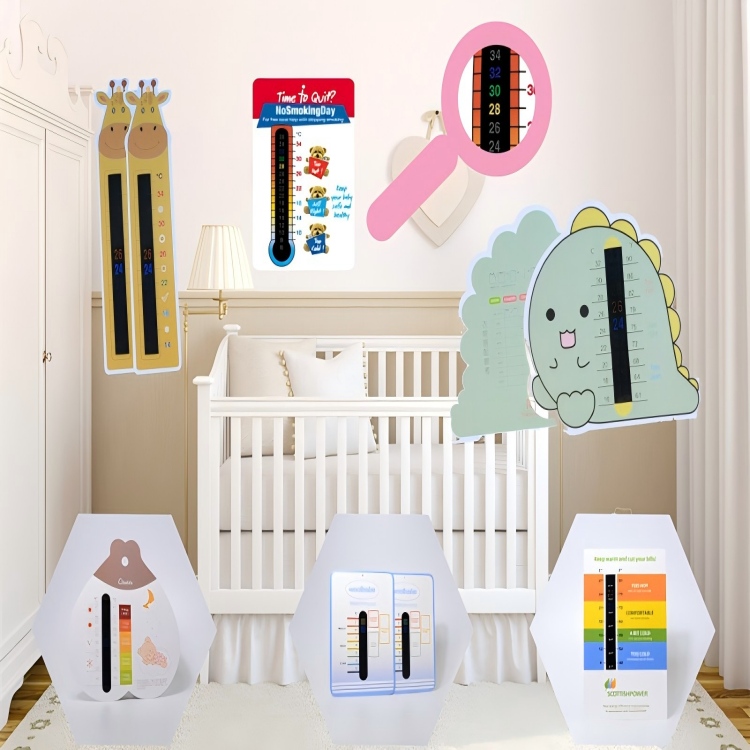
A thermometer card is a practical option when portability, battery-free operation, and easy-to-carry instructions matter.
Confirm that its display range covers the conditions you need to monitor. A card that is outside its active range may not provide a readable temperature indication.
Choose a digital model with verified minimum/maximum memory or data logging if your goal is to understand overnight temperature changes.
A standard liquid crystal card indicates current conditions; it does not show what happened while nobody was looking.
Choose a product with a separately specified humidity sensor if humidity monitoring is required.
Neither a standard thermometer card nor a basic analog wall thermometer measures relative humidity merely because it measures temperature.
A fixed thermometer and portable card can serve different purposes: one supports routine checks, while the other helps compare locations or travel accommodation.
Using two devices is not automatically necessary. Select the arrangement that answers your actual monitoring question.
Qingdao Focus On Color Industry & Trade Co., Ltd. brings more than 13 years of manufacturing experience across photochromic, thermochromic, liquid crystal thermometer, and fragrance product categories, with OEM/ODM and personalized customization services.
For a nursery thermometer project, that background should translate into a clearly defined product brief—not unsupported medical claims.
A useful development brief should specify:
1. Intended market and measurement units.
2. Temperature range, increments, and accuracy target.
3. Display interpretation and accessible written guidance.
4. Recommended mounting and stabilization instructions.
5. Materials, packaging, and applicable market requirements.
6. Sample evaluation and production acceptance criteria.
Color should not carry the entire message. Pair it with readable numbers and plain-language instructions.
Changing the substrate, laminate, adhesive, or mounting arrangement may affect how the completed product behaves or is read.
Ask the supplier to explain how finished samples will be evaluated, what documentation is available, and which claims the evidence supports.
Experience is valuable, but it does not replace product-specific verification.
For brands, distributors, and promotional-product buyers, the best starting point is a documented specification.
Contact Qingdao Focus On Color Industry & Trade Co., Ltd. with your target market, preferred temperature range, units, dimensions, artwork, order quantity, and packaging needs. Request OEM/ODM samples, relevant performance information, and a clear validation plan before approving production.
No. An ambient thermometer card measures its surrounding conditions, not a baby's internal temperature. Use an appropriate medical thermometer when checking for fever and follow healthcare guidance.
No. Compare stated accuracy, operating range, and supporting documentation. A digital display alone does not establish better accuracy.
Choose a secure, representative position near the sleeping area, outside the baby's reach and away from sunlight, heaters, and drafts. Follow the product's mounting instructions.
Possible reasons include different locations, surface contact, stabilization time, display increments, and measurement uncertainty. Compare them side by side before judging room-wide differences.
It can support informed decisions about room conditions, but it cannot assess clothing, bedding, illness, or the baby's individual response. Continue checking the baby and following safer-sleep guidance.
The liquid crystal indicator itself does not. Its color changes passively with temperature, although it normally needs external light to be read.
1. [The Lullaby Trust — Your Baby's Room Temperature]. Source for the 16–20°C guidance, room-thermometer use, and checking the baby's chest or neck. [lullabytrust.org]
2. [National Institute of Child Health and Human Development, Safe to Sleep — Ways to Reduce Baby's Risk]. Source for avoiding overheating, appropriate clothing, uncovered heads, and signs of excessive warmth. [safetosleep.nichd.nih]
3. [SpotSee — Liquid Crystal Thermometers]. Technical source for reversible color changes, segmented indicators, the green-indicator convention, and product-specific accuracy specifications. [spotsee]
4. [SpotSee — Liquid Crystal Technology: Science, Types & Applications]. Technical source for liquid crystal operation, formulation-dependent performance, and the absence of historical data logging in standard indicators. [spotsee]
5. [Electronic Temperature Instruments — Room Thermometer, 25 × 175 mm]. Product-specific example of a spirit-filled wall thermometer with stated ±1°C accuracy and positioning guidance. [thermometer.co]
6. [Electronic Temperature Instruments — Thermometry Basics]. Background on measurement technologies, accuracy specifications, and the distinction between surface and other temperature measurements. [thermometer.co]


