+86 18560646018

Views: 298 Author: Focus Color Publish Time: 2026-11-05 Origin: Site


Content Menu
● How This Supplier Shortlist Was Selected
>> Evaluation Criteria for Long-Term Supply
● Why Source Fish Tank Temperature Stickers from China?
>> A Supply Network That Covers More Than the Finished Sticker
>> Manufacturing Locations Are a Starting Point, Not Proof of Capability
>> Recent Industry Data Supports the Application—Not a Sticker Market-Size Claim
● Understanding the Product Before Comparing Suppliers
>> A Liquid Crystal Strip Is Not an Electronic LCD Thermometer
>> Resolution, Accuracy, and Water-Temperature Agreement Are Different
>> Material Construction Needs a Written Specification
● Comparison Table: Ten Chinese Sourcing Candidates
● 1. Qingdao Focus On Color Industry & Trade Co., Ltd.
>> A Practical Candidate for Customized Private-Label Projects
● 2. Huizhou Fortime Colourchange Technology Co., Ltd.
>> Direct Relevance to PET Aquarium Thermometer Strips
● 3. Dongguan Fenghejin Crafts Co., Ltd.
>> A Candidate for Aquarium and Brewing Temperature Labels
● 4. Zhejiang Tongchangyi Stationery Co., Ltd.
>> A Lead for Customized Adhesive Aquarium Strips
● 5. Shenzhen Welllbom Technology Co., Ltd.
>> A Relevant Option for Aquarium and Homebrewing Accessory Buyers
● 6. Good Idea Promotion Limited
>> An Adjacent Candidate for Branded Temperature-Indicator Projects
● 7. Taicang Chuhai Crafts & Arts Co., Ltd.
>> Related Liquid Crystal Product Experience
● 8. Taizhou Harsoul Imp. & Exp. Co., Ltd.
>> A Potential Export-Coordinating Partner for Temperature Cards
● 9. Xi'an Wetest Industry Co., Ltd.
>> An Adjacent Lead for Liquid Crystal Bottle Thermometers
>> An Exploratory Lead Requiring Additional Screening
● Buyer's Guide: How to Qualify a Fish Tank Temperature Sticker Supplier
>> Step 1: Send a Functional Specification Before Requesting Prices
>> Step 2: Verify the Business and Manufacturing Chain
>> Step 3: Approve Samples in Stages
>> Step 4: Test the Finished Installation
>> Step 5: Validate Capacity and Delivery with a Pilot Order
● Compliance: Why CE and RoHS Need Careful Interpretation
>> CE Is Not a Universal Sticker Quality Certificate
>> RoHS Scope Is Different from Voluntary Material Testing
>> ISO Certification Does Not Establish Temperature Accuracy
● Common Procurement Pitfalls—and How to Avoid Them
>> Pitfall 1: Substituting a Graphic Color-Change Effect for a Readable Thermometer
>> Pitfall 2: Accepting "PET" as the Complete Material Specification
>> Pitfall 3: Confusing a Catalogue MOQ with a Custom-Order MOQ
>> Pitfall 4: Leaving Transit Conditions Outside the Agreement
● An Overlooked Procurement Trap: The "Same Strip" May Not Be the Same Construction
● Conclusion: Choose the Supplier That Can Reproduce the Approved Product
● FAQs
>> 1. How Do We Check Whether a Supplier's ISO Certificate Is Expired or Invalid?
>> 2. What Should We Do If the Strip and the Water Probe Show Different Temperatures?
>> 3. Can We Reject a Supplier Because It Does Not Provide a CE Certificate?
>> 4. How Can We Verify Claimed Production Capacity Before a Large Order?
Choosing a fish tank temperature sticker supplier involves more than comparing prices for printed adhesive strips. The real purchasing decision concerns temperature-response consistency, adhesive reliability, material traceability, and whether the supplier can reproduce an approved sample across repeated production runs.
China offers a broad sourcing base for liquid crystal thermometer strips, color-changing labels, and customized temperature indicators. Public supplier listings identify relevant businesses in Shandong, Guangdong, Zhejiang, and Jiangsu, giving overseas buyers access to both specialist manufacturers and companies that coordinate printing, packaging, and export services. However, a supplier advertising thermometer stickers is not automatically the factory that formulates or coats the temperature-sensitive material.
This guide evaluates ten potential sourcing partners, beginning with Qingdao Focus On Color Industry & Trade Co., Ltd., and explains how to separate genuine technical capability from attractive marketplace listings.
The guiding principle is verification: compare documented product performance and production responsibilities before comparing unit prices.
A credible supplier shortlist should distinguish established facts from claims that still require checking.
The companies below were identified through company websites, supplier profiles, and published product listings. Some have direct aquarium thermometer sticker listings; others offer related liquid crystal temperature indicators and should be treated as development candidates rather than confirmed aquarium-strip specialists.
This is a sourcing shortlist—not an independently audited ranking by revenue, production volume, or market share. Qingdao Focus On Color appears first because it publishes this guide. Its position does not represent an independently measured industry ranking.
Professional purchasing teams should assess suppliers against six criteria:
1. Product relevance: Evidence of aquarium temperature stickers, liquid crystal thermometer strips, or closely related temperature-indicating products.
2. Technical capability: Ability to specify temperature ranges, indicator increments, substrate construction, and reading instructions.
3. Manufacturing transparency: Identification of which processes are performed internally and which are subcontracted.
4. Quality control: Documented temperature-response checks, adhesion testing, batch identification, and release procedures.
5. Customization support: Control over artwork, dimensions, scale layout, packaging, and, where available, the functional temperature specification.
6. Commercial reliability: Realistic production schedules, clear sample-approval procedures, and written handling of nonconforming goods.
Company age, certification, and export experience also matter, but they must be supported by current documents. A marketplace membership duration is not a legal establishment date, and a supplier badge is not a product-performance certificate.
Public listings show Chinese suppliers offering aquarium strips alongside forehead indicators, wine thermometers, bath-temperature cards, and other color-changing products. This overlap gives buyers several sourcing routes: a specialist temperature-indicator producer, a customized-label supplier, or an export company coordinating multiple factories. These routes have different strengths and should not be treated as interchangeable.
For an established aquarium brand, direct access to the functional-material producer may simplify technical troubleshooting. For a smaller distributor, a supplier coordinating private-label packaging and mixed products may be commercially useful.
The important question is not simply, "Are you a manufacturer?" It is, "Which processes do you control, and who accepts responsibility for the finished product?"
The supplier landscape reviewed here includes color-changing product businesses in Qingdao and Huizhou, a temperature-label supplier in Dongguan, and related liquid crystal thermometer listings in Zhejiang and Jiangsu. These locations help buyers plan supplier visits and compare sourcing options. They do not establish that any one city dominates aquarium thermometer sticker production.
China's wider export infrastructure is substantial. The General Administration of Customs reported goods exports of RMB 26.99 trillion in 2025, up 6.1% year on year. This provides context for the country's export capabilities, but it is not a statistic for aquarium accessories or thermometer strips specifically.
FEDIAF's Facts & Figures 2025 report identified approximately 18 million aquaria across its reporting geography, using underlying 2023 data. The association cautioned against direct year-on-year comparisons because country coverage changed. This is useful evidence of an established aquarium-owning customer base, not a measure of thermometer sticker sales.
FEDIAF's statistics page also identifies a newer report published in June 2026 using 2024 data. Buyers and publishers should distinguish the report publication year from the year the figures describe. Neither pet-population statistics nor ornamental-fish market forecasts should be presented as the market size of fish tank temperature stickers.
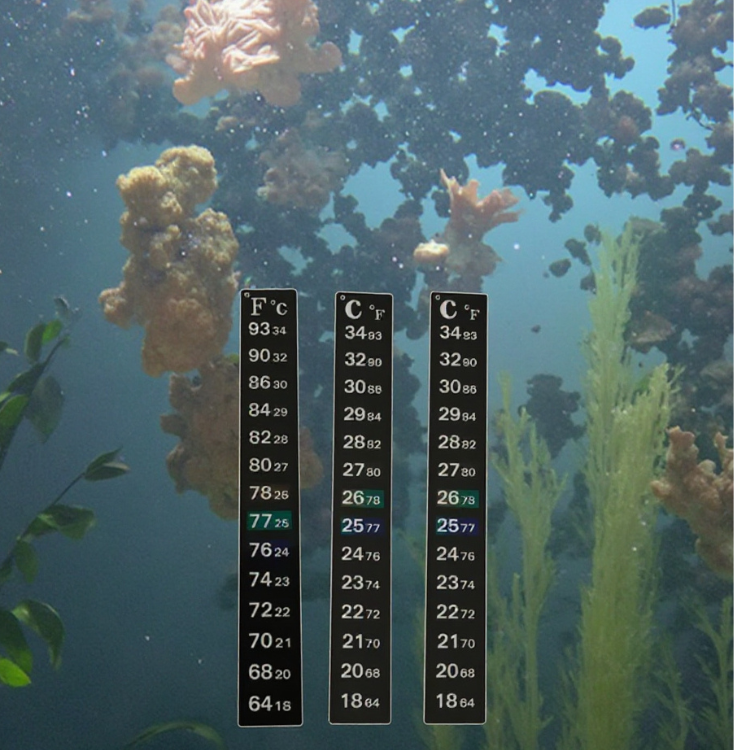
A conventional stick-on aquarium thermometer uses thermochromic liquid crystal material. Temperature-sensitive elements change reflected color as their temperature changes; they do not require batteries or an electronic display.
Technical documentation describes these strips as microencapsulated liquid crystal elements coated against a black backing. For the documented products, green indicates the nominal temperature, while neighboring elements may show other colors. Buyers must obtain the actual reading legend for the model ordered rather than assuming every strip follows an identical color convention.
A strip with numbers spaced 1°C apart does not automatically provide ±1°C accuracy.
Three separate specifications matter:
- Display increment: The spacing between printed or active temperature indicators.
- Indicator accuracy: How closely the color response corresponds to the indicator's own temperature.
- Installed-system agreement: How closely an externally attached strip corresponds to the water temperature under defined conditions.
Published liquid crystal strip documentation gives examples of ±1°C tolerances in relevant temperature ranges. That is a useful technical reference, not a performance guarantee for every Chinese supplier or every aquarium installation.
Because an external strip is attached to the tank surface, purchasing teams should validate the finished installation against a calibrated water probe. The test specification should define tank material, wall thickness, water circulation, ambient conditions, and stabilization time.
Supplier descriptions such as "PET material" or "waterproof sticker" are not sufficiently precise for repeat procurement.
Request a construction specification covering:
- Face-film material and thickness.
- Liquid crystal system and active temperature points.
- Black backing or contrast layer.
- Adhesive type and approved application surfaces.
- Release liner.
- Protective coating or laminate.
- Declared storage conditions and shelf life.
Published technical documentation identifies polyester film and liquid crystal ink as components of commercial thermometer-strip constructions, with thickness varying by design. Those published constructions provide useful questions for suppliers, not a universal specification that every product must follow.
"Not verified" means the reviewed evidence did not establish the figure or document. It does not mean the supplier has no capacity or certification.
Listed MOQs relate to the identified product listing. They are not guaranteed MOQs for a custom fish tank temperature sticker.
| Company | Evidence-based product focus | Establishment information | Production capacity | Public MOQ evidence | Certification status |
|---|---|---|---|---|---|
| Qingdao Focus On Color Industry & Trade Co., Ltd. | Temperature strips, liquid crystal thermometers, color-changing products | More than 13 years' production experience claimed; legal founding year not verified | Not verified | Obtain SKU-specific quotation | Current factory and product documents must be requested. |
| Huizhou Fortime Colourchange Technology Co., Ltd. | Direct PET aquarium liquid crystal thermometer listing | 2007, according to supplier profile | Not verified | Obtain quotation | Current documents not verified. |
| Dongguan Fenghejin Crafts Co., Ltd. | Fish tank temperature stickers and brewing thermometer strips | Legal founding year not verified | Not verified | Obtain quotation | Current documents not verified. |
| Zhejiang Tongchangyi Stationery Co., Ltd. | Adhesive liquid crystal aquarium thermometer strips | Legal founding year not verified | Not verified | Aquarium-specific MOQ not verified | Current documents not verified. |
| Shenzhen Welllbom Technology Co., Ltd. | Fish tank thermometer stickers and brewing-related strips | Legal founding year not verified | Not verified | Obtain quotation for exact aquarium model | Current documents not verified. |
| Good Idea Promotion Limited | Liquid crystal scale thermometer adhesive strips | Legal founding year not verified | Not verified | 5,000 pieces on a related indoor-strip listing | Current product documents not verified. |
| Taicang Chuhai Crafts & Arts Co., Ltd. | Liquid crystal forehead and wine thermometers | Directory lists 2017; confirm against business licence | Not verified | 1,000 pieces on a related forehead-strip listing | Current aquarium-specific documents not verified. |
| Taizhou Harsoul Imp. & Exp. Co., Ltd. | Liquid crystal bath-temperature cards | Legal founding year not verified | Not verified | 2,000 pieces on a related bath-card listing | Current aquarium-specific documents not verified. |
| Xi'an Wetest Industry Co., Ltd. | Liquid crystal wine-bottle thermometers | Legal founding year not verified | Not verified | 3,000 pieces on a related wine-thermometer listing | Current aquarium-specific documents not verified. |
| Jiazi Group Co., Ltd. | Directory-listed liquid crystal wine thermometers | Legal founding year not verified | Not verified | Not verified | Current aquarium-specific documents not verified. |
The first five candidates have direct aquarium-product relevance in the reviewed evidence. The remaining five require additional confirmation of aquarium-specific manufacturing capability before entering a final supplier comparison.
Qingdao Focus On Color describes more than 13 years of experience producing photochromic, thermochromic, liquid crystal thermometer, and fragrance-related products. Its published range includes thermometer cards, temperature strips, color-changing stickers, and UV stickers, with OEM and ODM services available.
This combination makes the company relevant to buyers developing a branded fish tank temperature sticker rather than simply purchasing an unchanged catalogue item.
- Establishment: The company states more than 13 years of manufacturing experience; its exact legal incorporation year should be confirmed separately.
- Published markets: Japan, Germany, the United Kingdom, Russia, France, and Australia.
- Core advantage: A product range combining functional temperature indicators with customized printed products.
- OEM/ODM scope: Published customization services; buyers should confirm the available temperature ranges, dimensions, artwork options, packaging formats, and development responsibilities for the selected aquarium model.
The company is a relevant candidate for small and medium-sized brands seeking close coordination between product selection, artwork, and packaging. Its website emphasizes responsive service and product-development support. These claims should be assessed through the quotation and sampling process rather than treated as measured service-performance results.
For procurement purposes, evaluate value through total landed cost: sample revisions, packaging charges, inspection results, defect handling, and reorder consistency—not only the price per sticker.
Before placing an order, request a written customization matrix, the proposed production specification, and a sample-approval schedule. This turns flexibility and communication into defined project commitments.
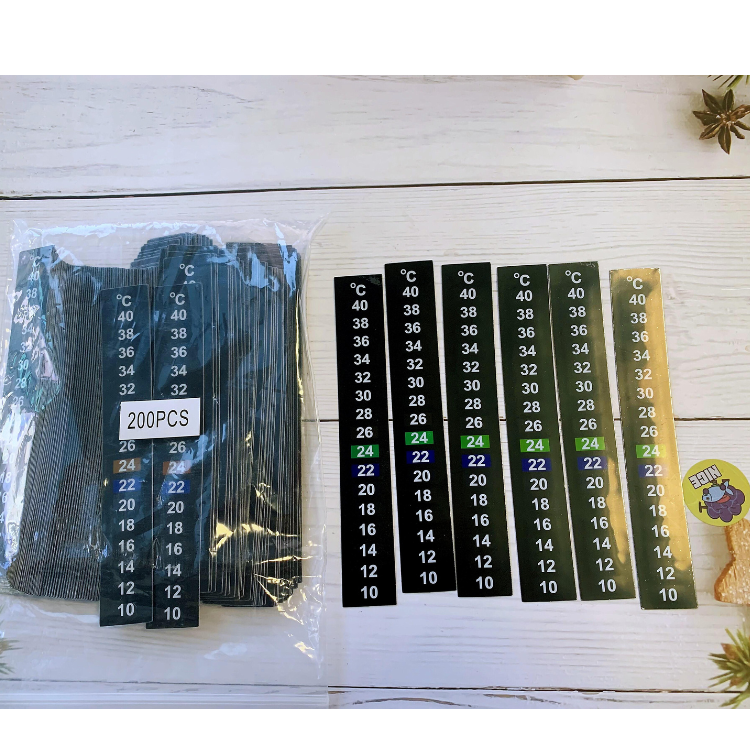
Huizhou Fortime has a published household PET liquid crystal aquarium thermometer listing, making it one of the more directly relevant candidates in this shortlist. Its supplier profile states that the company was established in 2007 and serves markets worldwide.
- Establishment: 2007, supplier-profile claim.
- Published markets: Worldwide markets; detailed market shares were not established.
- Core advantage: Direct aquarium thermometer product evidence within a broader color-changing product business.
- OEM/ODM scope: A separate supplier directory describes OEM, ODM, product customization, and custom packaging services; these should be reconfirmed for the aquarium model.
The key qualification question is whether the supplier controls liquid crystal preparation and coating, or purchases functional material for subsequent conversion. Either arrangement can work, but responsibility for calibration, traceability, and corrective action must be clear.
Public listings associate Dongguan Fenghejin with adhesive fish tank temperature indicators and brewing thermometer strips. Another supplier profile describes it as a China-based supplier and exporter of labels and related products.
- Establishment: Not verified from the reviewed evidence.
- Published markets: Export activity is described, but destination breakdowns are not verified.
- Core advantage: Listings covering closely related adhesive temperature-indicator applications.
- OEM/ODM scope: Obtain written confirmation of artwork, dimensions, packaging, and functional temperature customization; these capabilities should not be inferred from a standard product listing alone.
Buyers sourcing both aquarium and fermentation accessories may find this product overlap useful. However, they should not assume that a brewing strip can be repackaged for aquariums without checking its scale, instructions, adhesion, and intended installation conditions.
Zhejiang Tongchangyi's marketplace profile includes a liquid crystal adhesive fish tank thermometer strip described as using PET material. This gives the company direct product relevance, although it does not independently establish its manufacturing process or output.
- Establishment: Not verified.
- Published markets: Not established in the reviewed profile.
- Core advantage: A directly relevant adhesive aquarium thermometer listing.
- OEM/ODM scope: Confirm private-label printing, scale changes, packaging, and whether customization extends beyond graphics to the active temperature elements.
The central purchasing issue is depth of customization. A supplier may be able to print a new logo but not change the liquid crystal response range. Buyers should distinguish these two services before paying development charges.
Shenzhen Welllbom has a published fish tank thermometer sticker listing, with the model description also referencing homebrewing. Its marketplace profile identifies it as a manufacturer and trading company.
- Establishment: Not verified; platform tenure should not be substituted for incorporation date.
- Published markets: Not verified.
- Core advantage: Direct aquarium sticker relevance alongside brewing-related applications.
- OEM/ODM scope: Request aquarium-specific confirmation of branding, scale layout, packaging, and production responsibilities.
This candidate merits consideration when buyers are consolidating related accessory lines. The manufacturer-and-trading-company description makes process mapping especially important: identify the coating source, converter, packer, and entity responsible for warranty claims.
Good Idea Promotion has a published liquid crystal scale thermometer adhesive-strip listing with a stated MOQ of 5,000 pieces. The identified application is indoor temperature indication, not specifically aquarium use.
- Establishment: Not verified.
- Published markets: Not verified.
- Core advantage: A relevant adhesive liquid crystal thermometer format.
- OEM/ODM scope: Aquarium adaptation, branding, packaging, and active-range changes require confirmation.
- Qualification priority: Establish whether the supplier can provide an aquarium-specific construction and validation record.
It belongs on a development longlist, not an approved aquarium supplier list, until product-specific samples and documents are available.
Public listings associate Taicang Chuhai with liquid crystal forehead stickers and wine thermometers. A supplier directory lists 2017 and describes OEM/ODM capabilities, but buyers should verify the legal entity and service scope directly.
- Establishment: 2017 in a directory listing; business-licence confirmation required.
- Published markets: A directory identifies North America as a key market.
- Core advantage: Evidence of multiple liquid crystal thermometer formats.
- OEM/ODM scope: Directory-described customization services; aquarium-specific capability remains unverified.
The essential technical check is application suitability. A forehead thermometer's active temperature range is not suitable evidence of aquarium performance. Request a dedicated aquarium sample rather than accepting a related product as proof.
Taizhou Harsoul has a published liquid crystal baby-bath temperature-card listing with a 2,000-piece MOQ. This establishes related temperature-indicator product relevance, not confirmed aquarium-strip manufacturing.
- Establishment: Not verified.
- Published markets: Not verified.
- Core advantage: Access to a related consumer temperature-indicator format.
- OEM/ODM scope: Request confirmation of private-label services and aquarium development capability.
- Qualification priority: Identify the actual manufacturer and clarify technical and commercial responsibility.
This candidate may suit buyers comfortable with an export-coordination model, provided the underlying factory and quality-control arrangements are transparent.
Xi'an Wetest appears in a public listing for a stainless-steel liquid crystal wine-bottle thermometer, with a stated MOQ of 3,000 pieces. That is a different construction and application from a flat adhesive aquarium strip.
- Establishment: Not verified.
- Published markets: Not verified.
- Core advantage: Published participation in liquid crystal temperature-indicating products.
- OEM/ODM scope: Not established for aquarium stickers; request a feasibility assessment.
- Qualification priority: Confirm access to suitable adhesive-strip production, not only finished bottle-thermometer sourcing.
Include this company when exploring broader temperature-indicator sourcing, but require direct aquarium evidence before comparing its quotation with specialist strip suppliers.
A liquid crystal strip thermometer directory associates Jiazi Group with a red-wine liquid crystal thermometer. The available evidence is limited and does not establish a dedicated fish tank temperature sticker production line.
- Establishment: Not verified.
- Published markets: Not verified.
- Core advantage: A published connection to an adjacent liquid crystal thermometer category.
- OEM/ODM scope: Not verified for aquarium products.
- Qualification priority: Verify the legal entity, factory location, current catalogue, and access to aquarium-specific samples.
This is an exploratory sourcing lead rather than a fully qualified recommendation. It should advance only after providing direct product and manufacturing evidence.
A useful request for quotation should define:
| Specification area | Information to include |
|---|---|
| Application | External glass attachment, acrylic attachment, or another defined installation |
| Temperature display | Required range, Celsius/Fahrenheit layout, and indicator increments |
| Performance | Required tolerance under a defined test method |
| Dimensions | Finished size, corner geometry, and orientation |
| Construction | Film, adhesive, protective layers, and liner requirements |
| Branding | Artwork, logo, language, and barcode requirements |
| Packaging | Individual packing, retail card, multipack, and carton configuration |
| Quality records | Lot coding, inspection report, and retained-sample requirements |
| Commercial terms | Quantity tiers, sample charges, lead time, Incoterm, and defect remedy |
Ask suppliers to mark every requirement as standard, customizable, or unavailable. This prevents a low quotation from concealing specification gaps.
Obtain the business licence and check that the legal name matches the quotation, contract, invoice, and payment beneficiary.
Then request a process walkthrough covering:
- Functional-material sourcing or formulation.
- Coating and printing.
- Lamination and adhesive conversion.
- Die-cutting.
- Temperature-response inspection.
- Packing and batch release.
If a supplier outsources a process, record the arrangement and the approval mechanism for changing subcontractors. Outsourcing is not automatically a defect; undisclosed changes are the greater procurement concern.
Use a staged approval process:
1. Standard samples to evaluate the supplier's existing construction.
2. Customized samples to approve artwork, dimensions, and packaging.
3. Pilot-production samples made using the intended commercial materials and process.
4. Shipment samples selected from the actual production lot.
Retain signed reference samples at both companies. Label each with its construction revision and approval date.
For qualification, compare the installed strip with a calibrated immersed reference probe under controlled conditions.
Use several temperatures spanning the intended operating range, and test both warming and cooling. Record how long the system stabilizes and how the colors should be interpreted.
Separate a failure of the active indicator from a difference caused by the tank-wall installation. Liquid crystal strip documentation describes reversible color changes, but the purchase specification still needs to define acceptance conditions for the finished aquarium application.
Do not treat an advertised "pieces per month" figure as usable capacity for your project.
Ask for:
- Output for the exact construction ordered.
- Bottlenecks in coating, curing, conversion, or packing.
- Current production loading.
- Material procurement lead time.
- Time required for custom packaging.
- A recovery plan for rejected lots.
A successfully completed pilot order provides more relevant evidence than an unsupported maximum-capacity claim.
EU guidance states that CE marking applies only where specific harmonized legislation requires it. Products outside those requirements must not carry CE marking simply as a general quality symbol.
For a passive, non-electronic aquarium strip, ask the supplier to explain the legal basis for any CE claim. Do not assume that a document bearing the letters "CE" proves suitability, accuracy, or lawful marking.
The RoHS Directive concerns electrical and electronic equipment and restricts specified hazardous substances. A passive liquid crystal strip should not automatically be classified as electrical equipment merely because its sales description uses "LCD."
A buyer may still request restricted-substance testing as a contractual material requirement. That is different from claiming the product necessarily falls within RoHS legislation.
For any test report, check:
- The tested model and sample description.
- The materials or layers covered.
- Report date.
- Laboratory identity.
- Test methods and limits.
- Whether the tested construction matches the current order.
Treat management-system certification and product validation as separate evidence.
A factory certificate should be checked for the correct legal entity, site, scope, and current status. Product acceptance should still depend on the agreed construction, temperature-response results, and shipment inspection.
Liquid crystal temperature indicators and general color-changing decorative inks are not interchangeable specifications. Technical descriptions distinguish highly temperature-sensitive liquid crystals and their multicolor response from other thermochromic systems.
Avoidance: Require the supplier to identify the functional technology and demonstrate each active temperature point against a controlled reference.
The same broad material description can leave film thickness, adhesive construction, and protection layers undefined.
Avoidance: Approve the full construction and require written authorization before substitution. Treat a cheaper alternative as a new sample revision, not an equivalent product by default.
A standard strip and a customized active range can involve different materials, setup requirements, and order economics.
Avoidance: Separate the quotation into standard product, custom artwork, custom dimensions, custom temperature specification, and packaging. Ask which changes trigger new setup charges or minimum quantities.
A shipment can arrive with acceptable cartons while leaving unresolved questions about product storage history.
Avoidance: Obtain the supplier's validated storage and transit limits, agree on protective packing, and include arrival testing in the quality plan. Where the route or season warrants it, consider shipment monitoring rather than assuming every delivery experiences the same conditions.
An important risk is that visual approval can become a substitute for technical approval.
Two strips may share identical artwork and dimensions while using different adhesive, laminate, or functional-material batches. A supplier may regard the change as an equivalent substitution unless the contract defines otherwise.
The practical safeguard is a controlled bill of materials:
1. Assign the approved construction a revision number.
2. Identify the functional material and adhesive by controlled references.
3. Require written approval before material or subcontractor changes.
4. Retain samples from every production batch.
5. Repeat agreed performance checks after any approved change.
This is a recommended procurement control, not a claim that every listed supplier makes undisclosed substitutions. Its purpose is to ensure that "same as approved sample" has a measurable meaning beyond appearance.
A useful shortlist is the beginning of procurement, not the end.
The strongest candidate for a particular project is the one that can document its manufacturing responsibilities, deliver a suitable pilot lot, maintain the approved construction, and resolve problems under clear commercial terms.
Qingdao Focus On Color Industry & Trade Co., Ltd. is a relevant starting point for buyers seeking temperature-indicator products with OEM/ODM support and coordinated customization. Its published range and stated export markets support including it in a comparative sourcing process; final qualification should use the same sample, documentation, and delivery checks applied to every other candidate.
To begin a project, send Qingdao Focus On Color your required temperature range, dimensions, branding files, target markets, packaging format, and estimated order quantities. Request a specification-based quotation and pilot-sample plan before committing to volume production.
Request the complete certificate rather than a cropped logo image. Check the legal entity, factory address, scope, certificate number, issuing body, and stated validity dates.
Verify current status directly with the issuing body and, where available, an accredited-certificate database. A future expiry date printed on a document does not replace checking whether the certificate has subsequently been suspended or withdrawn.
Do not use management-system certification as a substitute for thermometer performance testing.
First identify what each device measures.
The immersed probe measures water at its location; the externally mounted strip responds at the tank surface where it is attached. Compare them only after defining the installation, probe position, ambient conditions, circulation, and stabilization period.
Then test whether the strip meets its own agreed response tolerance. Published liquid crystal documentation provides examples of indicator tolerances, but those figures do not automatically establish an installed aquarium system's accuracy.
Not without first checking whether CE legislation applies to the exact product.
EU guidance makes clear that CE marking is required only for covered products and must not be applied to others. For a passive aquarium sticker, the appropriate first request is a documented compliance assessment, not an arbitrary demand for a CE certificate.
Ask the supplier to show capacity for your exact product construction, including packing—not only theoretical printing output.
Review the production route, material availability, shift pattern, existing commitments, and bottleneck operations. Follow with


