+86 18560646018

Views: 217 Author: Focus Color Publish Time: 2026-09-19 Origin: Site


Content Menu
● Why UV-C Output Verification Matters
● UV Test Cards: Fast Visual Verification
>> Key Benefits of UV-C Test Cards
>> What UV-C Test Cards Cannot Prove
● Laboratory Spectrometers: Quantitative Performance Analysis
>> What a Laboratory Spectrometer Can Measure
>> Strengths of Spectrometer-Based Verification
● UV Test Card vs. Laboratory Spectrometer
● A Practical Two-Level Verification Program
>> Level 1: Laboratory Qualification
>> Level 2: Field Coverage Verification
● Choosing the Right Tool by Application
>> For UV-C Lamp Manufacturers
>> For UV-C Equipment Distributors
>> For Hospitals and Facilities
>> For UV-C Product Developers
● Expert Insight: The Most Common Verification Mistake
● How to Specify a Customized UV-C Test Card
● FAQ
>> 1. Can a UV test card measure UV-C irradiance in mW/cm²?
>> 2. Can a UV-C test card confirm that a lamp is disinfecting effectively?
>> 3. Why does a UV-C lamp need spectral testing?
>> 4. Are UV test cards useful for UV-C LED systems?
>> 5. How often should UV-C lamp output be checked?
>> 6. What causes uneven UV-C test card color changes?
>> 7. Can customized UV test cards be made for OEM projects?
A UV test card and a laboratory spectrometer serve very different roles when verifying UV-C disinfection lamp output. UV test cards are fast, visual tools for confirming that UV-C energy reaches a target area, while laboratory spectrometers provide quantitative spectral and irradiance data needed for product development, calibration, compliance testing, and performance validation.
For manufacturers, distributors, facility managers, and OEM buyers, the practical question is not simply which tool is "better." The right question is: What level of evidence do you need, at what stage of the UV-C product lifecycle, and for what business or technical decision?
At Qingdao Focus On Color Industry & Trade Co., Ltd., we have spent more than 13 years developing functional color-change materials, including photochromic products, thermochromic products, liquid crystal temperature indicators, UV-sensitive materials, and customized sensory products. From this manufacturing perspective, a UV-C test card is most valuable when it is engineered as a clear, repeatable visual indicator—not when it is mistaken for a laboratory measurement instrument.

UV-C disinfection performance depends on more than whether a lamp visibly turns on. A UV-C source may emit light, but still deliver inadequate energy at a surface because of aging, distance, lamp orientation, shielding, dust, temperature variation, poor reflector design, or shadowed areas.
The relevant exposure is usually expressed as UV dose:
UV Dose=Irradiance×Exposure Time
Irradiance is commonly measured in mW/cm², while exposure time is measured in seconds. The resulting dose is often expressed in mJ/cm².
A UV-C system may appear operational while delivering a lower-than-expected dose at the point of use. This distinction matters in hospitals, laboratories, food-processing facilities, HVAC systems, water-treatment equipment, packaging lines, and controlled manufacturing environments.
A robust verification program should answer several separate questions:
- Is UV-C radiation present at the target location?
- Does the UV-C light reach difficult or shadow-prone surfaces?
- Is the delivered exposure above a selected visual or operational threshold?
- What wavelength or wavelengths are being emitted?
- What is the actual irradiance at defined distances and positions?
- Has output changed after lamp aging, maintenance, or replacement?
- Can the result support a formal technical claim, customer specification, or validation record?
A UV test card can address some of these questions quickly. A laboratory spectrometer is required for others.
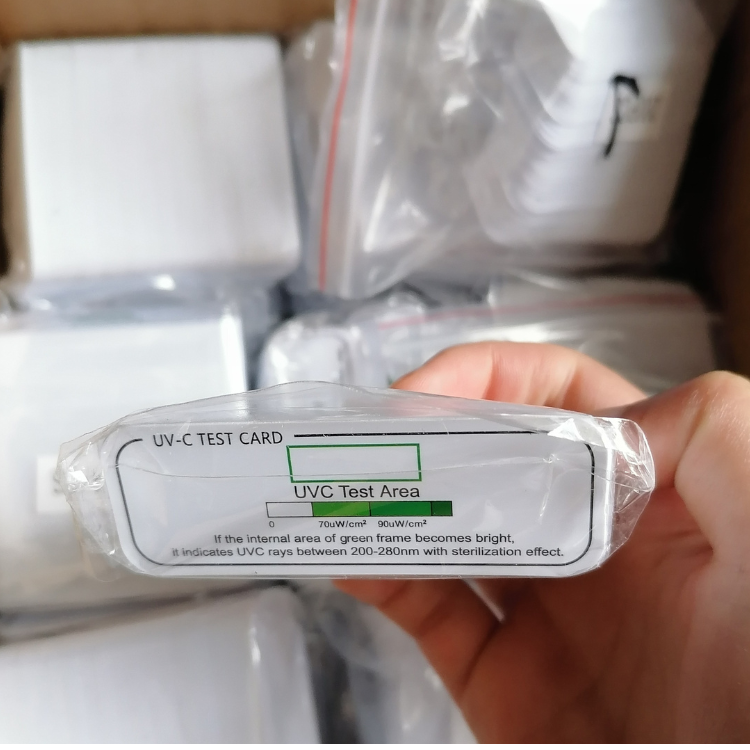
A UV test card, also called a UV-C dose indicator card or colorimetric UV-C indicator, uses a photosensitive coating that changes color after receiving ultraviolet exposure. The visual change may indicate that UV-C energy reached the card and, depending on the card design, may correspond to approximate exposure ranges.
The core value of a UV-C test card is simplicity. It converts invisible radiation into a visible result that operators can understand in seconds.
A properly designed card contains a UV-responsive chemical or pigment system. When exposed to sufficient UV energy within its intended wavelength response range, the active area changes color.
The user places the card at a target location, runs the UV-C cycle, and compares the final color with a printed reference scale or pass/fail guide.
For example, an operator may place cards:
- On the center and corners of a workbench
- Behind equipment where shadows may occur
- On the top, side, and bottom of a medical device
- At near-field and far-field positions from a UV-C lamp
- Inside a disinfection cabinet, chamber, or conveyor system
- At the end of an HVAC duct treatment zone
- On a sample product during UV-C packaging-line validation
This immediately reveals whether the system's geometry allows UV-C light to reach the intended surfaces.
Immediate visual feedback. Operators do not need to interpret spectral graphs, irradiance units, or calibration coefficients.
Low deployment cost. Cards can be distributed across many locations in one cycle, making them useful for mapping coverage.
Excellent for identifying shadowing. A laboratory instrument measures one point at a time. A set of cards can show whether UV-C reaches multiple surfaces simultaneously.
Useful for training. Test cards help technicians understand how distance, angles, obstructions, lamp position, and exposure time affect UV-C delivery.
Easy for routine checks. They can support daily, weekly, or batch-level operational verification without interrupting production for complex measurement work.
Flexible for OEM and private-label programs. Customized cards can include a customer's logo, color standard, packaging, instruction language, target exposure range, and application-specific layout.
A UV-C test card should not be presented as a replacement for a calibrated radiometer or spectrometer. Its response is influenced by the card formulation, UV wavelength, cumulative dose, exposure duration, storage condition, temperature, humidity, viewing conditions, and the user's interpretation of color.
Most importantly, a card does not directly measure the emission spectrum of the lamp.
It cannot independently confirm:
- Exact peak wavelength
- Spectral bandwidth
- Absolute radiant flux
- Precise irradiance in mW/cm²
- Lamp output efficiency
- Electrical-to-optical conversion performance
- Calibration traceability
- Full conformance with a technical testing protocol
- Microbial inactivation performance under all real-world conditions
Commercial colorimetric UV-C indicators are widely recognized as practical tools for showing UV-C delivery on surfaces, but they generally provide rough or qualitative estimates, not laboratory-grade measurement data. They are especially useful for training, initial placement checks, and routine confirmation that light reaches specified positions.
A laboratory spectrometer, often used with calibrated optics, detectors, integrating spheres, cosine-corrected irradiance probes, or radiometric accessories, analyzes light across wavelengths. For UV-C verification, it can show whether a source emits at the intended wavelength region and quantify the spectral output.
Depending on the equipment configuration, a laboratory may use a spectrometer, spectroradiometer, UV radiometer, or a combined measurement setup. Although these terms are sometimes used loosely, they are not identical.
- A spectrometer separates light by wavelength and records spectral distribution.
- A spectroradiometer combines spectral analysis with calibrated radiometric measurement.
- A UV-C radiometer measures irradiance over a specified spectral response range.
- An integrating sphere system may be used to measure total radiant flux from a source.
- A calibrated photodiode sensor may be used for repeatable irradiance measurements at defined positions.
For formal UV-C lamp output verification, measurement equipment must be selected and calibrated for the relevant wavelength range, source type, geometry, and operating conditions.
A laboratory-grade system can support detailed answers to technical questions, including:
- Peak emission wavelength, such as a mercury lamp near 254 nm or a UV-C LED near a specified wavelength band
- Relative spectral power distribution
- Spectral shifts caused by temperature or drive current
- Irradiance at a defined working distance
- Output stability after warm-up
- Variation between lamp batches
- Output degradation over operating life
- Stray visible, UV-A, or UV-B emission
- Comparative performance between different lamp or LED suppliers
- Conformance with internal specifications and defined test conditions
These data matter because UV-C disinfection is wavelength-dependent. A source emitting near a desired region is not automatically equivalent to another source with a different spectral profile, irradiance level, optical design, or exposure geometry.
Technical guidance for UV-C device design emphasizes radiometric measurement across the disinfection area, including measurements at different working distances and worst-case locations.
High measurement detail. Spectral data can reveal whether a source is producing the intended UV-C wavelength profile.
Stronger technical documentation. Results can support product specifications, supplier qualification, engineering change control, and laboratory reports.
Better root-cause analysis. If output changes, spectral data can help distinguish between source aging, driver issues, temperature effects, filter problems, optical contamination, or incorrect component selection.
Calibration capability. When equipment is calibrated with appropriate reference standards, results can be linked to recognized measurement systems.
Support for development work. Engineers can compare prototypes, optimize reflectors, evaluate thermal management, and select LED or lamp configurations using measured data rather than visual assumptions.
NIST describes calibration work for UV sources and UV meters, including calibration of UV LED irradiance sources against spectral irradiance standards and calibration of UV meters used to determine integrated irradiance from field sources.
| Comparison Factor | UV Test Card | Laboratory Spectrometer |
|---|---|---|
| Primary purpose | Visual confirmation of UV-C exposure or approximate dose range | Quantitative analysis of spectral output and radiometric performance |
| Typical user | Operator, technician, installer, quality inspector | Laboratory technician, optical engineer, validation specialist |
| Result format | Color change, reference scale, pass/fail appearance | Spectral graph, wavelength data, irradiance, flux, calibration data |
| Speed | Seconds to minutes after exposure | Minutes to hours, depending on setup and reporting |
| Cost per check | Low | High equipment, calibration, labor, and facility cost |
| Coverage mapping | Excellent; many cards can be placed at once | Limited; usually measured point by point |
| Peak wavelength verification | No | Yes |
| Exact irradiance measurement | No | Yes, with suitable calibrated configuration |
| Shadow-area detection | Excellent | Possible, but requires multiple measurement positions |
| Routine field use | Very suitable | Less convenient for frequent broad-area checks |
| Formal technical validation | Supportive evidence only | Often essential |
| Training value | Very high | Moderate; requires trained interpretation |
| Best use | Daily checks, installation mapping, visible confirmation | R&D, product qualification, calibration, troubleshooting, formal reports |
The most effective approach is often not a choice between UV test cards and laboratory spectrometers. It is a layered verification system that uses each tool where it creates the most value.

For UV-C lamp manufacturers, OEM brands, service providers, and end users, the following workflow is practical and defensible.
Use calibrated laboratory instruments during product development, supplier approval, product validation, and scheduled performance audits.
The laboratory stage should define:
1. The source type and intended wavelength range
2. The target operating current, temperature, warm-up time, and distance
3. The measurement geometry and detector orientation
4. The minimum acceptable irradiance or output value
5. The locations representing average and worst-case performance
6. The calibration status and uncertainty of the equipment
7. The reporting method for repeat tests and lamp aging
For linear UV-C lamps, ISO 15727 provides a method for measuring lamp output and relies on controlled measurement conditions, including calibrated UV-C radiometric equipment, stable operating conditions, geometry control, and reflection management.
Use UV-C test cards during installation, operator training, maintenance checks, process changeovers, and routine audits.
A practical field procedure is:
1. Identify the critical target surfaces and likely shadow zones
2. Place UV-C test cards at representative locations
3. Record lamp type, distance, cycle time, date, and operator
4. Run the normal UV-C disinfection cycle
5. Compare the color change with the approved reference guide
6. Photograph the cards under consistent lighting if records are needed
7. Investigate any weak, inconsistent, or unexpected response
8. Confirm major changes with calibrated instrumental measurement
This method is particularly useful after replacing lamps, changing reflector designs, moving equipment, adjusting cycle time, or modifying product loading patterns.
Use a laboratory spectrometer or calibrated radiometric system to establish product specifications, validate production samples, investigate quality deviations, and document source performance.
Use UV test cards as a customer-friendly accessory that demonstrates coverage and helps users operate the lamp correctly after installation.
A manufacturer that supplies only a card may not have enough evidence to support precise performance claims. A manufacturer that supplies only laboratory data may leave the end user without an easy way to confirm real-world coverage.
Use cards for demonstrations, customer training, and installation verification. They make invisible UV-C exposure visible and reduce confusion during commissioning.
For high-value projects, ask the original equipment manufacturer for documented spectral and irradiance test information. If the buyer needs an exact output claim, independent laboratory data should be part of the purchasing discussion.
Use UV test cards to identify coverage gaps caused by room layout, furniture, equipment, shadows, and incorrect lamp placement.
Do not use a single card result to claim that an entire room, device, or workflow has achieved a defined microbial reduction. Surface type, organism, humidity, lamp distance, dose, and exposure geometry all influence real disinfection results.
Use spectrometer-based measurement to compare LED bins, optical systems, drive conditions, and thermal designs. Then use cards to visualize the practical result of the optical design on real surfaces.
This combination is especially valuable for enclosed disinfection boxes, UV-C conveyors, air-treatment modules, portable lamp systems, and customized OEM products.
The most common mistake is treating presence of UV-C light as equivalent to verified disinfection performance.
A color change on a UV test card confirms that the card received a defined type or range of ultraviolet exposure under the conditions of use. It does not automatically establish:
- A universal germicidal dose
- A specific log reduction for all organisms
- Uniform exposure across every surface
- Equivalent performance at every lamp age
- Sufficient output after maintenance failures
- Safety for people, animals, materials, or occupied spaces
UV-C output also declines as lamps age. For this reason, performance planning should consider end-of-life output rather than only new-lamp output.
The strongest product and operational claims are built from several types of evidence:
- Calibrated optical measurements
- Clearly defined test geometry
- Repeatable operating conditions
- Appropriate biological or application testing when required
- Field coverage checks using practical indicators
- Documented maintenance and replacement procedures
When sourcing a UV-C test card from a specialized color-change material manufacturer, buyers should provide a clear specification rather than requesting a generic "UV indicator."
Key specification questions include:
- What UV-C wavelength range should trigger the response?
- Is the card intended for presence detection, approximate dose indication, or pass/fail verification?
- What exposure range should produce the target color change?
- Will the card be used with mercury lamps, UV-C LEDs, pulsed xenon devices, or another source?
- What is the expected exposure time?
- What storage temperature, humidity, and shelf-life conditions are required?
- Does the design need to minimize response to UV-A or UV-B?
- Is a printed color reference chart required?
- Does the customer need OEM branding, multilingual instructions, or private-label packaging?
- Will the cards be used once, or must the response remain visible for audit records?
For pulsed xenon and mixed-spectrum sources, it is particularly important to understand whether an indicator may respond to UV-A or UV-B as well as UV-C. This can affect interpretation and should be checked during product selection and validation.
Choose a UV test card when you need fast, visible, low-cost confirmation that UV-C light reaches selected surfaces. Choose a laboratory spectrometer or calibrated radiometric system when you need precise wavelength, irradiance, output, calibration, and performance data.
For most serious UV-C disinfection programs, use both.
Laboratory measurement establishes what the lamp or device can deliver under controlled conditions. UV-C test cards help confirm whether that energy reaches real-world target areas during installation and daily operation. Together, they provide a more complete picture of UV-C system performance than either tool alone.
Qingdao Focus On Color Industry & Trade Co., Ltd. supports OEM/ODM development of customized UV-sensitive indicator materials, color-change cards, labels, packaging inserts, and application-specific visual verification solutions. If you are developing a UV-C product, private-label verification card, or customized disinfection accessory, share your light source, wavelength range, expected exposure conditions, target response, and branding requirements to begin a feasibility evaluation.
Usually, no. A UV test card provides a colorimetric response that may correspond to an approximate exposure range or pass/fail threshold. It is not a direct substitute for a calibrated irradiance meter or spectroradiometer.
It can show that UV energy reached the card, but it cannot independently prove a specific microbial reduction level. Effective disinfection depends on dose, wavelength, exposure time, distance, shadowing, target organism, surface conditions, and other variables.
Spectral testing identifies the wavelength distribution of the source. This helps verify whether the lamp or UV-C LED is emitting in the intended range and whether changes in temperature, aging, drive conditions, or components have altered output.
Yes. They are useful for visual coverage mapping and practical operating checks. However, the card should be selected and validated for compatibility with the LED's wavelength range and expected exposure conditions.
The frequency should reflect the application's risk level, operating hours, manufacturer instructions, maintenance plan, and the consequences of underperformance. Routine visual checks may be frequent, while calibrated instrumental verification is typically scheduled at defined intervals and after major service changes.
Common causes include different distances from the lamp, shadows, angled exposure, reflectivity differences, lamp aging, inconsistent cycle time, contamination on the card, mixed UV wavelengths, and variations in the card's storage or handling conditions.
Yes. Customized programs may include adjusted response ranges, printed color scales, product branding, packaging formats, multilingual instructions, and application-specific card layouts. Development should include controlled testing with the intended UV-C source.
1. [National Institute of Standards and Technology — Detector Metrology]
2. [Demeersseman et al. — Shedding a Light on Ultraviolet-C Technologies in the Hospital Environment]
4. [Test Labs UK — BS ISO 15727: Measuring the Output of a UV-C Lamp]
5. [U.S. Environmental Protection Agency — Ultraviolet Disinfection Guidance Manual]
6. [UV Solutions — Standards and Guidelines for Measuring the Output of UV Lamps and Devices]


