+86 18560646018

Views: 231 Author: Focus Color Publish Time: 2026-11-13 Origin: Site


Content Menu
● Italy's Position in the Thermometer Strip Supply Chain
>> An Industrial Purchasing Base, Not a Proven Strip-Manufacturing Cluster
>> What Recent Industry Data Actually Shows
● Selection Criteria: How These Suppliers Were Evaluated
● Understand the Product Before Comparing Suppliers
>> Reversible Liquid Crystal Thermometer Strips
>> Irreversible Temperature Indicator Strips
>> Time–Temperature Indicators
● Five Thermometer Strip Manufacturers and Suppliers to Consider
>> 1. Qingdao Focus On Color Industry & Trade Co., Ltd.
>>> China-Based OEM/ODM Alternative for Italian Buyers
>>> Core Strengths and Customization Scope
>>> Italian Purchasing Channel for Industrial Threshold Strips
>>> Core Strengths
>>> OEM/ODM Scope and Limitations
>>> Laboratory Procurement and Consolidated Purchasing
>>> Core Strengths
>>> OEM/ODM Scope and Limitations
>>> Catalog Supply for Maintenance and Safety Teams
>>> Core Strengths
>>> OEM/ODM Scope and Limitations
>>> Italian Instrumentation Supplier Worth Technical Evaluation
>>> Core Strengths
>>> OEM/ODM Scope and Limitations
● Supplier Comparison: Capacity, MOQ, and Certification Transparency
● Technical Buyer's Guide: What to Specify Before Requesting Prices
>> 1. Define the Complete Material Construction
>> 2. Specify Accuracy and Reading Conditions Separately
>> 3. Evaluate the Strip on the Final Assembly
● Compliance: CE and RoHS Require a Scope Check
>> CE Marking Is Not a General Quality Certificate
>> RoHS Is Primarily an Electrical and Electronic Equipment Requirement
● Common Procurement Pitfalls—and How to Avoid Them
>> Material Substitution Between Sampling and Production
>> Confusing a Distributor with the Original Manufacturer
>> Accepting Unrelated Test Reports
>> Ignoring Shelf Life and Transit Exposure
● An Underdiscussed Qualification Trap: Approving Artwork Instead of the Production Process
● A Practical Sampling and Logistics Workflow
>> Step 1: Issue One Comparable RFQ
>> Step 2: Screen Standard Samples First
>> Step 3: Validate the Custom Pilot
>> Step 4: Confirm Production Controls
>> Step 5: Agree on Shipping Responsibility
● Conclusion: Select the Supply Model Before Selecting the Supplier
● FAQs
>> 2. Can a liquid crystal strip replace a calibrated electronic thermometer?
>> 3. Why can two strips with the same printed range perform differently?
>> 4. What should happen if an irreversible strip arrives already activated?
>> 5. Can an OEM supplier change the temperature range without further validation?
Choosing a thermometer strip supplier in Italy requires more than comparing prices and temperature ranges. Procurement teams need to distinguish manufacturers from distributors, reversible indicators from permanent threshold labels, and documented product performance from unsupported compliance claims.
This guide evaluates suppliers through six practical dimensions: manufacturing transparency, development capability, temperature-performance documentation, quality-control processes, delivery planning, and customization support. The objective is to help buyers build a dependable supply chain—not simply identify the lowest quotation.
Italy offers established purchasing channels for industrial temperature labels, laboratory consumables, and safety-identification products. However, an Italian sales address does not necessarily mean that a thermometer strip is manufactured in Italy. Testo, CARLO ERBA Reagents, Seton, and ROMETEC provide relevant examples of suppliers with Italian operations or Italian-language purchasing channels, but their roles and product portfolios differ.

Italy's practical advantage is its access to industrial instrumentation, laboratory supply, and technical distribution. The Milan area illustrates this concentration: Testo S.p.A. lists its Italian address in Settimo Milanese, while CARLO ERBA Reagents is headquartered in nearby Cornaredo. These locations support a regional procurement ecosystem, but they do not establish that liquid crystal strip production is concentrated there.
For procurement managers, this distinction matters. A local supplier can simplify communication, invoicing, and replenishment without owning the coating, printing, or converting processes used to manufacture the strip.
Buyers should therefore ask two separate questions:
- Who manufactures the temperature-sensitive element?
- Who takes contractual responsibility for the product supplied in Italy?
The answers may identify different companies.
Italy's pharmaceutical and food-export sectors provide relevant context for temperature-monitoring procurement. According to the Italian Ministry of Foreign Affairs, citing the Italian Trade Agency's *Mercati in tempo reale* bulletin, Italian exports reached €322.6 billion in the first half of 2025, increasing 2.1% year over year. Pharmaceutical exports grew 38.8%, while agri-food exports rose 5.8%. These are downstream-sector figures, not thermometer strip sales figures.
Farmindustria also publishes *Indicatori Farmaceutici 2026*, a current industry reference for assessing Italy's pharmaceutical manufacturing environment. However, it should not be presented as a dedicated market-size report for temperature strips.
The useful conclusion is limited but commercially relevant: Italy has substantial industries in which temperature-monitoring products may be purchased. These sources do not establish Italy's share of global thermometer strip manufacturing or justify a strip-market growth forecast.
This is an application-based shortlist rather than a numerical ranking. It draws on public company information and product documentation, not factory visits, independently commissioned laboratory testing, or audited delivery records.
The companies were assessed against the following purchasing criteria.
| Selection criterion | Evidence buyers should request | Why it matters |
|---|---|---|
| Manufacturing transparency | Legal entity, production location, manufacturer identity, subcontracting disclosure | Separates production capability from resale |
| Technical suitability | Indicator technology, operating range, accuracy, response conditions | Prevents selection of the wrong product type |
| Development capability | Custom artwork process, prototype procedure, technical feasibility review | Shows whether customization extends beyond logo printing |
| Quality control | Incoming inspection, lot-release criteria, traceability, retained samples | Supports repeatability between orders |
| Compliance documentation | Applicable legislation, material declarations, product-specific reports | Avoids reliance on irrelevant certificates |
| Delivery reliability | Written lead time, stock position, production schedule, shelf-life commitment | Reduces replenishment and expiry risks |
| Commercial suitability | MOQ, order multiples, tooling charges, packaging configuration | Determines whether the supplier fits the buyer's volume |
Supplier-specific production capacity, current certificate status, and custom-order MOQs were not consistently available in the reviewed sources. They are identified as unverified rather than replaced with estimated figures.
"Thermometer strip" is often used for several technologies that should not be treated as interchangeable.
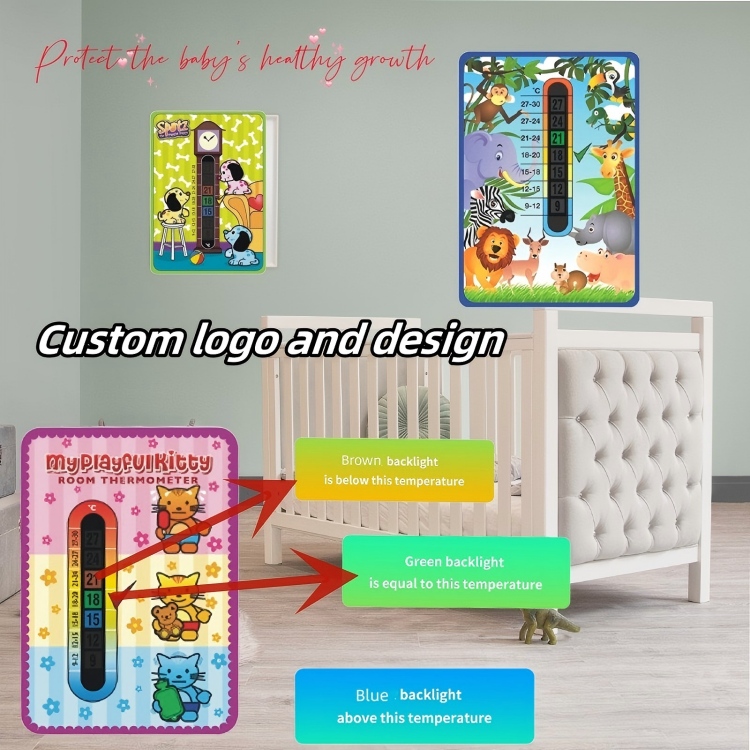
Thermochromic liquid crystal strips indicate current surface temperature through reversible color changes. A technical datasheet available through Farnell describes microencapsulated liquid crystals coated onto a black backing. In that product family, green identifies the rated temperature, and the color sequence reverses during cooling.
Typical procurement requirements include:
- Temperature range and scale increments.
- Defined color-reading conditions.
- Accuracy at the indicated temperature.
- Adhesive compatibility with the final surface.
- Readability through protective packaging.
- Performance after storage and environmental exposure.
Accuracy is product-specific. The cited datasheet specifies ±1°C for its general products and ±0.5°C for certain medical products; those values must not be transferred to another supplier's strips without supporting documentation.
Irreversible strips record whether a specified temperature threshold has been reached. SpotSee explains that its Thermax technology uses compounds with defined melting points: after melting, the material is absorbed into a substrate and produces a permanent dark indication.
These products are relevant when buyers need evidence of a thermal event rather than a live temperature display.
Testo's Italian product page, for example, lists a testoterm strip covering 161–204°C, with eight temperature steps and a stated color-change response of two to three seconds. These specifications apply to that listed product, not every temperature label sold under the brand.
A time–temperature indicator provides information about exposure duration as well as temperature conditions. RAJAPACK Italy's WarmMark listing describes manually activated indicators with progressive windows intended to show exposure beyond a specified threshold. That is a different function from a reversible liquid crystal strip or a simple peak-temperature label.
Before requesting quotations, define whether the application requires current temperature, a permanent threshold record, or cumulative exposure information.
Qingdao Focus On Color Industry & Trade Co., Ltd. is a China-based manufacturer of photochromic, thermochromic, liquid crystal thermometer, and fragrance-related products. Its website states more than 13 years of manufacturing experience and identifies thermometer cards, temperature strips, color-changing stickers, and related functional products within its portfolio.
Company profile:
- Location: Qingdao, China.
- Establishment year: Not confirmed in the reviewed first-party material; the company states more than 13 years of experience.
- Stated markets: Domestic and international customers; a country-by-country sales breakdown is not published.
- Supply role: Manufacturer offering OEM and ODM services.
- Main fit: Branded thermometer strips and customized functional products.
The company's published OEM/ODM information describes support for material selection, product design, production, and packaging. It also states that its sales team and designers help buyers develop products from artwork or initial concepts. This makes it relevant to smaller brands that need design-to-production support rather than a standard catalog item alone.
Its service page states that a new design sample can be produced within seven days. Buyers should treat this as a published service claim and confirm when the clock starts, what technical development is included, and whether shipping time is excluded. It is not evidence of a guaranteed bulk-production lead time.
For an Italian private-label project, the practical areas to discuss include:
- Printed scale and language.
- Strip dimensions and die-cut shape.
- Branding and graphics.
- Adhesive and backing options.
- Individual packaging and retail presentation.
- Feasibility of the requested temperature range.
The depth of customization is a useful reason to evaluate the company. However, lower total cost, faster communication, and smaller MOQs should be tested through comparable RFQs and a pilot project rather than assumed.
The reviewed first-party pages do not establish independently verified monthly thermometer strip capacity, a fixed custom MOQ, or current product-specific certification status.
Request a quotation that separates standard production from custom development, and require the approved sample, technical specification, and batch acceptance criteria to become part of the purchase agreement.
Testo's corporate history dates to 1957, when Testoterm was founded. Its Italian business lists an address in Settimo Milanese and offers testoterm temperature strips through an Italian product page. The group's founding date should not be confused with the incorporation date of its Italian subsidiary.
Company profile:
- Founding year: 1957 for the Testo/Testoterm business.
- Italian location: Settimo Milanese, Milan.
- Relevant markets and applications: Industrial temperature measurement, laboratories, transport monitoring, and moving or small components.
- Supply role: Measurement-technology manufacturer with an Italian sales operation.
- Main fit: Standardized irreversible temperature strips.
Testo provides model-specific technical information that makes initial screening relatively straightforward. Its Italian listing for product 0646 2532 gives:
- A 161–204°C measuring range.
- Eight temperature thresholds.
- Self-adhesive construction.
- A two-to-three-second stated color-change response.
- A booklet containing ten strips.
- A stated accuracy of ±(1% of measured value + 1°C).
This documentation is useful for buyers who already know the threshold range required and prefer to source a defined catalog product.
The reviewed strip listing does not establish private-label manufacturing, custom liquid crystal formulation, or bespoke packaging as standard services.
Testo is therefore more directly suited to industrial catalog procurement than to a branded consumer-strip development project. Confirm local stock, remaining shelf life, and current delivery timing before placing recurring orders.
CARLO ERBA Reagents traces its business origins to 1853. The company is headquartered in Cornaredo, Italy, and states that it operates directly in Italy, France, Germany, and Spain while serving markets worldwide.
Company profile:
- Founding year: 1853, referring to the business's historical origins.
- Headquarters: Cornaredo, Milan.
- Main markets: Industrial and academic laboratories, quality-control laboratories, chemicals, and life sciences.
- Supply role for thermometer strips: Laboratory supplier and distribution channel.
- Main fit: Buyers consolidating strips with other laboratory consumables.
Its Italian catalog lists irreversible testoterm strips with eight temperature points. This provides a relevant purchasing route for laboratory buyers who already source reagents, labware, and measurement products through the company.
The main procurement benefit is potential order consolidation rather than evidence of proprietary strip manufacturing. Buyers may be able to coordinate temperature labels with other laboratory requirements through an established supplier relationship.
The reviewed thermometer strip listing does not establish custom strip formulation, private-label printing, or in-house strip production.
CARLO ERBA's chemical manufacturing capabilities should not be treated as evidence that it manufactures the temperature strips it distributes. For qualification, obtain the original product datasheet, manufacturer identity, lot information, and documentation for the specific strip ordered.
Seton's company history dates to the founding of Seton Nameplate Corporation in 1956. Its Italian website focuses on safety, identification, and workplace products and includes a dedicated temperature-indicator category.
Company profile:
- Founding year: 1956 for the original Seton business.
- Italian presence: Italian-language commercial website and purchasing channel.
- Main customer focus: Workplace safety, maintenance, identification, and inspection.
- Supply role: Catalog supplier.
- Main fit: Facilities and maintenance teams purchasing temperature labels alongside safety materials.
Seton Italy lists several temperature-indicator formats, including:
- Reversible three-level and eleven-level indicators.
- Irreversible single-level indicators.
- Irreversible indicators with four to six levels.
- Products described for cold-chain and high-temperature applications.
The category page also publishes pack configurations. Examples include ten-label packs for certain reversible products, thirty-label packs for four-to-six-level irreversible products, and sixty-label packs for single-level irreversible products. These are listed packaging quantities, not proof of the minimum contractual order.
Seton's broader company information mentions tailored solutions, but this does not establish custom sensing chemistry or private-label strip manufacturing for the listed temperature indicators. Confirm whether customization applies to the indicator itself, surrounding graphics, or unrelated identification products.
For qualification, request the exact threshold tolerance, storage requirements, and manufacturer documentation rather than relying solely on the category description.
ROMETEC's temperature-indicator catalog includes a product family described as reversible and irreversible thermometric labels. This establishes relevant product-category coverage, although detailed strip specifications require further inquiry.
Company profile:
- Establishment year: Not verified in the reviewed public material.
- Market location: Italy.
- Customer focus: Technical instrumentation and measurement procurement, based on its catalog.
- Supply role: Supplier of measurement and process-related products.
- Main fit: Buyers seeking technical discussion alongside broader instrumentation requirements.
ROMETEC may be relevant when a temperature label is one part of a wider measurement requirement. Its catalog includes labels alongside electronic temperature indicators and other instruments, giving buyers a basis for discussing whether a passive indicator is appropriate for the application.
That said, listing a product category is not equivalent to publishing full technical qualification data.
The reviewed page does not establish custom strip manufacturing, formulation development, a production MOQ, or private-label capabilities.
Before shortlisting ROMETEC for a recurring program, request:
- Original manufacturer and country of origin.
- Current datasheet.
- Available temperature ranges.
- Traceability and shelf-life information.
- Sample availability.
- Written clarification of any customization service.
The table below separates public information from items that require a current quotation. A pack size must not be mistaken for a factory MOQ, and no supplier's annual production capacity should be inferred from the size of its catalog.
| Supplier | Most relevant purchasing fit | Published strip capacity | MOQ or published pack information | Certification and compliance position |
|---|---|---|---|---|
| Qingdao Focus On Color | Customized branded strips; OEM/ODM development | Not publicly verified | Custom MOQ requires quotation | Request current, product-specific declarations and applicable reports; no certificate status assumed. |
| Testo S.p.A. | Standard industrial irreversible strips | Not disclosed in reviewed listing | Referenced model supplied as ten strips; confirm order minimum | Technical range and accuracy are published; request compliance documents applicable to the selected model. |
| CARLO ERBA Reagents | Laboratory purchasing consolidation | Own strip production not established | Confirm selected catalog item and order multiple | Obtain original manufacturer documentation; do not transfer chemical-plant credentials to strips. |
| Seton Italy | Maintenance and safety procurement | Not disclosed in reviewed category | Selected products listed in packs of 10, 30, or 60 | Verify documents for the exact indicator; category breadth does not establish certification. |
| ROMETEC srl | Technical instrumentation sourcing | Not disclosed in reviewed page | Quote required | Manufacturer, test documentation, and certificate applicability require confirmation. |
"Plastic thermometer strip" is not an adequate purchasing specification.
Ask suppliers to identify the proposed construction, including:
- Carrier material and thickness.
- Temperature-sensitive layer.
- Printed scale and protective coating.
- Adhesive type.
- Release liner.
- Finished dimensions.
- Packaging materials.
Then define the actual use conditions: indoor or outdoor exposure, application surface, moisture, cleaning chemicals, bending, and expected service life.
Treat these as qualification requirements rather than assuming that "industrial grade," "waterproof," or "medical grade" has a shared meaning across quotations.
Scale resolution is not the same as measurement accuracy. A strip with closely spaced printed numbers still needs a defined tolerance.
Published specifications vary between product families. The Farnell-hosted liquid crystal datasheet and Testo's Italian irreversible-strip listing use different accuracy statements, illustrating why procurement teams must compare actual datasheets rather than generic category claims.
A useful RFQ should ask:
- At which temperatures is accuracy verified?
- What reference instrument is used?
- What surface is used during testing?
- How long is the strip allowed to stabilize?
- What constitutes a valid color reading?
- Does the tolerance cover the finished label or only its sensing material?
A surface indicator should be qualified where it will actually be used. For a bottle, collection container, machine housing, or package, the test arrangement should reproduce the intended mounting position and reading conditions.
As a purchasing protocol, compare the strip with an appropriate reference measurement on the final assembly. Record the substrate, application method, exposure profile, and acceptance criteria.
This avoids approving a loose sample under conditions that the production product will never experience.
European Union guidance states that CE marking is required only for products covered by legislation that mandates it. If no such requirement applies, the CE mark must not be used.
Therefore, asking every thermometer strip supplier for a "CE certificate" is not a reliable qualification method.
Instead, ask the supplier to identify:
1. The product's intended use.
2. The legislation it considers applicable.
3. The reason CE marking is or is not required.
4. The supporting conformity documentation where applicable.
A passive industrial label and a product marketed for medical use should not automatically receive the same regulatory assessment.
The European Commission describes RoHS as legislation restricting hazardous substances in electrical and electronic equipment. It currently restricts ten substances.
For a standalone passive temperature label, do not assume that a RoHS report establishes a statutory certification requirement. A buyer may still request restricted-substance testing as part of its own material policy, but the supplier should distinguish that commercial requirement from legal applicability.
Also, neither a chemical test report nor a management-system certificate proves temperature accuracy.
A quotation may leave enough ambiguity for the backing, adhesive, or protective layer to change after sample approval.
To reduce this risk:
- Record the approved construction in the specification.
- Require written approval before material changes.
- Keep a signed reference sample.
- Test the first production lot against the same acceptance criteria.
A distributor can be a strong long-term partner, particularly when local availability and purchasing support matter. The problem is not distribution itself; it is an unclear chain of responsibility.
Require the contracting supplier to explain who controls design changes, investigates complaints, and authorizes replacements.
Check whether each report identifies the relevant product, material construction, sample description, date, and test method.
A report for a different color-changing sticker should not be accepted automatically as evidence for the thermometer strip being purchased.
Some irreversible indicators are active before use. One published eight-event temperature-label listing explicitly warns that the product can trigger at its rated threshold and specifies storage conditions and a twelve-month shelf life. Those conditions are product-specific, but they demonstrate why transport and storage need explicit review.
Ask for manufacturing date, expiry date, storage instructions, and a minimum remaining shelf life at delivery.
A visually correct sample does not establish that future batches will deliver the same temperature response.
The practical distinction is between three approvals:
- Artwork approval: Text, scale, branding, dimensions, and layout.
- Functional approval: Temperature response on the intended application.
- Production approval: Repeatability in a normal manufacturing run.
For a custom project, request a pilot lot produced through the intended commercial process. Select samples from different parts of that run, rather than allowing only hand-selected demonstration pieces.
A useful additional control is a blind sample test: ask the supplier to provide numbered samples, then evaluate them against the agreed protocol before receiving the supplier's own results.
This is a proposed qualification method—not a claim that any company listed here uses inadequate sampling.
Send every supplier the same requirements:
- Indicator technology.
- Temperature range and tolerance.
- Dimensions and substrate.
- Adhesive requirements.
- Artwork and language.
- Annual demand and order frequency.
- Packaging.
- Intended use and destination.
- Required documentation.
- Minimum shelf life on arrival.
Use standard samples to assess readability, adhesion, and basic functional suitability before investing in custom tooling or artwork.
Approve appearance and function separately. Retain pilot samples and the agreed test record.
Request lot identification, inspection criteria, change-control procedures, complaint handling, and a written lead time.
For direct factory sourcing, clarify whether printing, sensing-layer manufacture, coating, and converting occur in-house or through subcontractors.
For deliveries into Italy, specify the Incoterm, named destination, importer responsibility, transport method, and handling requirements.
For temperature-sensitive inventory, agree how potential transit exposure will be investigated. Where justified by the product's storage limits and shipment value, include an independent transport-temperature record.
For buyers sourcing thermometer strips in Italy, the most important decision is whether the project requires a documented catalog product or a custom-developed branded strip.
Testo provides a clearly documented route for industrial irreversible strips. CARLO ERBA Reagents is relevant to laboratory purchasing consolidation. Seton offers temperature-indicator choices within a wider safety catalog, while ROMETEC merits inquiry for instrumentation-related sourcing.
Qingdao Focus On Color Industry & Trade Co., Ltd. is a relevant overseas alternative when the project requires design, packaging, and OEM/ODM support. Its published customization services justify technical evaluation, while pricing, capacity, MOQ, and application performance still require project-specific confirmation.
Before awarding a long-term contract, send a complete RFQ, request samples, verify applicable documentation, and approve a production-representative pilot.
For a customized thermometer strip project, contact Qingdao Focus On Color with the required temperature range, application surface, dimensions, artwork, packaging, and expected order volume. Request a written feasibility review and sample plan before committing to production. Its published contact email is Mandy@focolor.com.

Search the legal company name or certificate number in IAF CertSearch. Review the status, certified site, standard, scope, issuing certification body, and accreditation information. The platform provides certificate-status and scope-verification functions.
Match the certified site to the manufacturing location—not just the sales office. If the record is missing or inconsistent, contact the issuing certification body for clarification before accepting the claim.
Not automatically. Reversible liquid crystal strips provide a visual temperature indication, while irreversible strips record threshold events; they do not perform the same function.
For procurement approval, define the required uncertainty, reading interval, recordkeeping, and consequences of an incorrect reading. Use application testing to determine whether a strip can meet that requirement.
The printed range does not establish identical construction or accuracy. Published liquid crystal and irreversible-strip documentation describes different sensing technologies and different performance specifications.
Compare the complete datasheet and qualify both samples on the same final assembly using the same exposure and reading procedure.
Quarantine the affected shipment, retain packaging and lot information, and document the indication before discussing replacement.
For products that are active during transport, activation may indicate exposure before delivery rather than a defect in the sensing chemistry. The referenced eight-event label listing explicitly warns that the indicator is always active and may trigger at its rated threshold.
The purchase agreement should define storage limits, evidence requirements, and responsibility for transit-related activation.
Do not treat that request as an artwork-only revision. Liquid crystal strips use temperature-sensitive elements, while irreversible products can use different compounds for individual thresholds.
Require a revised technical specification, functional samples, and agreed acceptance testing. Also confirm whether the change affects shelf life, response conditions, packaging, or lead time.
- Italian Ministry of Foreign Affairs: "Italian exports, pharmaceuticals, and the agri-food sector drive the first half of 2025." [esteri]
- Farmindustria: *Indicatori Farmaceutici 2026*. [farmindustria]
- European Union, Your Europe: CE marking requirements and applicability. [europa]
- European Commission: RoHS Directive overview. [environment.ec.europa]
- IAF CertSearch: Accredited management-system certificate verification. [iafcertsearch]


