+86 18560646018

Views: 288 Author: Focus Color Publish Time: 2026-09-14 Origin: Site


Content Menu
● What Is a Sticker Thermometer?
● How to Read a Sticker Thermometer Correctly
>> Read the Strip While It Is in Full Contact
● How Long Does a Sticker Thermometer Take to Respond?
>> Why Surface Material Matters
● Where Should You Put a Sticker Thermometer?
>> Aquarium Thermometer Sticker Placement
>> Baby Bottle Temperature Sticker Placement
>> Wine and Beverage Bottle Thermometer Placement
>> Forehead Thermometer Strip Placement
● How Liquid Crystal Thermometer Stickers Change Color
>> Why Green Usually Marks the Reading
● Common Mistakes When Reading a Thermometer Sticker
>> Applying the Strip to a Dirty or Wet Surface
>> Using the Wrong Temperature Range
>> Installing Near Heat Sources
>> Treating It as a Precision Instrument Without Verification
● Sticker Thermometer Accuracy: What Buyers Should Understand
>> Key Specifications to Confirm
● Choosing the Right Sticker Thermometer for Your Product
>> Aquarium and Pet Care Products
>> Baby and Family Care Products
>> Beverage and Promotional Packaging
>> Industrial and Equipment Applications
>> Educational and Retail Applications
● Custom Sticker Thermometers: What OEM and ODM Buyers Can Request
>> Common Customization Options
● A Practical Quality Checklist Before Bulk Ordering
● When to Use Another Temperature Measurement Method
● Make Temperature Visible With a Custom Sticker Thermometer
>> 1. What color indicates the temperature on a sticker thermometer?
>> 2. How do I read a thermometer strip when no green number appears?
>> 3. Are sticker thermometers accurate?
>> 4. Can I put a sticker thermometer inside an aquarium?
>> 5. Why is my thermometer sticker not changing color?
>> 6. Can a sticker thermometer measure body temperature?
>> 7. How long do liquid crystal thermometer strips last?
>> 8. Can I order a custom temperature range and custom logo?
Knowing how to read a sticker thermometer helps users get fast, visual temperature feedback without batteries, wires, or complicated equipment. Also called a liquid crystal thermometer strip, color-changing thermometer sticker, or stick-on temperature indicator, this compact product changes color as the monitored surface warms or cools.
At Qingdao Focus On Color Industry & Trade Co., Ltd., we have worked with color-changing materials and liquid crystal temperature-indication products for more than 13 years. In practical product development, the most important lesson is simple: a sticker thermometer is easy to use only when the user understands what the colors mean, where to apply the strip, and what its reading can—and cannot—tell them.
This guide explains how to read a thermometer sticker correctly, how liquid crystal color changes work, how to avoid common application mistakes, and how businesses can specify custom temperature strips for real-world products.

A sticker thermometer is a thin, self-adhesive temperature indicator that displays temperature through color. It normally contains a row of temperature-sensitive cells, each associated with a printed temperature value in Celsius, Fahrenheit, or both.
Most sticker thermometers use thermochromic liquid crystal technology. Each temperature cell contains a specially formulated material that reacts within a defined temperature range. When the surface temperature reaches a particular point, one cell becomes brightly colored—usually green—and reveals the corresponding temperature.
Common names include:
- Liquid crystal thermometer strip
- Stick-on thermometer
- Temperature sticker
- Color-changing temperature label
- Adhesive temperature indicator
- Aquarium thermometer sticker
- Forehead temperature strip
- Baby bottle temperature sticker
- Wine bottle thermometer label
Unlike electronic thermometers, a sticker thermometer does not require a power source. It is a passive visual indicator designed for convenient temperature checking on compatible surfaces.
The most common question is: which color shows the actual temperature?
For many liquid crystal temperature strips, the answer is green. The number or temperature cell that appears green is generally the closest indicated temperature.
However, users should always check the instructions supplied with the specific product. Color design, printed scales, temperature intervals, and intended applications may vary by product design.
A typical liquid crystal thermometer strip follows this pattern as temperature rises:
| Display color | Usual meaning | How to interpret it |
|---|---|---|
| Tan, amber, brown, or red | Below the active temperature point | The surface is cooler than that temperature cell |
| Green | Current or closest indicated temperature | Read the number beside or within the green cell |
| Blue | Above the active temperature point | The surface is warmer than that temperature cell |
| Black or inactive | Outside the usable range, or not yet activated | Wait, check surface contact, or use a strip with a different range |
For example, imagine an aquarium sticker thermometer with the following scale:
| Temperature cell | Displayed color |
|---|---|
| 24°C | Tan |
| 25°C | Green |
| 26°C | Blue |
In this example, the best reading is 25°C. The green cell indicates the temperature that most closely matches the surface being measured.
Sometimes the strip may show one cool-side color and one warm-side color, but no clear green cell. This can happen when the actual temperature falls between two printed values or when the display is still stabilizing.
For example:
- 20°C appears blue.
- 21°C appears tan.
- No temperature cell appears green.
The approximate surface temperature may be between 20°C and 21°C.
This is useful for monitoring general temperature trends. However, it should not be interpreted as a precise laboratory measurement unless the product's stated accuracy and resolution support that use.
A sticker thermometer should be read when it is fully attached to the intended surface. If it is lifted, partially detached, bent, or exposed to changing air conditions, the indication may shift quickly.
For the most consistent result:
1. Apply the strip to a clean, dry, smooth surface.
2. Press it flat so the adhesive has complete contact.
3. Wait for the display to stabilize.
4. Observe the green temperature cell first.
5. If green is absent, compare the adjacent cool-side and warm-side cells.
6. Record or act on the indicated temperature based on the product's purpose.
Response time depends on several factors:
- The type of liquid crystal formulation
- The temperature difference between the strip and the measured surface
- Surface material and thickness
- Adhesive contact quality
- Ambient airflow
- Moisture, condensation, or direct sunlight
- The product's intended operating range
For many consumer and industrial strip designs, the display changes within seconds after proper contact with the target surface. A larger temperature difference may cause a more visible color transition, while small changes may require additional time to stabilize.
For consistent use, allow the strip to settle before reading it. Do not apply it and interpret the result immediately.
A sticker thermometer measures the temperature of the surface it touches. It does not automatically measure the temperature of everything inside a container.
For example:
- An aquarium thermometer strip reads the outside glass surface, not water directly.
- A bottle thermometer label reads the outer bottle wall, not necessarily the center of the liquid.
- A room-temperature strip placed near a heater may display a higher local surface temperature than the overall room air temperature.
- A forehead strip indicates skin-surface temperature, which can be influenced by sweat, airflow, exercise, sunlight, or a cold environment.
This is one of the most important practical limits to explain to end users. Good temperature indication begins with choosing the right installation location.
Correct placement improves the usefulness of a liquid crystal temperature sticker. The best location depends on the application, the product's temperature range, and the information the user needs.
For aquarium use, place the sticker on the outside of the glass, below the waterline where it can receive stable temperature transfer from the tank.
Avoid placing it:
- Directly beside a heater
- Near a filter outlet
- In intense sunlight
- On a curved, dirty, or heavily scratched section of glass
- Where condensation frequently lifts the label edge
A location away from concentrated heat sources provides a more representative reading of the aquarium wall temperature.
For baby bottle applications, place the strip on the smooth outer wall of the bottle where it can make complete contact. Do not cover the strip with a thick sleeve, cloth, or label that blocks visibility or changes heat transfer.
A color-changing bottle indicator can provide a quick visual reminder that the bottle surface is too warm, near the desired range, or cooling. However, caregivers should follow relevant product instructions and use a suitable verification method when an exact feeding temperature is required.
For wine bottles, beer bottles, and beverage containers, apply the strip to a clean and dry external surface. Avoid direct sunlight, warm hands covering the label, refrigeration vents, and recently washed surfaces that still have moisture.
A bottle thermometer sticker is particularly useful for hospitality, wine retail, gifting, promotional packaging, and product education because it offers a simple visual indication without requiring a separate device.
A forehead strip should be placed on clean, dry skin according to the product instructions. Sweat, skin oils, makeup, recent exercise, outdoor heat, cold air, or a warm pillow can affect surface temperature.
A forehead sticker thermometer should not be positioned as a substitute for a clinical diagnostic instrument unless it is specifically designed, validated, labeled, and regulated for that medical purpose. When a health concern exists, users should use an appropriate medical thermometer and seek qualified medical advice as needed.
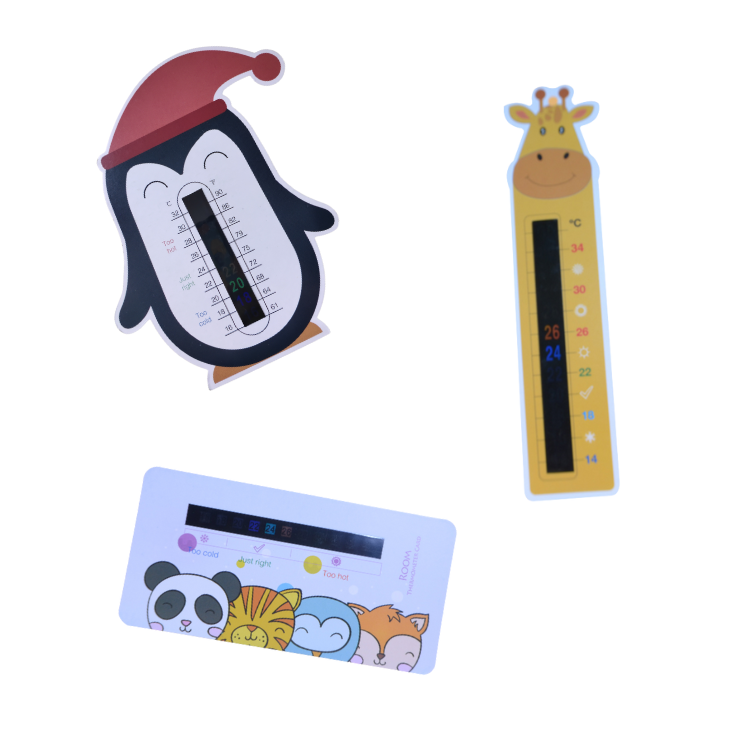
Liquid crystal thermometer strips use temperature-sensitive materials that interact with visible light differently as temperature changes.
In a typical design, microencapsulated thermochromic liquid crystals are printed or incorporated into individual temperature cells. Each cell is formulated to respond around a specific temperature point. As the temperature changes, the internal structure of the liquid crystal material shifts. That shift changes the wavelengths of light reflected back to the viewer.
The result is a visible progression of colors.
In many liquid crystal thermometer designs, green is selected as the key reading color because it is vivid and easy to identify against the label's black background. The temperature cell that turns green is usually calibrated as the actual indicated value.
As the temperature rises, neighboring cells may show cooler-side and warmer-side colors. This makes the strip more informative than a simple one-color warning label because users can see the direction of the temperature change.
Many liquid crystal temperature stickers are designed for reversible use. This means the color sequence changes as the surface warms and returns as the surface cools.
For example:
- A bottle moves from a refrigerator to a warm room.
- The displayed temperature gradually rises.
- The active green cell shifts toward higher temperature values.
- If the bottle is cooled again, the display shifts back toward lower values.
This reversible behavior makes liquid crystal strips useful for repeated temperature observation, provided the product is stored and used within its specified environmental limits.
Even a well-designed sticker thermometer can give an unclear result if it is installed or read incorrectly. The following mistakes are especially common.
Dust, oil, moisture, and condensation can reduce adhesive contact. Poor contact means slower, less stable heat transfer between the surface and the indicator.
Better approach: Clean the application area, dry it completely, and press the strip flat from the center outward.
The strip needs time to react to the target surface. Reading too soon may show an incomplete color pattern.
Better approach: Wait until the color display stabilizes. Use the timing guidance supplied with the product.
A sticker thermometer only works properly within its intended scale. A 20–30°C aquarium strip is not suitable for monitoring a hot industrial pipe, while a high-temperature process label may not provide useful detail for refrigerated beverage storage.
Better approach: Match the temperature range, increment, adhesive, substrate, and intended environment to the actual application.
A label placed beside a heater, in direct sunlight, or under a hot light may show a localized temperature rather than the temperature users actually want to monitor.
Better approach: Choose a representative, stable point on the surface.
Temperature strips are excellent visual indicators, but their reading performance depends on strip design, surface contact, environmental conditions, and the product's stated tolerance.
Better approach: Use the strip for trend monitoring, visual confirmation, routine observation, or consumer guidance. For critical quality, safety, laboratory, or diagnostic decisions, verify with a suitable calibrated instrument.
Accuracy is not a single universal number for all sticker thermometers. It depends on the selected liquid crystal material, temperature range, scale spacing, product construction, substrate, calibration method, and final application environment.
Some liquid crystal thermometer technologies can detect small changes in temperature, but that does not mean every commercial strip is intended for precision measurement. A strip designed for a gift bottle, promotional package, or general aquarium display has different requirements from an industrial monitoring label.
When sourcing a custom sticker thermometer, buyers should define the performance target before discussing shape or artwork.
| Specification | Why it matters |
|---|---|
| Temperature range | Ensures the strip covers the actual operating temperatures |
| Temperature increments | Determines whether the display changes in 1°C, 2°C, 5°F, or another interval |
| Indication color system | Defines how users interpret green, blue, tan, red, or other colors |
| Tolerance target | Helps align the strip with the intended use |
| Response time | Affects user experience in fast-changing conditions |
| Adhesive type | Determines bonding performance on glass, plastic, metal, paperboard, or coated surfaces |
| Surface compatibility | Reduces lifting, bubbling, or poor heat transfer |
| Water and humidity resistance | Important for aquariums, bottles, bathrooms, cold-chain packages, and outdoor use |
| Artwork and language | Supports clear branding, instructions, compliance communication, and export markets |
| Packaging format | Affects retail display, bulk handling, application efficiency, and product protection |
A clear specification sheet avoids a common sourcing problem: choosing an attractive color-changing label that does not match the required temperature range or end-use environment.
A sticker thermometer should be designed around its application, not selected only by appearance. The same basic color-changing technology can be adapted for consumer products, educational tools, packaging, promotional items, and industrial visual monitoring.
Aquarium strips are usually designed for easy reading through aquarium glass. Buyers often prioritize water resistance, durable adhesive, readable Celsius/Fahrenheit scales, and branding that suits pet stores or aquarium accessory packaging.
For baby bottles, bath products, feeding accessories, and family-care items, users need intuitive communication. The label should be easy to read quickly, use a clear color legend, and include appropriate usage guidance.
Wine, beer, spirits, coffee cups, reusable drinkware, and branded gift packaging can use temperature-sensitive labels to create an interactive customer experience. In these projects, visual design is as important as the functional temperature range.
Equipment labels can be used for routine observation of surface temperature changes on pipes, tanks, machinery housings, electrical enclosures, and process containers. These applications may require higher-temperature formulations, stronger adhesives, chemical resistance, or custom warning designs.
Color-changing thermometer cards and strips can help explain heat transfer, temperature variation, or material science in educational kits, museum displays, science toys, and retail demonstrations.
Custom thermometer stickers can do more than display a temperature scale. They can become functional branded components of a finished product.
Qingdao Focus On Color Industry & Trade Co., Ltd. supports OEM, ODM, and personalized projects involving liquid crystal thermometers, thermochromic products, photochromic products, color-changing stickers, and fragrance-related products. A custom project can be developed around the buyer's temperature range, size, artwork, packaging, branding, and application needs.
- Custom Celsius, Fahrenheit, or dual-scale temperature ranges
- Custom shape, size, and die-cut format
- Branded logo, color palette, text, and instructions
- Multi-language artwork for export markets
- Aquarium, bottle, cup, baby product, room, or equipment applications
- Clear, white, metallic, black, or specialty printed backgrounds
- Custom adhesive for glass, PET, PP, metal, paperboard, or other surfaces
- Individual retail packaging, cards, sheets, rolls, or bulk packs
- Scratch-and-sniff or fragrance effects combined with temperature-sensitive designs
- Product sampling and artwork confirmation before mass production
For a successful custom program, provide the application surface, target temperature range, expected environment, required dimensions, artwork file, and desired packaging format. The more clearly the end-use conditions are defined, the more effectively the temperature-sensitive material can be matched to the project.
Before approving large-scale production, buyers should evaluate samples under real conditions rather than relying only on artwork proofs.
Use this checklist:
1. Test the strip on the actual target surface, such as glass, plastic, metal, or coated packaging.
2. Check whether the temperature range matches real operating conditions.
3. Compare the display against a suitable reference thermometer when accuracy is important.
4. Test adhesion after exposure to humidity, cold storage, handling, and normal cleaning conditions.
5. Confirm that the green reading cell is easy to identify under typical lighting.
6. Inspect print clarity, color consistency, edge quality, and readability.
7. Review the user instruction wording for clarity in every sales language.
8. Confirm packaging protects the strips from excessive heat, pressure, moisture, and sunlight during transport.
9. Validate the final sample after any artwork, adhesive, material, or temperature-range change.
10. Keep an approved reference sample for production quality comparison.
This process reduces preventable complaints and improves the end user's experience from the first application.
A sticker thermometer is highly practical for visual monitoring, general guidance, and temperature trend observation. However, some situations require a different tool.
Use a calibrated digital probe, contact thermometer, infrared instrument, or regulated medical device when:
- A precise measurement determines product release or quality acceptance
- The temperature involves food safety or controlled storage requirements
- A medical decision depends on the result
- A process requires documented calibration and traceability
- The surface temperature differs significantly from the internal temperature
- The reading will trigger safety, compliance, or operational decisions
For example, an aquarium sticker can help users notice that water conditions may be changing, but a professional fish facility may also use a calibrated digital thermometer for records and tighter temperature control.
A well-designed sticker thermometer turns an invisible condition into a simple visual signal. When the correct temperature range, label placement, color system, and adhesive are selected, liquid crystal temperature strips can improve product usability, support safe handling, add interactive value to packaging, and strengthen brand recognition.
If you are developing aquarium accessories, baby-care products, beverage packaging, educational items, promotional gifts, or industrial temperature indicators, Qingdao Focus On Color Industry & Trade Co., Ltd. can help turn your concept into a custom color-changing solution.
Contact our team to discuss your required temperature range, application surface, artwork, packaging, and OEM/ODM requirements. Request samples first, test them in your real-use environment, and build a sticker thermometer that your customers can read with confidence.
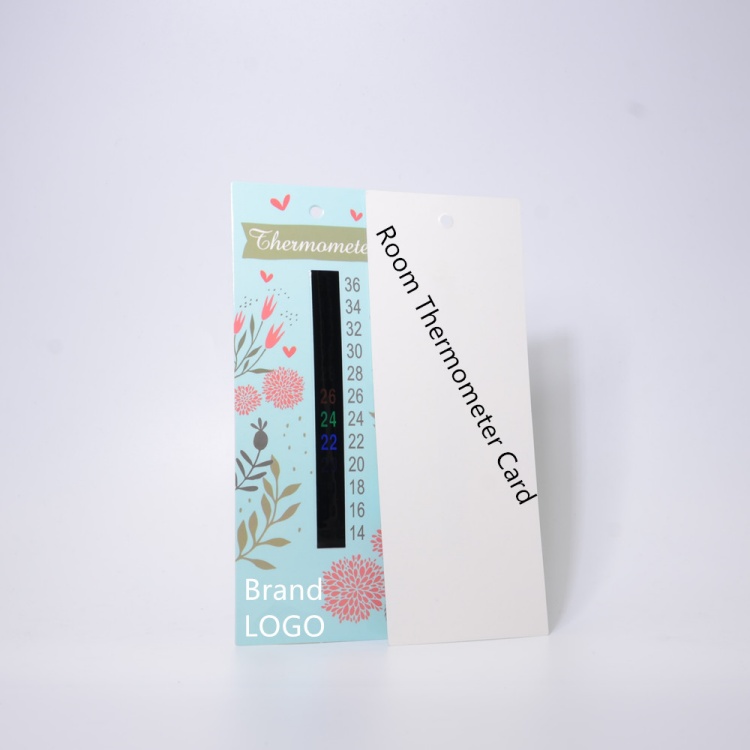
On many liquid crystal thermometer strips, the green cell indicates the current or closest temperature reading. Tan, amber, red, or brown commonly indicate a cooler adjacent range, while blue commonly indicates a warmer adjacent range. Always follow the instructions for the specific strip design.
If a cool-side color and a warm-side color appear in neighboring cells but green does not, the temperature may fall between those marked values. For example, if 20°C is blue and 21°C is tan, the temperature may be approximately between 20°C and 21°C.
Sticker thermometers can be useful for visual indication and temperature trend monitoring. Their practical accuracy depends on the product's range, scale increment, material formulation, calibration, placement, contact quality, and surrounding conditions. Use a suitable calibrated instrument for critical measurements.
Most aquarium thermometer stickers are designed for application on the outside of the aquarium glass. Applying a standard adhesive strip inside the aquarium may damage the label or introduce materials not intended for direct water exposure. Follow the product instructions for the specific model.
Possible causes include poor surface contact, moisture under the adhesive, an incorrect temperature range, direct sunlight, a damaged strip, or a temperature outside the strip's active range. Clean and dry the surface, confirm the range, press the strip flat, and allow time for stabilization.
A forehead temperature strip may indicate skin-surface temperature, but it should not automatically be treated as a medical diagnostic device. Skin temperature can be affected by the environment, perspiration, physical activity, and placement. Use an appropriate medical thermometer when an accurate body-temperature assessment is needed.
Service life varies according to the formulation, adhesive, storage conditions, exposure to UV light, moisture, chemicals, abrasion, repeated temperature cycles, and application environment. For commercial projects, buyers should test samples under the actual expected use conditions.
Yes. OEM and ODM projects can be developed with custom temperature ranges, Celsius/Fahrenheit scales, shapes, dimensions, printing, logos, language versions, adhesives, packaging, and application-specific materials.
1. [Qingdao Focus On Color Industry & Trade Co., Ltd. — Company Profile]
Company product scope, including liquid crystal thermometers, photochromic products, thermochromic products, fragrant products, and color-changing stickers.
2. [Qingdao Focus On Color Industry & Trade Co., Ltd. — Alibaba Company Overview]
Company overview and product categories, including liquid crystal thermometer stickers/cards, thermochromic products, photochromic products, scratch-and-sniff stickers, and air freshener cards.
3. [SpotSee — Liquid Crystal Thermometers]
Background on microencapsulated thermochromic liquid crystal thermometer construction, color sequence, green temperature indication, reversible behavior, operating ranges, and accuracy concepts.
4. [SIS — Liquid Crystal Thermometer Strip Product Information]
Guidance on interpreting green, tan, and blue color indications and reading temperatures between adjacent temperature cells.
5. [U.S. Food and Drug Administration — Non-Contact Infrared Thermometers]
Context on temperature measurement and the distinction between consumer indicators and medical temperature-assessment tools.
6. [National Nanotechnology Coordinated Infrastructure — Making a Liquid Crystal Thermometer]
Educational information on observing temperature changes with liquid crystal thermometer strips.


