+86 18560646018

Views: 228 Author: Focus Color Publish Time: 2026-11-02 Origin: Site


Content Menu
● What Is a Forehead Strip Thermometer?
● How to Read a Forehead Strip Thermometer Step by Step
>> 1. Check the Product Instructions First
>> 2. Prepare the Forehead and Surroundings
>> 3. Position the Strip Correctly
>> 4. Wait for the Display to Stabilize
>> 5. Read It While It Is Still on the Forehead
● What Do the Colors on a Forehead Thermometer Strip Mean?
>> What If Two Numbers Appear?
● Are Forehead Strip Thermometers Accurate Enough for Fever?
>> A Clearly Read Display Is Not Necessarily a Reliable Fever Result
>> Do Not Convert a Strip Reading Into a "Core Temperature"
● When Should You Use Another Thermometer or Seek Help?
● Troubleshooting an Unclear Forehead Strip Reading
>> Why Averaging Two Devices Is Unhelpful
● A Manufacturer's Perspective: Better Instructions Matter
>> Specify the Instructions Before Finalizing the Design
>> Separate Display Resolution From Measurement Accuracy
>> Test Whether First-Time Users Understand the Packaging
● Cleaning, Storage, and Reuse
● Discuss a Custom Liquid Crystal Thermometer Project
>> 1. Which Color Should I Read on a Forehead Strip Thermometer?
>> 2. How Long Should I Leave a Forehead Thermometer Strip in Place?
>> 3. What If There Is No Green Number?
>> 4. Can a Forehead Strip Rule Out Fever in a Baby?
>> 5. Is a Forehead Strip the Same as an Infrared Thermometer?
>> 6. Should I Add a Degree to a Low Strip Reading?
Learning how to read a forehead strip thermometer starts with three steps: place it correctly on clean, dry skin, wait for the display to stabilize, and interpret the colors according to its instructions. On many liquid crystal strips, a green number indicates the temperature to read. However, color rules and reading times vary between products.
The most important distinction is accuracy: a forehead strip responds to skin temperature, not a direct measurement of internal body temperature. A reassuring strip reading cannot reliably rule out fever.
At Qingdao Focus On Color Industry & Trade Co., Ltd., our manufacturing perspective emphasizes both readable color-changing displays and clear product instructions. With more than 13 years of production experience across photochromic, thermochromic, liquid crystal thermometer, and fragrance products, we believe users should understand what a temperature indicator can—and cannot—tell them.
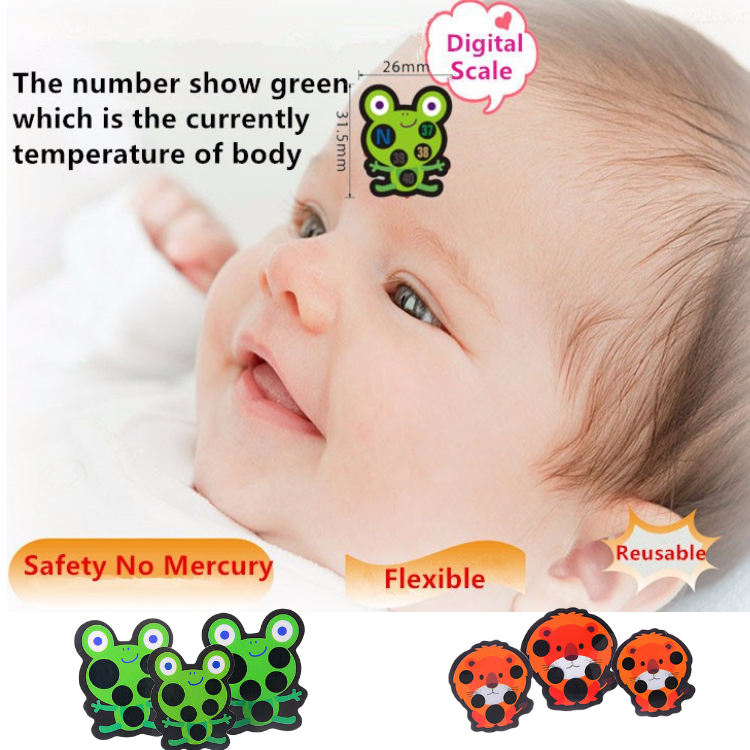
A forehead strip thermometer is a flexible temperature indicator placed against the forehead. Temperature-sensitive liquid crystal areas change color as they warm or cool, revealing numbers or marked temperature intervals.
These products are also called:
- Liquid crystal forehead thermometers.
- Forehead temperature strips.
- Color-changing thermometer strips.
- Forehead fever strips.
They do not work like battery-powered infrared forehead thermometers. Although both are used near the forehead, their sensing methods, operating instructions, and performance are different.
A strip's convenient format should not be confused with clinical reliability. Health guidance cautions against relying on forehead strips to determine whether a child has a fever.
Before applying the strip, identify:
- Whether the scale uses Celsius, Fahrenheit, or both.
- Which color represents the indicated temperature.
- The required contact time.
- Whether it is reusable or single-use.
- Any operating-temperature or storage restrictions.
Do not assume every strip uses the same rules. For example, one published product instruction specifies approximately 15 seconds, while general medical guidance describes reading a plastic strip after one minute.
The instructions supplied with your particular product should determine its reading time.
Use the strip indoors, away from direct sunlight, heaters, and strong drafts. Move hair away and make sure the contact area is clean and dry.
Sweat, recent bathing, vigorous activity, heavy clothing, and a very warm environment can affect temperature measurements. Allow the person to settle before checking, following the product instructions and relevant health guidance.
Do not deliberately cool the forehead with ice or a cold cloth before measuring. That would change the skin temperature you are trying to observe.
Place the strip across the center of the forehead, usually just above the eyebrows, if that matches its instructions.
For a handheld strip, hold the ends so the sensing area stays evenly against the skin. For an adhesive version, follow its application directions.
Avoid touching or covering the numbered display unnecessarily. Good positioning makes the strip easier to read and helps maintain consistent contact.
Never leave a young child unattended during temperature measurement.
Keep the strip in place for the specified time. Watch for the color pattern to stop changing rather than guessing from the first number that appears.
Reading too early can capture the strip while it is still responding to the forehead.
Do not keep extending the waiting period indefinitely if the display remains unclear. Recheck the instructions and use an appropriate clinical thermometer when the result matters.
Look at the temperature scale while the strip remains in contact with the skin.
Removing it first can allow the display to change as the strip responds to the surrounding air. If reading your own forehead is difficult, ask another person to check the display.
Record the temperature, measurement time, and device type if you plan to discuss the result with a healthcare professional.
On many liquid crystal strips, green identifies the temperature to read. Adjacent colors may show that the temperature is transitioning between marked values.
However, there is no safe universal rule for interpreting every color-changing thermometer.
| Display appearance | Possible interpretation | Recommended action |
|---|---|---|
| One clearly green number | Often the indicated temperature | Check that the product defines green this way |
| Blue and tan numbers without green | Some products indicate a temperature between those values | Follow the supplied interpretation guide |
| Several changing colors | The strip may still be stabilizing | Maintain contact for the specified time |
| No readable number | The result cannot be interpreted confidently | Check positioning, instructions, and condition |
| An unexpected reading | Skin conditions, surroundings, or illness may be involved | Confirm with an appropriate clinical thermometer |
Some product instructions state that, when green is absent, the temperature lies between the blue and tan values.
For example, if the relevant instructions identify blue at 37°C and tan at 38°C as an interval, interpret the display as falling between those marks—not automatically as exactly 37.5°C.
Do not invent decimal precision that the product does not provide.
Likewise, do not apply an "add one degree" or "subtract one degree" rule from another brand. Interpretation rules must match the actual strip.

Forehead strips are not a dependable way to confirm or exclude fever.
The reason is straightforward: forehead skin temperature is influenced by the surrounding environment and local conditions. It is not interchangeable with a temperature taken using an appropriate clinical thermometer.
Public health guidance specifically warns that strip-type forehead thermometers show skin temperature rather than body temperature.
Two separate questions matter:
1. Did you interpret the strip correctly?
2. Is that measurement suitable for the health decision?
You can read a green number correctly and still lack a sufficiently reliable measurement for assessing fever.
This distinction is particularly important when checking babies, young children, or anyone who appears seriously unwell.
There is no universal adjustment that turns a forehead strip result into an oral, rectal, or other body-temperature measurement.
Different measurement sites are not related by one exact correction factor. Adding a fixed amount can create false confidence.
When speaking to a clinician, report how the temperature was measured rather than presenting an adjusted number as equivalent.
Use an age-appropriate clinical thermometer when you suspect fever, when the strip result seems unusual, or when symptoms do not match the display.
For children under five, UK health guidance recommends a digital thermometer in the armpit. Recommendations can differ between countries and clinical settings, so follow local advice and the device instructions.
Seek urgent medical advice for:
- A baby under three months with a temperature of 38°C or higher.
- A baby aged three to six months with a temperature of 39°C or higher.
- A child who appears seriously unwell, regardless of the strip reading.
Severe breathing difficulty or unresponsiveness requires emergency help. A high temperature accompanied by a rash that does not fade under pressure also requires emergency assessment.
Do not delay seeking help while repeatedly checking a strip.
An unclear display should be treated as an uncertain result, not as evidence of normal temperature.
| Problem | What to check | Practical next step |
|---|---|---|
| Colors keep changing | Contact time and forehead contact | Follow the specified waiting period |
| Display is difficult to see | Lighting and viewing position | Ask another person to read it in suitable indoor light |
| Readings vary after activity | Recent exercise, bathing, or environmental exposure | Allow appropriate settling time before rechecking |
| Strip differs from a digital thermometer | Different devices and measurement sites | Do not average the readings |
| Strip is damaged or unreadable | Product condition and storage history | Replace it and use another suitable thermometer |
Suppose a strip displays a lower value than a digital thermometer. Averaging them does not produce a more trustworthy body temperature.
The devices may be measuring different sites with different limitations. Instead, use the recommended clinical method and explain any conflicting results to a healthcare professional.
For distributors and private-label buyers, product usability deserves as much attention as appearance.
A colorful display is useful only when the user understands placement, timing, interpretation, and limitations. From our manufacturing perspective, these are essential parts of responsible product development—not optional packaging details.
A practical development brief should address:
- Intended use and target users.
- Temperature range and scale increments.
- Color interpretation.
- Contact time and reading position.
- Single-use or reusable handling.
- Storage and cleaning requirements.
- Limitations and confirmation advice.
- Required documentation for the destination market.
These points are procurement recommendations, not claims that every product shares identical specifications.
A scale printed in small increments does not automatically demonstrate equivalent measurement accuracy.
Buyers should request documentation explaining the test conditions and what the stated performance covers. A specification for a strip's response under controlled conditions should not be presented as proof that it can diagnose fever.
Product claims should match the evidence available for that specific model.
Before approving artwork, ask someone unfamiliar with the product to explain how they would use it.
Can they identify the reading color? Do they know when to read it? Do they understand that a normal-looking result cannot exclude illness?
This simple usability exercise can reveal confusing instructions before large-scale production.
Follow the product's own care instructions. Do not assume a disposable strip is reusable or that every reusable strip tolerates the same cleaning method.
One published liquid crystal product guide permits specified cleaning methods but warns against soaking. That instruction should not be generalized to every construction or adhesive.
Keep strips within their labeled storage conditions and protect them from prohibited environmental exposure. Replace products with damaged surfaces, unreadable markings, or other signs that prevent reliable interpretation.
Qingdao Focus On Color Industry & Trade Co., Ltd. provides OEM/ODM and personalized customization services backed by more than 13 years of production experience.
For a custom forehead strip thermometer project, send us your intended application, target market, preferred temperature scale, dimensions, branding requirements, and packaging language.
Our team can discuss product options and instruction requirements so your project begins with a clear, practical specification.
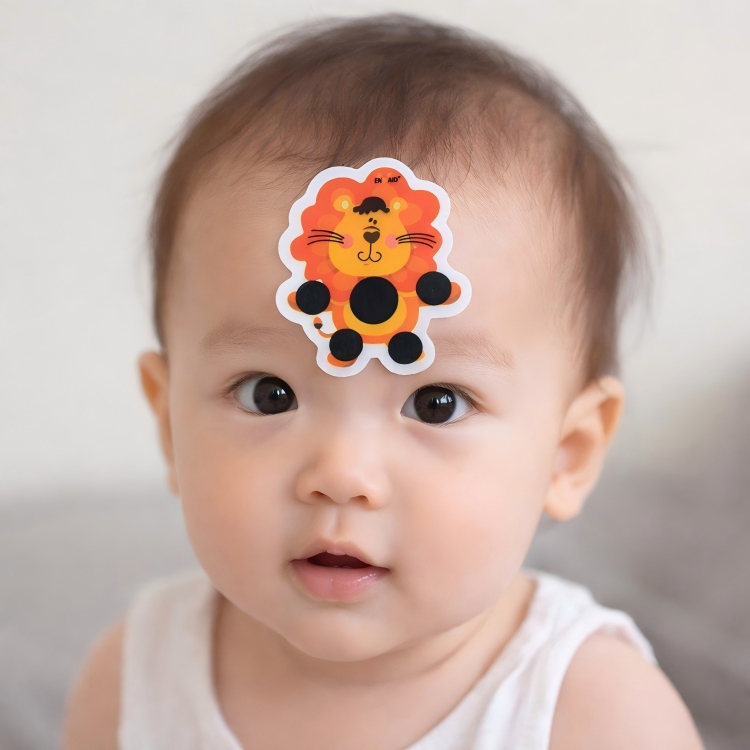
Many products use green to identify the indicated temperature. Check your strip's instructions because color meanings are not universal.
Use the time specified for your product. Published instructions vary, including approximately 15 seconds for one model and one minute in general medical guidance. Read it while it remains on the forehead.
Some strips use blue and tan to indicate an interval when green is absent. Others may require a different interpretation. If the instructions do not resolve the display, use another suitable thermometer.
No. Forehead strips are not reliable for excluding fever. Use an age-appropriate clinical thermometer and seek prompt medical advice when a young baby has a suspected fever or concerning symptoms.
No. A strip changes color in response to temperature at the skin-contact area. An infrared thermometer uses an electronic sensor. Follow the instructions and limitations for the specific device.
No universal correction is valid. Do not add a fixed amount to make a strip reading match another measurement site. Confirm it using an appropriate clinical thermometer.
1. NHS. "[How to take your baby's temperature]." Guidance on digital armpit measurement, forehead-strip limitations, and infant temperature thresholds. Page reviewed July 18, 2023. [nhs]
2. MedlinePlus Medical Encyclopedia. "[Temperature measurement]." Reviewed January 14, 2026. Covers measurement methods, preparation, and the limitations of plastic strip thermometers. [medlineplus]
3. TIP TEMPerature Products. "[Reusable Digital Forehead Thermometer Products: Instructions for Use]." Product-specific guidance on placement, reading time, color interpretation, handling, and clinical confirmation. [825790.app.netsuite]
4. Mayo Clinic. "[Thermometers: Understand the options]." Explains thermometer types and why temperatures from different measurement sites cannot be reconciled using an exact adjustment. [mayoclinic]
5. Raising Children Network. "[How to take temperature in children]." Guidance on thermometer selection, fever-strip limitations, and concerning symptoms. [raisingchildren.net]


