+86 18560646018

Views: 268 Author: Focus Color Publish Time: 2026-11-01 Origin: Site


Content Menu
● How We Selected These Thermometer Strip Suppliers
● Why Consider Japan for Thermometer Strip Sourcing?
>> Established Temperature-Indicating Technology
>> Industrial and Scientific Supply Networks
>> What Recent Industry Reporting Actually Shows
● Five Thermometer Strip Manufacturers and Suppliers to Evaluate
>> 1. Qingdao Focus On Color Industry & Trade Co., Ltd.
>>> Overseas OEM Alternative for Custom Thermometer Strip Programs
>>> Core Strengths
>>> OEM/ODM Fit and Limitations
>>> Specialist Japanese Manufacturer for Industrial Temperature Indicators
>>> Core Strengths
>>> OEM/ODM Fit and Limitations
>>> Laboratory and Research Procurement Channel
>>> Core Strengths
>>> OEM/ODM Fit and Limitations
>> 4. MISUMI
>>> Industrial Procurement Platform for Standard Temperature Labels
>>> Core Strengths
>>> OEM/ODM Fit and Limitations
>>> Japan-Focused MRO Supplier for Packaged Temperature Labels
>>> Core Strengths
>>> OEM/ODM Fit and Limitations
● Supplier Comparison: Capacity, MOQ, and Certification Evidence
● Technical Buyer's Guide: Specify the Product Before Selecting the Supplier
>> Reversible Liquid Crystal Strips Versus Irreversible Labels
>> Materials and Construction: Avoid Vague "High-Grade" Claims
>> Separate Display Resolution from Accuracy
>> CE and RoHS: Request Applicable Evidence, Not Decorative Logos
● Common Procurement Problems and How to Avoid Them
>> Material Substitution After Sample Approval
>> Confusing a Threshold Label with a Current-Temperature Strip
>> The Less-Discussed Trap: Approving Only a "Naked" Strip
● How to Verify a Factory and Run a Sampling Program
>> Step 1: Confirm the Contracting and Manufacturing Entities
>> Step 2: Send an Application-Based Request for Quotation
>> Step 3: Agree on Sample Acceptance Before Testing
>> Step 4: Validate Delivery and Storage Conditions
● Conclusion: Choose the Sourcing Model That Matches the Application
● FAQs
>> 2. Can a Supplier's Published Pack Size Be Used as Its Custom MOQ?
>> 3. Is CE Marking Proof That a Forehead Thermometer Strip Is Suitable for Medical Use?
>> 4. How Can We Protect Against Performance Changes After the First Order?
>> 5. What Should We Do If Temperature Labels Arrive Already Activated?
Finding a reliable thermometer strip supplier in Japan requires more than comparing prices or choosing a familiar industrial brand. Professional buyers need to establish whether a supplier manufactures temperature-sensitive materials, converts them into finished labels, or distributes products made by another company. They also need to distinguish reversible liquid crystal thermometer strips from irreversible temperature-indicating labels: these products answer different monitoring questions and are not interchangeable.
Japan offers established temperature-indicating material technology alongside industrial and laboratory distribution channels. NiGK, for example, traces its temperature, ultraviolet, and dew-indicator development activities to 1965, while suppliers such as AS ONE and MISUMI make temperature-indicating products accessible through broader procurement networks.
This guide evaluates five relevant sourcing options using product suitability, technical documentation, manufacturing transparency, customization scope, quality-control evidence, and delivery accountability.
A useful supplier assessment should separate documented capabilities from claims that still require verification. The following criteria provide a practical framework for an initial procurement shortlist.
| Selection criterion | What procurement teams should examine | Why it matters |
|---|---|---|
| Product suitability | Reversible or irreversible operation, temperature range, scale increments, intended application | Prevents selection of the wrong monitoring technology |
| Manufacturing transparency | Legal entity, actual production site, subcontracting arrangements, country of origin | Clarifies who controls materials and production |
| Technical development | Ability to review temperature windows, label construction, graphics, adhesive, and application conditions | Indicates whether customization extends beyond printing a logo |
| Quality control | Incoming-material checks, temperature-response testing, lot identification, retained samples | Supports repeatability between orders |
| Certification evidence | Current management-system certificates and product-specific compliance documents | Separates organizational certification from product conformity |
| Delivery reliability | Material availability, production scheduling, shipment conditions, remaining shelf life | Helps prevent supply interruptions and unusable stock |
| Commercial suitability | MOQ, setup charges, sampling costs, replenishment arrangements | Determines whether the supplier fits the buyer's order pattern |
These are recommended purchasing criteria, not a claim that every shortlisted company has passed an independent audit. Where strip-specific production capacity, custom MOQ, or current certification scope is not available in the reviewed material, it is identified as unverified rather than estimated.
Japan's relevance to this category is illustrated by manufacturers such as NiGK, whose portfolio includes irreversible temperature labels, reversible indicators, small-format labels, and products intended for demanding environments. Its published applications include industrial process control, infrastructure inspection, and worker-safety monitoring.
This matters because a temperature indicator used on electrical equipment has different requirements from a room-temperature strip or a promotional thermometer card. Application-specific construction can be more important than the supplier's overall catalog size.
Japan's sourcing advantage also comes from its distribution infrastructure. AS ONE's history connects its development to Osaka's scientific-instrument trade, with subsequent expansion into research, cleanroom, hospital, and industrial products. MISUMI offers temperature-recording and temperature-indicating labels through its industrial procurement channels.
It would be misleading to describe Japan as having a single, documented "thermometer strip manufacturing cluster." A more defensible interpretation is that specialist indicator-material expertise operates alongside scientific-supply and industrial-purchasing networks.
For buyers, this creates two distinct procurement routes:
- Work with a specialist manufacturer when material performance or product development is central.
- Use a distributor when standardized specifications, smaller packaged quantities, and purchasing convenience are the priority.
Japan's White Paper on Manufacturing Industries 2025, approved on May 30, 2025, examines manufacturing business conditions, employment, research and development, economic security, decarbonization, and digital transformation. It provides useful context for evaluating Japanese manufacturing partners, but it does not establish the size of Japan's thermometer strip market.
One relevant finding is that approximately 60% of manufacturing companies had not yet implemented economic-security measures. For procurement managers, this reinforces the value of checking supply continuity and material dependencies rather than assuming that every established supplier has a complete resilience plan.
Japan Customs also provides official trade-statistics search and download services. However, a general thermometer or measuring-instrument export figure should not be presented as thermometer strip revenue without confirming the classification and product coverage. This guide therefore does not assign an unsupported 2025 or 2026 market value to this niche.
Qingdao Focus On Color Industry & Trade Co., Ltd. produces photochromic, thermochromic, liquid crystal thermometer, fragrance, and related functional products. Its published range includes thermometer cards, temperature strips, color-changing stickers, ultraviolet stickers, and other customized products. The company states that it has more than 13 years of relevant production experience in China.
Company profile:
- Location: Qingdao, China.
- Establishment: The exact legal incorporation year was not independently verified; the company reports more than 13 years of production experience.
- Reported markets: Japan, Germany, the United Kingdom, Russia, France, Australia, and other destinations.
- Relevant products: Thermometer cards, temperature strips, and color-changing labels.
- Customization positioning: OEM/ODM and personalized functional-product projects, according to the company information supplied for this guide. Its public website also describes customized functional products.
For small and midsized brands, Qingdao Focus On Color is worth evaluating as a potentially cost-conscious alternative to purchasing only standardized Japanese catalog products. Its combination of temperature-sensitive and printed functional products is relevant to projects that require coordinated label graphics, branded cards, and packaging.
The purchasing case should focus on flexibility rather than unsupported claims of superior performance. Buyers can use the quotation and sampling stages to assess:
- How quickly the team converts an application brief into a technical proposal.
- Whether temperature requirements and artwork are reviewed together.
- Whether adhesive, backing, dimensions, and packaging can be specified.
- Whether proposed minimum quantities fit a pilot launch.
- Whether development changes are recorded clearly between sample revisions.
These are evaluation points, not verified response-time or MOQ guarantees.
The company is particularly relevant to buyers seeking a development conversation rather than simply selecting an existing part number. However, custom temperature ranges, tolerances, adhesive options, material testing, and production quantities should all be confirmed in writing.
No audited monthly capacity, fixed custom MOQ, or current product-specific certification package was established from the reviewed public material. Request those documents before treating the supplier as approved for regulated or technically critical applications.
NiGK is the clearest specialist manufacturer in this shortlist. Its current corporate entity was established on December 1, 1980, while its predecessor business dates to 1938. Its history records temperature-indicating material production beginning in 1962, and its English indicator overview describes development activity since 1965. These dates represent different milestones and should not be treated as interchangeable founding dates.
Company profile:
- Location: Japan, with historical manufacturing roots in Kawagoe.
- Established: 1980 as the current company.
- Principal application markets: Industrial process control, electrical infrastructure, transportation equipment, research, and related temperature-monitoring applications.
- Relevant products: Irreversible temperature labels, reversible indicators, durable outdoor labels, miniature labels, and special-purpose indicators.
- Customization scope: Its broad technical portfolio supports a specialist application discussion, but availability of private-label or bespoke OEM programs must be confirmed directly.
NiGK publishes useful product-level distinctions. Its Temperature Label-F is a single-use irreversible indicator covering selected temperatures from 50°C to 125°C, with a 3 mm indicator area. The larger Temperature Label-LI covers selected temperatures from 40°C to 250°C and is designed for visibility and durability. Both pages state RoHS compliance for the described products.
These details help buyers compare actual constructions and applications rather than relying on a generic "temperature sticker" description.
NiGK is a logical starting point for industrial buyers who prioritize specialist indicator technology and documented standard products. Buyers seeking custom dimensions, unusual operating environments, or integrated label designs should submit the complete application conditions rather than assuming that a catalog product can simply be resized.
Certification history also requires careful interpretation. NiGK records ISO 9001 certification in 2005 and ISO 14001 certification in 2014, but its history states that ISO 14001 certification was relinquished in 2019 in favor of internal environmental activities. An old certification reference should therefore not be copied into a current supplier qualification record.
AS ONE was founded in 1933 as Iuchi Seieido Store and incorporated in 1962. Its development includes scientific instruments, research catalogs, cleanroom products, and hospital and care supplies.
Company profile:
- Location: Osaka, Japan.
- Founded: 1933; incorporated in 1962.
- Principal customer markets: Research laboratories, industrial facilities, hospitals, and related scientific users.
- Geographic reach: Its history includes subsidiaries in China and the United States.
- Relevant products: Its AXEL GLOBAL catalog lists reversible indoor liquid crystal temperature labels.
- OEM/ODM scope: Custom thermometer strip manufacturing was not established from the reviewed listings; treat AS ONE primarily as a sourcing and distribution channel.
AS ONE is useful when thermometer strips form part of a broader laboratory purchasing requirement. Its listings provide access to identifiable temperature-indicating products without requiring the buyer to develop a custom label from the beginning.
For procurement teams, the key task is to distinguish the seller from the underlying manufacturer. Product brand, original manufacturer, current availability, and country of origin should be checked at SKU level.
AS ONE is more suitable for catalog sourcing and product comparison than for assuming direct control over liquid crystal formulation or label conversion.
Availability also needs checking. One Thermo Pit liquid crystal listing reviewed for this guide is explicitly marked discontinued. A visible catalog page is therefore not sufficient evidence that a product remains orderable.
MISUMI was established in Japan in 1963 and supplies manufacturing-related components, tools, and consumables through an international procurement network. Its regional catalogs include temperature-indicating products from NiGK and MISUMI-branded temperature-recording labels.
Company profile:
- Location: Japan-headquartered industrial supply organization.
- Established: 1963.
- Principal markets: Manufacturing, automation, machinery, and industrial maintenance.
- Relevant products: Irreversible temperature-recording labels and third-party temperature-indicating labels.
- OEM/ODM scope: Bespoke liquid crystal strip manufacturing was not verified; the documented fit is standardized industrial procurement.
MISUMI's temperature-recording label description clearly identifies irreversible behavior: once the color develops, it does not return to its original state. This is relevant for buyers who need evidence of a temperature event rather than a continuously changing current-temperature display.
Its listings also illustrate why a procurement team should classify products by function before comparing prices. A temperature-history label may be appropriate for an overheating check but unsuitable for an application requiring a reusable thermometer strip.
MISUMI is a practical option for standardized industrial purchasing. For a custom project, first establish whether MISUMI will support the development request or whether the buyer needs to work with the underlying indicator manufacturer.
Regional listings demonstrate catalog availability in those markets; they do not guarantee identical inventory, pricing, or export terms in every country.
MonotaRO was established in October 2000. Its investor information describes an online indirect-materials business serving factories and other businesses in Japan, including small and midsized manufacturing customers.
Company profile:
- Location: Japan.
- Established: October 2000.
- Principal market: Japanese business and industrial purchasing.
- Relevant products: NiGK temperature-indicating labels, including irreversible and combination types.
- OEM/ODM scope: Custom thermometer strip production was not established from the reviewed evidence; its documented strength is catalog distribution.
MonotaRO provides a useful domestic purchasing route for recognizable industrial temperature-label models. One reviewed NiGK listing specifies a three-stage indication format at 10°C intervals and a case containing 20 labels.
For buyers performing maintenance trials or application comparisons, clearly identified packaged products can simplify initial purchasing.
A distributor's case quantity is not a factory's custom-production MOQ. Similarly, domestic availability does not establish international shipping eligibility, overseas warranty handling, or export documentation.
MonotaRO is therefore most relevant when the buyer needs an existing industrial label and has confirmed the purchasing and delivery arrangements for the destination.
The table below distinguishes published information from items requiring a quotation. "Not verified" does not mean a supplier lacks a capability; it means the reviewed evidence does not support a dependable claim.
| Supplier | Main sourcing role | Thermometer strip or label focus | Strip-specific production capacity | MOQ or packaged quantity | Certification and compliance evidence |
|---|---|---|---|---|---|
| Qingdao Focus On Color | China-based manufacturer and customization partner | Liquid crystal thermometer products, temperature strips, functional printed products | Not publicly verified | Custom MOQ requires quotation | Request current certificates and product-specific reports; no package independently verified here. |
| NiGK | Japanese specialist manufacturer | Reversible and irreversible temperature indicators | Not publicly verified | F and LI examples list 40 pieces per package; custom MOQ requires quotation | F and LI pages state RoHS compliance; historical ISO references require current verification. |
| AS ONE | Japanese scientific-supply distributor | Reversible liquid crystal labels and related indicators | Distributor capacity is not manufacturing capacity | Confirm current SKU and sales unit | Historical management-system milestones are published; verify current scope and individual product evidence. |
| MISUMI | Industrial procurement platform | Standard temperature-recording and indicating labels | Not established for thermometer strips | Selected listings specify 20-piece packages; regional terms vary | Verify conformity and manufacturer documentation for the exact part. |
| MonotaRO | Japanese MRO distributor | Standard NiGK industrial temperature labels | Not applicable as evidence of original factory capacity | Reviewed 3E listing specifies 20 labels per case | Obtain documentation for the original manufacturer and selected model. |
For a long-term contract, ask manufacturers to distinguish nameplate capacity from capacity available for your order. For distributors, request confirmed stock, replenishment lead time, and remaining shelf life instead.
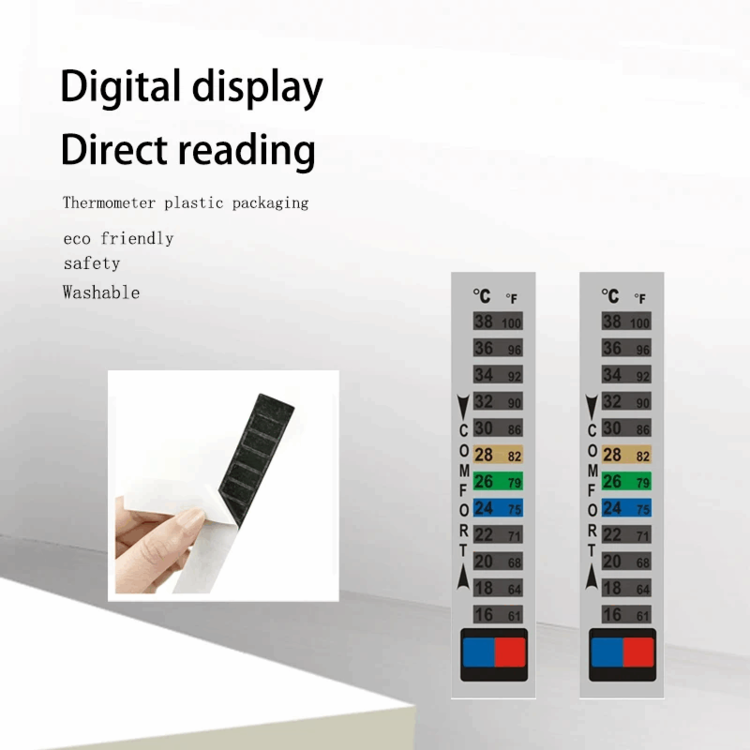
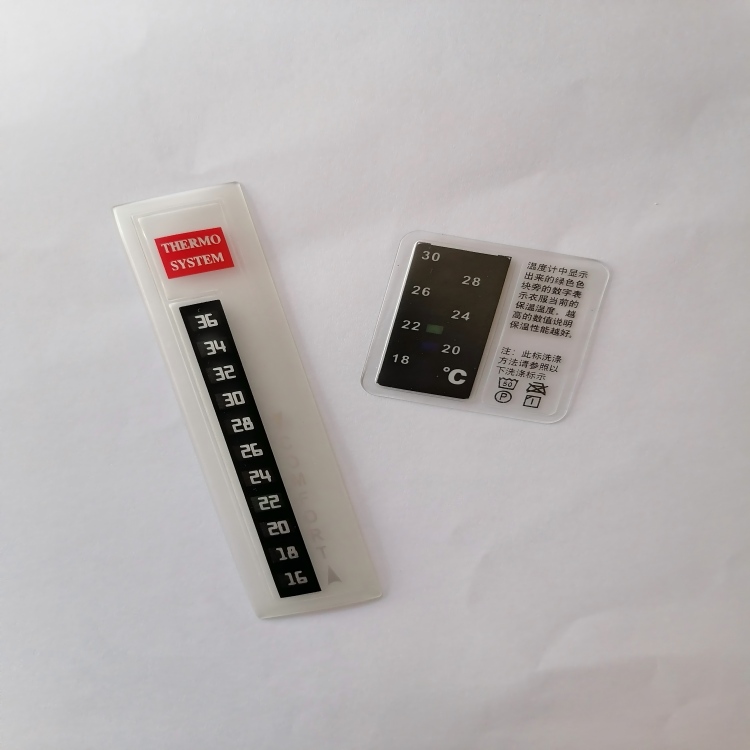
A reversible liquid crystal thermometer strip displays current temperature through a changing optical response. Traditional thermochromic liquid crystal constructions use temperature-sensitive elements on a black backing; the green element commonly identifies the current temperature.
An irreversible label records a threshold event by permanently changing color. NiGK's F and LI products, for example, are explicitly described as single-use irreversible indicators.
| Purchasing requirement | Appropriate starting point |
|---|---|
| Repeated visual checks of current temperature | Reversible thermometer strip |
| Evidence that a temperature threshold was exceeded | Irreversible temperature indicator |
| Both present condition and past overheating evidence | Combination indicator, subject to application validation |
| Continuous time-stamped temperature history | A separate recording solution rather than relying solely on a visual strip |
Combination products are available: MonotaRO lists a NiGK construction that uses a reversible sheet for current temperature and an irreversible element for past temperature history.
A useful material specification should identify the functional layers rather than simply requesting "premium PET" or "industrial adhesive."
For a custom thermometer strip, ask the supplier to document:
1. Temperature-sensitive material and display behavior.
2. Carrier or backing material.
3. Protective film or laminate.
4. Adhesive type and intended application surface.
5. Release liner.
6. Printing and die-cutting requirements.
7. Storage conditions and shelf-life basis.
Liquid crystal strip construction may include microencapsulated thermochromic material on a black backing. Industrial irreversible indicators can use different materials and sealing methods; NiGK describes its F and LI indicator elements as sealed in heat-resistant film. These technologies should not share a specification merely because both change color.
A strip displaying temperatures in 1°C increments is not automatically accurate to ±1°C. Procurement specifications should separately state:
- Display increment.
- Claimed indication tolerance.
- Reference measurement method.
- Stabilization conditions.
- Heating and cooling test procedure.
- Reading conditions and acceptance rule.
Request evidence for the exact construction being purchased. A tolerance attached to one industrial label cannot be transferred to another supplier's liquid crystal strip.
CE marking is not a universal quality mark. The European Commission states that it is required only for products covered by applicable harmonized legislation that mandates it, and must not be used where no such requirement exists. Intended use and product classification therefore matter more than whether a supplier can place a CE symbol on packaging.
For RoHS-related purchasing requirements, ask for documentation tied to the exact product and material construction. NiGK's published RoHS statements for specific F and LI products should not be generalized to every product supplied by every company in the shortlist.
If a strip is marketed for body-temperature assessment, do not infer clinical suitability from a general thermometer description. Qingdao Focus On Color's website itself describes forehead strips as measuring approximate body temperature; any stronger intended-use claim needs separate substantiation.
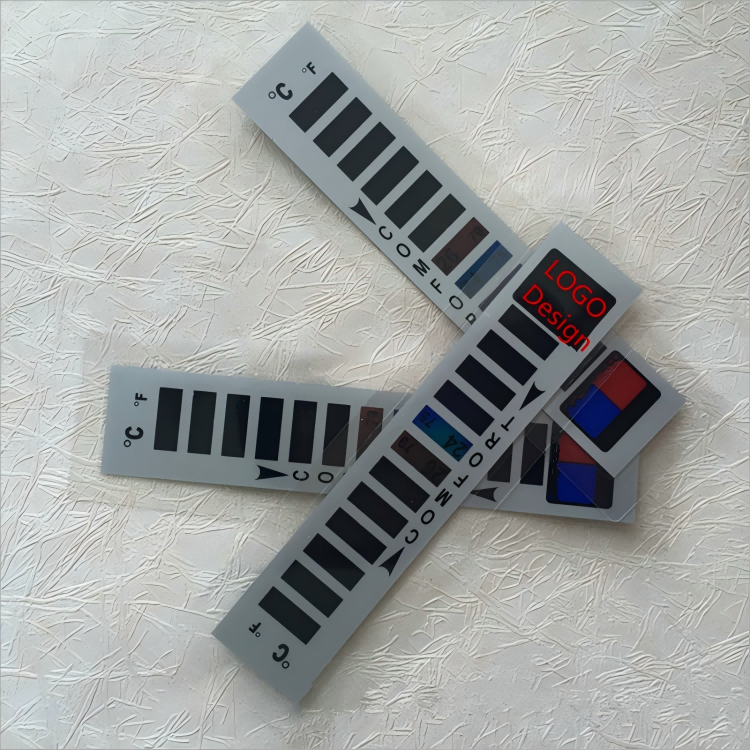
A visually similar replacement film, adhesive, or protective layer may escape a simple artwork inspection.
Recommended controls include:
- Approve a written construction specification.
- Require notice before material substitutions.
- Retain signed reference samples.
- Link inspection records to production lots.
- Requalify changes that may affect temperature indication or adhesion.
For cost comparisons, ask suppliers to quote against the same construction and test requirements. Otherwise, a lower price may represent a different product rather than a more efficient factory.
A report for a pigment, adhesive, or unrelated label is not sufficient evidence for every finished thermometer strip.
Check the report's product identification, sample description, laboratory, date, tested requirements, and relationship to the current production specification. Where the report covers only a component, record that limitation explicitly.
This is a functional purchasing error, not a minor terminology issue. An irreversible label remains changed after the event; a reversible strip is intended to change with current temperature. Approve the required behavior before reviewing artwork or price.
An important application-validation trap is testing the temperature-sensitive element separately, then assuming the finished branded product will behave identically in use.
The strip's backing, adhesive, laminate, and mounting arrangement are part of the product construction, not merely packaging details. Published liquid crystal and industrial-label descriptions demonstrate that these layers differ between product types.
A practical safeguard is to approve three sample stages:
1. Functional sample: assesses the proposed temperature indication.
2. Production-intent sample: includes final printing, adhesive, protective layers, and die cutting.
3. Application sample: is mounted on the actual bottle, housing, card, or other target surface.
Treat performance established at one stage as provisional until the next stage is accepted. This is especially important when a supplier changes construction to improve appearance, durability, or cost.
Request the legal company name, business registration, production address, and details of any subcontracted coating, printing, laminating, or packing.
For distributors, confirm the original manufacturer and model. Buying through a Japanese supplier does not, by itself, establish Japanese origin.
Include:
- Intended application and destination market.
- Reversible or irreversible operation.
- Temperature range and display increments.
- Required tolerance and validation method.
- Dimensions, artwork, language, and units.
- Target surface and exposure conditions.
- Annual volume and order frequency.
- Packaging, lot identification, and documentation requirements.
A complete brief makes quotations more comparable and reveals whether the supplier can identify missing technical information.
Define what constitutes a pass before samples arrive. Use a reference instrument with suitable calibration evidence, document the setup, and record the conditions under which the strip is read.
For repeat orders, retain approved samples and representative production samples so that changes can be investigated.
Ask for storage instructions, shipment limits where specified, shelf life, and minimum remaining shelf life on arrival.
For irreversible indicators, clarify how pre-delivery activation will be handled. For reversible products, agree on the incoming functional check rather than assuming that an unchanged appearance proves acceptable performance.
The purchase order should also identify delivery terms, import responsibilities, packaging requirements, and the process for reporting damaged or nonconforming goods.
The most useful shortlist combines different supplier roles rather than treating every seller as an equivalent factory.
NiGK offers specialist Japanese temperature-indicating technology. AS ONE provides a scientific-supply route that includes reversible liquid crystal labels. MISUMI and MonotaRO support standardized industrial-label procurement. Qingdao Focus On Color provides a China-based customization option for buyers evaluating branded thermometer strips and functional printed products for Japan and other markets.
For a custom program, send Qingdao Focus On Color Industry & Trade Co., Ltd. a brief containing your application, temperature range, dimensions, artwork, expected order volume, and destination requirements. Request a production-intent sample, a written construction specification, and a complete quotation before approving volume production.
Search the legal company name or certificate number in IAF CertSearch, then examine the standard, status, certified locations, scope, issuing certification body, and accreditation details. The database provides those fields for certificate validation.
Match the certified address and scope to the actual activities involved in your order. If the record is unavailable or inconsistent, contact the issuing certification body directly rather than accepting a scanned certificate without further checking.
Historical certification is not enough. NiGK's published ISO 14001 history illustrates why: its site records both obtaining and later relinquishing that certification.
No. A pack containing 20 or 40 standard labels describes a sales unit for that product, not the minimum quantity for a new temperature scale, custom die, or branded construction. The reviewed MonotaRO and NiGK listings provide packaged quantities, but do not establish custom-production MOQs.
Request separate quantities for stock products, printed customization, structural changes, and new functional development.
Not by itself. CE requirements depend on the applicable legislation and product classification. A logo without the relevant conformity documentation does not establish the intended use or performance claim.
Ask the supplier to identify the precise intended purpose, the basis for its regulatory classification, and the documentation supporting the claims you intend to publish.
Use a controlled specification, approved reference samples, lot identification, agreed acceptance testing, and written change-notification requirements.
Do not approve a reorder solely because its dimensions and artwork match. Temperature indication, adhesion, and the finished construction should remain within the agreed specification.
First determine whether the product is reversible or irreversible. A permanently changed irreversible indicator cannot be treated as an unused indicator for the same threshold event. NiGK describes irreversible labels as single-use products whose color change remains after activation.
Quarantine the shipment, preserve packaging and lot records, document the observed condition, and follow the agreed investigation and replacement procedure. Establish responsibility for shipment exposure before placing the order, not after a disputed delivery.
- Japan Ministry of Economy, Trade and Industry — White Paper on Manufacturing Industries 2025, released May 30, 2025. [meti.go]
- METI — English summary of the White Paper on Manufacturing Industries 2025. [meti.go]
- Japan Ministry of Finance, Customs and Tariff Bureau — Trade Statistics of Japan, including search and download services. [customs.go]
- European Commission — Official guidance on when CE marking is required and permitted. [europa]
- International Accreditation Forum's IAF CertSearch — Accredited management-system certificate verification. [iafcertsearch]


