+86 18560646018

Views: 288 Author: Focus Color Publish Time: 2026-10-29 Origin: Site


Content Menu
● How We Selected These UV Test Card Suppliers
● Why Source UV Test Cards from China?
>> A Diverse Manufacturing and Printing Supply Base
>> What the Latest Official Trade Data Actually Shows
● Understand the Product Before Comparing Manufacturers
● Top 10 UV Test Card Manufacturers and Suppliers in China
>> 1. Qingdao Focus On Color Industry & Trade Co., Ltd.
>>> A Practical Candidate for Customized Functional-Printing Projects
>> 2. Shenzhen Prostek Card Co., Ltd.
>>> A Candidate for Branded Plastic-Card Programs
>> 3. Zhejiang Beibo Crafts & Arts Co., Ltd.
>>> A Candidate for Promotional and Gift-Oriented Orders
>> 4. Guangzhou Panz Smart Technology Co., Ltd.
>>> A Candidate for Custom Plastic Indicator Cards
>> 5. Shenzhen Chuangxinjia Smart Technology Co., Ltd.
>>> A Candidate for UV Cards Within Larger Smart-Card Projects
>> 6. Shanghai Keyan Phosphor Technology Co., Ltd.
>>> A Technically Different Option for Optical UV Detection
>> 7. Huizhou Reerfid Technology Co., Ltd.
>>> A Candidate for PVC/PET Cards With Additional Connectivity
>> 8. Shenzhen Flitome Technology Co., Ltd.
>>> A Candidate for Existing Multi-Zone Indicator Formats
>> 9. Jiaxing Nuomo Intelligent Household Products Co., Ltd.
>>> An Application-Specific Candidate for Reptile Accessories
>> 10. Foshan Qimo Automobile Products Co., Ltd.
>>> An Application-Specific Candidate for Window-Film Demonstrations
● Supplier Comparison: Capacity, MOQ, and Certification Evidence
● Technical Buying Guide: Specifications That Prevent Expensive Mistakes
>> 1. Define the Intended Claim
>> 2. Specify the Complete Material Structure
>> 3. Test Finished Cards Under Controlled Conditions
>> 4. Apply Compliance Requirements Correctly
● An Overlooked Pitfall: The Protective Layer Can Change the Result
● Factory Verification, Sampling, and Logistics
>> Verify the Manufacturing Role
>> Use a Three-Stage Sampling Process
>> Plan Shipment Around Validated Storage Limits
>> 1. How Can We Check Whether a Supplier's ISO Certificate Has Expired?
>> 2. Can One UV Test Card Reliably Detect UVA, UVB, and UVC?
>> 3. Can a Card Prove That Window Film Blocks 99% of UV or That a Fabric Achieves UPF 50+?
>> 4. How Can We Prevent a Supplier from Changing the Ink After Sample Approval?
>> 5. How Should We Set Shelf Life and Reuse Claims?
Choosing a UV Test Card manufacturer requires more than comparing printing prices. A card can look professionally finished yet respond inconsistently, react to the wrong wavelength, or lose sensitivity before it reaches the customer.
For professional buyers, the real priorities are repeatable performance, documented materials, dependable production, and clear technical communication. A suitable supplier should explain what its card detects, how it tests production batches, and which claims the finished product can legitimately support.
China offers a diverse sourcing base, from specialist color-changing printers to plastic-card producers and optical-material developers. The shortlist below includes companies with publicly listed UV indicator products or relevant detection-card capabilities. However, their manufacturing roles and technical depth differ substantially. Some are potential development partners; others are more appropriate for established card formats or application-specific sourcing.
This guide compares those differences, identifies information buyers still need to verify, and explains how to avoid purchasing an attractive demonstration card that does not perform as intended.
This is a procurement shortlist, not an independently audited ranking of China's ten largest producers. Placement reflects application relevance and sourcing considerations rather than verified market share.
The review uses five selection criteria:
| Evaluation area | What buyers should verify | Why it matters |
|---|---|---|
| Product relevance | Actual UV indicator or detection-card offerings | Conventional UV-printed cards are not necessarily UV-sensitive cards |
| Technical capability | Response wavelength, ink selection, coating process, and development support | Determines whether the product suits the intended application |
| Quality control | Incoming-material checks, batch testing, retained samples, and change control | Helps prevent performance differences between orders |
| Manufacturing transparency | Legal entity, production location, subcontracting, and current certificates | Establishes who actually makes and controls the product |
| Commercial reliability | Sampling procedure, MOQ, production scheduling, and delivery commitments | Supports predictable replenishment |
Public supplier listings are useful starting points, but they do not establish current certificate validity, available production capacity, or independently verified performance.
Where reliable figures are unavailable, this guide identifies the gap rather than inventing a number.
The reviewed companies illustrate several relevant sourcing locations:
- Shenzhen and Guangzhou offer plastic-card, smart-card, and customized printing suppliers.
- Longgang, Zhejiang, provides a printing-and-gift manufacturing environment.
- Qingdao has specialist functional-printing suppliers.
- Shanghai offers optical-material and detection-card expertise.
These locations offer different procurement advantages. A promotional brand may prioritize artwork flexibility and packaging integration. An optical-equipment distributor may need wavelength-specific technical information. A buyer combining UV indication with NFC functionality may prefer a smart-card supplier.
The correct manufacturing cluster therefore depends on the application—not simply the lowest quoted unit price.
China's General Administration of Customs reported that total goods exports reached 26.99 trillion yuan in 2025, an increase of 6.1% year on year. Total goods trade reached 45.47 trillion yuan. These figures provide context for China's export infrastructure, but they do not measure the UV Test Card market.
No independently verifiable 2025–2026 industry report establishing the size of China's UV Test Card manufacturing market was identified for this review. Consequently, this article does not attach unrelated ultraviolet-equipment forecasts to indicator cards or present a fabricated niche-market growth rate.
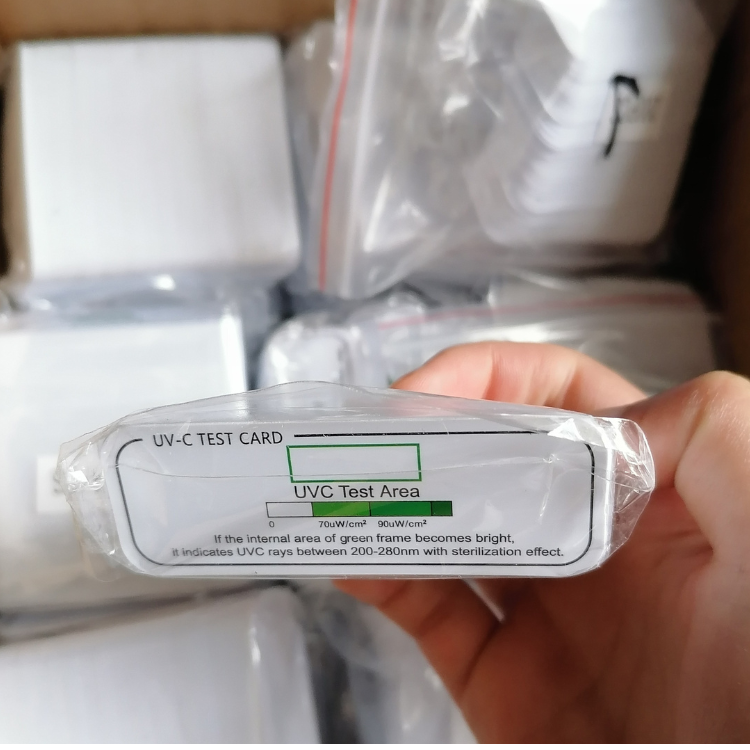
"UV Test Card" covers products that should not automatically be treated as interchangeable.
| Product category | Typical sourcing purpose | Essential verification |
|---|---|---|
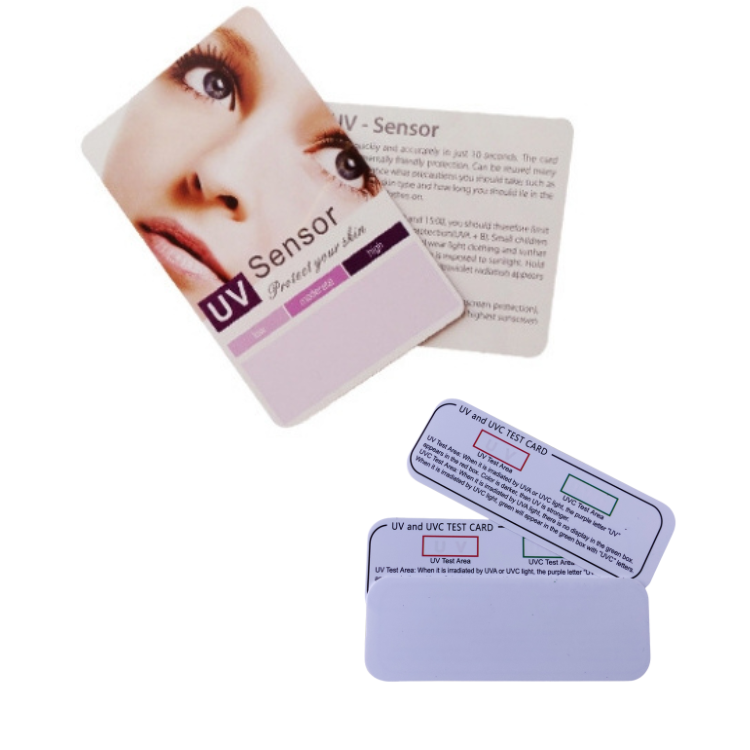
| Photochromic UV indicator card | Sunlight demonstrations, promotional campaigns, and comparative UV-blocking demonstrations | Response characteristics, reversibility, temperature conditions, and durability |
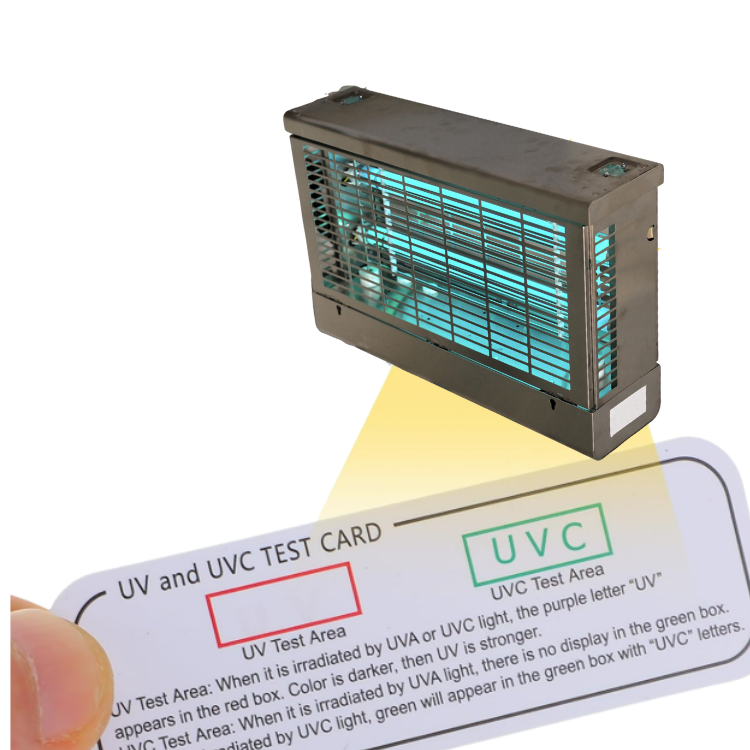
| UV-C indicator card | Checking exposure to a specified UV-C source | Wavelength compatibility, exposure conditions, and whether the response is reversible or cumulative |
| Optical UV detection card | Visualizing ultraviolet radiation in optical work | Detection mechanism, wavelength response, and suitability for the optical application |
| UV-printed decorative card | Printed graphics or surface effects | Whether any functional UV-sensitive area exists |
Shanghai Keyan, for example, describes an optical detection card that converts invisible ultraviolet radiation into visible light and supports qualitative wavelength differentiation. That is a different purchasing proposition from a promotional sunlight-sensitive card.
The central buying principle is verification: define the application first, then confirm that the finished card—not merely the raw ink—meets the agreed requirement.
Qingdao Focus On Color specializes in photochromic, thermochromic, liquid-crystal thermometer, fragrance, and related functional products. Its website states more than 13 years of manufacturing experience and offers OEM/ODM services. Published export destinations include Japan, Germany, the United Kingdom, Russia, France, and Australia.
- Establishment: Exact legal incorporation year was not confirmed; the company states more than 13 years of production experience.
- Location: Qingdao, China.
- Published markets: Japan, Germany, the UK, Russia, France, Australia, and other destinations.
- Relevant capabilities: UV test stickers, color-changing products, thermometer cards, and customized functional printing.
For small and medium-sized brands, its relevant attraction is the combination of functional-printing experience and customization support. A project involving a UV-sensitive area, branded graphics, instructions, and coordinated packaging fits this supplier's published product scope.
The company also emphasizes responsive service and personalized customization. Buyers should evaluate those claims through the sampling process: Does the team clarify the application? Does it identify unsuitable claims? Does it document revisions efficiently?
Its value-oriented positioning should be assessed through total project cost, including development, sampling, packaging, and replenishment—not through an unsupported claim that it always offers the lowest price.
Before approval, request the intended card structure, response specification, production MOQ, batch-testing procedure, and product-specific compliance documents.
Prostek's supplier profile lists a registration date of July 3, 2014. Its product range includes UV test cards alongside smart cards, hotel key cards, warranty cards, magnetic-stripe cards, and related labels.
- Established: 2014.
- Location: Shenzhen, Guangdong.
- Reported markets: North America, Eastern Europe, and other export destinations.
- OEM scope: Customized plastic cards, printed graphics, related labels, and card-based identification products.
The company states that its overall manufacturing operation includes three production lines and annual output exceeding 150 million cards and other RFID products. That figure is supplier-reported and is not a verified UV Test Card capacity figure.
Prostek is worth considering when a buyer needs a conventional card format with branded printing. However, production scale in ordinary cards does not establish expertise in sensitive photochromic coatings.
Ask who controls functional-ink selection and application, and whether the approved UV-sensitive formulation can be locked for repeat orders.
Beibo is located in Longgang, a recognized printing-and-gift manufacturing location. Its listings include customized color-changing UV test cards and credit-card-size printed UV sensor cards.
- Established: A supplier profile reports 2011; confirm against its business license.
- Location: Longgang, Zhejiang.
- Published markets: Domestic China, North America, and South America.
- Customization scope: Graphic processing, sample-based customization, and on-demand customization.
This supplier may suit promotional distributors and brands that need to coordinate card artwork with a broader campaign.
The important qualification question is whether it controls the functional coating or purchases a pre-coated component. Either model can work, but the buyer needs traceability and a clearly assigned party responsible for performance consistency.
Panz lists establishment in 2010 and describes itself as a manufacturer and trading company. Its publicly listed products include plastic cards incorporating UV-sensitive and UV-C testing areas.
- Established: 2010, according to its supplier profile.
- Location: Guangzhou, Guangdong.
- Main markets: Not sufficiently established in the reviewed evidence.
- Relevant customization scope: Printed plastic-card formats and UV/UV-C indicator layouts.
This product range may interest distributors seeking branded indicator cards for equipment demonstrations or accessory programs.
Buyers should carefully validate any advertised intensity range. Request the wavelength, source distance, exposure duration, and measurement method behind the stated performance.
A printed number on a card should not be accepted as evidence of traceable calibration.
Chuangxinjia publishes a broad portfolio of RFID/NFC products, and marketplace listings include customized UV intensity sensor cards. Its company profile describes worldwide sales and research capabilities.
- Establishment: A company profile states 1999; confirm the incorporation date of the exact contracting entity.
- Location: Shenzhen, Guangdong.
- Published markets: Worldwide.
- OEM/ODM scope: Custom card printing, RFID/NFC products, tags, and related technical development.
This supplier may be relevant where the UV card is part of a wider connected-product program rather than a standalone promotional item.
An important procurement detail is legal-entity identification. Similar Chuangxinjia names appear across public listings. Confirm that the business license, invoice, bank beneficiary, manufacturing location, and certificates belong to the entity being contracted.
Do not treat the group's total card-production capability as verified capacity for functional UV-sensitive cards.
Shanghai Keyan's UV detection card converts invisible UV radiation into visible light. The company describes qualitative differentiation of 253 nm, 365 nm, and 400 nm using alternating UV-1 and UV-2 detection, alongside applications in optical-axis alignment and UV laser spot analysis.
- Establishment: Public sources differ; one company-associated website states 2000, while a historical company record lists incorporation in 2003.
- Location: Shanghai.
- Markets: A company-associated website reports exports to more than 70 countries.
- Customization scope: Special detection-card specifications are available by request.
Its published card has a 30 × 50 mm detection area. This makes it a more specialized candidate for optical applications than for low-cost branded sunlight promotions.
Buyers should not substitute this product for a photochromic promotional card without first understanding its operating mechanism and intended use.
Reerfid's listings include customized PVC and PET UV sensor cards, with NFC and other communication-interface options also appearing in the product description.
- Established: Not independently confirmed in the reviewed evidence.
- Location: Huizhou, Guangdong.
- Main markets: Not sufficiently documented.
- Listed customization scope: Printed PVC/PET cards and optional electronic functionality.
Its potential relevance is the combination of visual indication and digital interaction—for example, linking a physical promotional card to product instructions.
However, the listing alone does not establish that every advertised feature is available in the same configuration.
Ask for a functional prototype, exact material structure, electronics specification where applicable, and confirmation of whether UV coating is performed internally or subcontracted.
Flitome appears in public listings for reusable cards advertised with UVA, UVB, and UVC testing functions. Its company website also describes international business relationships.
- Established: Public directory dates conflict; verify the current business license.
- Location: Shenzhen, Guangdong.
- Published market coverage: The company website states business relationships with customers in more than 100 countries.
- Relevant product scope: Existing multi-function UV indicator-card formats; customization depth requires confirmation.
The key qualification issue is zone-by-zone validation. Do not assume that three printed labels correspond to three independently validated spectral responses.
Request separate testing information for each indicator area, including potential response outside the claimed wavelength range.
Nuomo appears in listings for NOMOY PET UVB sensor cards used in reptile-lamp applications. Its published product descriptions connect the business with the NOMOY operation established in Jiaxing in 2008.
- Establishment: The associated business describes a 2008 origin; confirm the legal incorporation date of the contracting entity.
- Location: Jiaxing, Zhejiang.
- Main markets: Not reliably established in the reviewed evidence.
- Relevant scope: Reptile equipment and UV indicator accessories; private-label availability should be confirmed.
This supplier is more application-specific than a general promotional printer.
For reptile-related products, buyers should ask whether the card merely indicates that a lamp produces a response or supports a validated interpretation relevant to the intended use. Those are different claims.
Also confirm the relationship between the brand owner, seller, and actual card producer before agreeing to private-label packaging.
Qimo lists automotive-film tools, film testers, and display products. Public listings also show UV-sensitive demonstration cards for window-film applications.
- Established: Public business records identify 2017.
- Location: Foshan, Guangdong.
- Market focus: Automotive-film businesses; a reliable geographical breakdown was not confirmed.
- Customization scope: Sample-based and minor customization are listed; full card-development capability requires confirmation.
This supplier may suit buyers sourcing a demonstration kit rather than a standalone card.
Its role in the card's production should be verified. Public profiles describe differing business models, so buyers should establish whether it manufactures the functional card, assembles a kit, or sources the indicator externally.
The table distinguishes published information from unverified claims. MOQ figures are examples from public listings, not current quotations. Artwork, substrate, coating, packaging, and functionality can change the minimum order.
| Supplier | Main sourcing focus | Public capacity evidence | Example listed MOQ | Certification position |
|---|---|---|---|---|
| Qingdao Focus On Color | Functional printing and customization | UV-card-specific capacity not verified | 1,000–3,000 pieces | Request current documents for the exact product |
| Prostek | Branded plastic cards | Supplier claims over 150 million cards/RFID products annually; not UV-specific | 500 pieces | ISO 9001 reported by a directory; verify current validity |
| Beibo | Promotional printed cards | UV-card-specific capacity not verified | 100–1,000 pieces | Current relevant certificates not verified |
| Panz | Plastic UV/UV-C indicator cards | UV-card-specific capacity not verified | 1,000 pieces | Request current product-specific evidence |
| Chuangxinjia | Smart cards and customized UV cards | Group-scale card capability reported; UV capacity not verified | 500 pieces | ISO 9001 and other credentials claimed publicly; verify entity and scope |
| Shanghai Keyan | Optical detection cards | Product-specific capacity not disclosed | Request quotation | Request application-relevant technical documentation |
| Reerfid | PVC/PET and connected-card options | UV-card-specific capacity not verified | 100 pieces | Current relevant certificates not verified |
| Flitome | Existing multi-zone indicator cards | UV-card-specific capacity not verified | 500 pieces | Current relevant certificates not verified |
| Nuomo/NOMOY | Reptile-related UV accessories | Card-specific capacity not verified | 100 pieces | Confirm product claims and supporting test evidence |
| Qimo | Automotive-film demonstrations | Card-specific capacity not verified | 10 pieces | Confirm manufacturing role and relevant documents |
Capacity, MOQ, and certification information above comes from company profiles and product listings rather than independent production audits. Prostek's ISO information is directory-reported, while Chuangxinjia's credentials are company-profile claims.
A useful capacity question is: "How many cards meeting our approved response specification can you manufacture, test, and pack each week during peak season?"
That is more meaningful than asking for the factory's total printing output.
Decide whether the product is intended to:
- Show a visible response to sunlight.
- Demonstrate a qualitative difference between covered and uncovered areas.
- Indicate exposure to a specified lamp.
- Visualize radiation in an optical setup.
- Support a validated quantitative measurement.
Do not approve numerical intensity, UV protection, or safety claims solely because the card changes color. Require an appropriate validation method for each claim.
Avoid vague terms such as "premium material." Your specification should identify:
- Substrate type and thickness.
- Approved material grade or supplier.
- Printed background and indicator-area dimensions.
- Functional ink or coating reference.
- Protective layer and adhesive, if used.
- Edge finish and packaging.
- Storage conditions and acceptance criteria.
Do not assume virgin material always performs better or recycled material always performs worse. Evaluate the approved structure against the intended durability and compliance requirements.
Require written approval before any material substitution.
A practical sample-approval protocol should record:
1. Light-source identity and wavelength.
2. Source-to-card distance.
3. Exposure duration.
4. Temperature and lighting conditions.
5. Initial card condition.
6. Time to visible response.
7. Recovery behavior, where relevant.
8. Results after repeated exposure and storage.
For color comparisons, use controlled viewing conditions rather than smartphone photographs alone.
Request production-line samples, not only manually prepared development samples.
CE marking is not a general quality award. The European Commission states that it applies only to products covered by the relevant legislation and must not be affixed to products outside that scope. A passive printed card therefore should not automatically be required to carry a CE mark simply because it will be sold in Europe.
RoHS primarily concerns electrical and electronic equipment. A passive card and a card incorporating electronics may require different assessments. A RoHS test report should not be treated as universal proof that every relevant legal obligation has been met.
Ask the supplier and your compliance adviser to identify:
- Applicable destination-market requirements.
- The exact product covered by each report.
- Tested materials and components.
- Report date and issuing laboratory.
- Whether subsequent material changes affect the evidence.
A useful inspection question is: "Was the approved response tested before or after the final protective layer was applied?"
Buyers often concentrate on the photochromic ink and overlook the complete optical path. Treat any change to the coating, laminate, adhesive, or packaging window as a reason to recheck finished-card performance.
The practical safeguard is to approve the complete construction:
- Retain a signed finished sample.
- Record the material and coating references.
- Include a no-substitution clause.
- Retest after any approved structural change.
- Compare samples from the beginning, middle, and end of production.
Another important safeguard is to avoid using one convenient UV torch as the sole acceptance method. The test source should match the intended application and the supplier's stated response specification.
These are proposed procurement controls, not claims that every listed supplier currently follows them.
Request a live production walkthrough showing card preparation, functional coating or printing, inspection, and packing.
Ask which processes are internal and which are subcontracted. Subcontracting is not automatically a problem; undisclosed subcontracting and unclear quality responsibility are.
Confirm that the purchase order names the responsible legal entity and manufacturing site.
1. Capability sample: Establish whether the response concept fits the application.
2. Pre-production sample: Approve final artwork, materials, instructions, and packaging.
3. Pilot batch: Check variation, packing quality, inspection records, and scheduling.
Keep sealed reference samples from each approved stage.
Ask the supplier to document acceptable storage and transport conditions. Then select packaging and shipping arrangements consistent with those limits.
The purchase order should also clarify:
- Carton quantities and labeling.
- Batch identification.
- Production and dispatch milestones.
- Freight responsibility and insurance.
- Importer responsibilities.
- Inspection timing and remedies for nonconforming goods.
Use a customs broker to confirm classification rather than assuming every UV Test Card belongs under the same tariff code.
A suitable UV Test Card partner combines application knowledge, controlled materials, repeatable production, and clear documentation.
For customized functional-printing projects, Qingdao Focus On Color offers a relevant starting point because of its published photochromic product experience and OEM/ODM scope. For conventional plastic-card programs, Prostek, Beibo, Panz, and Chuangxinjia merit evaluation. Shanghai Keyan addresses a different, more optical-focused requirement, while the remaining suppliers offer application-specific or additional sourcing options.
Before placing a production order, send shortlisted suppliers the same technical brief: intended light source, use environment, finished size, artwork, packaging, order volume, destination market, and required evidence.
For a tailored proposal, contact Qingdao Focus On Color with those details and request an application review, finished-card sample plan, and itemized OEM/ODM quotation. Approve the tested product specification before scaling the order.
Obtain the complete certificate, including its number, legal entity, site address, standard, scope, issuing body, and dates.
Check its status through IAF CertSearch where applicable, and contact the issuing certification body if necessary. IAF CertSearch supports validation of accredited management-system certifications and distinguishes statuses such as active, suspended, withdrawn, and expired.
A current certificate still needs the correct manufacturing scope. It does not independently validate UV-card performance.
Do not assume so from the product name. Multi-zone cards are publicly offered, but the claims need separate verification for each indicator area.
Request wavelength-response information and tests using relevant sources. Specify whether you need qualitative detection, comparative indication, or a calibrated measurement.
Do not approve either numerical claim from a visual card demonstration alone.
Require the seller making the claim to provide an appropriate test method and supporting report. Position the card as a demonstration tool unless its quantitative interpretation has been independently validated for that specific purpose.
Attach a controlled specification to the purchase order. Identify the approved functional coating by supplier reference, internal code, or another traceable identifier that protects legitimate formulation confidentiality.
Require written approval for changes, retained batch samples, and comparison against the signed reference card.
Include a remedy for unauthorized substitution.
Do not select a shelf life or reuse count simply because it appears in a competitor's listing.
Request test evidence for the finished card and its actual packaging. Define storage conditions, exposure cycles, response limits, and acceptable degradation.
If evidence is insufficient, use a pilot program and conservative labeling rather than publishing an unsupported durability claim.
- China's General Administration of Customs: 2025 annual goods-trade figures and export performance. These are national trade statistics, not UV Test Card market estimates. [customs.gov]
- State Council of the People's Republic of China: English-language summary of China's 2025 foreign-trade results. [english.www.gov]
- European Commission: Official explanation of CE marking, its scope, and restrictions on inappropriate use. [trade.ec.europa]
- European Parliament: Background on restrictions of hazardous substances in electrical and electronic equipment. [europarl.europa]
- International Accreditation Forum, IAF CertSearch: Accredited management-system certificate validation and certificate-status explanations. [iafcertsearch]
- Qingdao Focus On Color: Company capabilities, product categories, OEM/ODM services, and stated export destinations. The requested About Us page could not be retrieved; the accessible company homepage supplied the company information used here. [focolor]
- Shanghai Keyan: Official UV detection-card specifications and stated applications. [kpt.net]
- Supplier product listings: UV indicator-card formats and example minimum-order quantities; these require confirmation through current quotations. [accio]
- Prostek, Beibo, Panz, Chuangxinjia, and Qimo profiles: Supplementary company-background and manufacturing information, subject to legal-entity and current-document verification. [linkedin]


