+86 18560646018

Views: 294 Author: Focus Color Publish Time: 2026-10-31 Origin: Site


Content Menu
● Fish Tank Temperature Sticker vs. Hand Testing: The Practical Comparison
● What Water Parameters Do Betta Fish Actually Need?
>> Temperature: Warm Water With Consistent Monitoring
>> Water Chemistry: A Separate Monitoring Task
● How Does a Fish Tank Temperature Sticker Work?
>> Liquid Crystal Elements Create a Visible Reading
>> An External Sticker Does Not Directly Measure the Entire Tank
● Why Hand Testing Is Not a Reliable Betta Temperature Test
>> "Feels Warm" Does Not Establish a Temperature
>> Hand Testing Cannot Provide a Useful Temperature History
● Are Fish Tank Temperature Stickers Accurate Enough?
>> Separate Resolution, Accuracy, and Installed Performance
>> Use a Reference Instrument When the Reading Matters Most
● A Practical Installation and Verification Procedure
>> Step 1: Check the Product Instructions
>> Step 2: Select a Representative Position
>> Step 3: Prepare the Surface
>> Step 4: Allow the Display to Stabilize
>> Step 5: Compare With an In-Water Thermometer
>> Step 6: Record Conditions, Not Just Numbers
● A Useful Upgrade: Check the Tank Under Different Room Conditions
● Build a Complete Betta Monitoring Routine
>> Daily: Check Temperature and Equipment
>> Weekly: Test Water Chemistry
>> During Water Changes: Verify Replacement Water
● What Aquarium Brands Should Specify When Ordering Temperature Stickers
● Choose a Monitoring Method You Can Verify
>> Is a fish tank temperature sticker better than hand testing?
>> Can a temperature sticker measure ammonia or pH?
>> Where should I place an aquarium thermometer sticker?
>> Why does my sticker disagree with my digital thermometer?
>> Can I use a temperature sticker without a heater?
>> Can I order customized aquarium temperature stickers?
A fish tank temperature sticker gives you a visible temperature reading; hand testing gives you only a personal impression. When comparing a fish tank temperature sticker vs. hand testing for maintaining betta fish water parameters, measurement is the decisive difference. A properly selected sticker supports routine monitoring, while touching the water cannot reliably confirm whether your betta's aquarium is within its recommended temperature range.
From a manufacturer's perspective, however, a useful comparison must also acknowledge product limitations. An external temperature sticker measures conditions at the aquarium wall—not directly throughout the water. Neither a sticker nor your hand measures ammonia, nitrite, nitrate, or pH.
This guide explains where each method helps, where it falls short, and how to build a more dependable monitoring routine.
For this comparison, "hand testing" means touching aquarium water with a finger or hand to judge its warmth. It does not mean manually using a chemical water-testing kit.
| Comparison point | Fish tank temperature sticker | Hand testing |
|---|---|---|
| Output | Visible temperature indication | Subjective warm-or-cool sensation |
| Measurement location | Aquarium wall at the installation point | Water touching the skin |
| Repeatability | More consistent when installation and conditions remain unchanged | Depends on the person and their recent temperature exposure |
| Daily convenience | Read without opening the aquarium | Requires physical contact |
| Main limitation | Room conditions and wall construction can influence readings | Cannot establish a dependable numerical temperature |
| Water chemistry testing | Cannot measure chemical parameters | Cannot measure chemical parameters |
| Best role | Convenient daily screening, with independent verification | An informal observation, not a monitoring method |
My practical recommendation is straightforward: use a readable thermometer for routine checks, verify questionable readings with an appropriate in-water instrument, and test water chemistry separately.
PetMD's betta care guidance recommends 76–81°F, approximately 24.4–27.2°C. It also emphasizes stable conditions and checking temperature with a thermometer.
That range is a care guideline, not a reason to keep adjusting the heater whenever the display changes slightly. First establish whether a change is real, persistent, and outside the intended operating range.
A thermostat-controlled aquarium heater helps regulate temperature. A separate thermometer checks the result. The heater setting alone does not confirm the actual water temperature.
Temperature is only one part of maintaining betta fish water parameters.
| Parameter | Practical monitoring objective | Suitable method |
|---|---|---|
| Temperature | Maintain the recommended range and watch for changes | Aquarium thermometer |
| Ammonia | Target 0 mg/L | Aquarium ammonia test |
| Nitrite | Target 0 mg/L | Aquarium nitrite test |
| Nitrate | Track accumulation and manage through maintenance | Aquarium nitrate test |
| pH | Maintain suitable, stable conditions | Aquarium pH test |
PetMD identifies approximately pH 7 as a target and notes that bettas can tolerate roughly 6.5–7.8. Avoid treating a single preferred number as a reason to make abrupt chemical adjustments.
Clear water is not proof of safe water. The RSPCA specifically identifies ammonia and nitrite testing as essential.
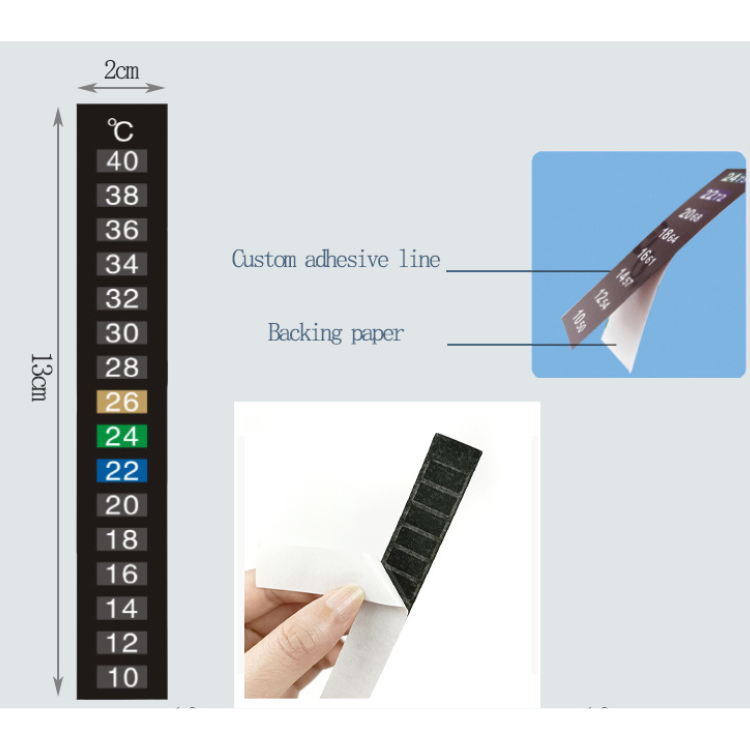
Many stick-on aquarium thermometers use thermochromic liquid crystals. These materials change their reflected color as their temperature changes.
A typical strip contains several temperature-sensitive elements arranged beside printed values. As conditions change, different elements become visible.
This is a passive display: it does not require batteries or an electronic screen.
Some designs use green to indicate the relevant temperature, with neighboring colors helping show an intermediate reading. However, users should follow the instructions supplied with their particular product rather than assume every strip uses identical conventions.
An externally mounted strip responds to its own temperature through contact with the aquarium wall. That wall is influenced by both the water inside and conditions outside.
Consequently, the reading can be affected by:
- A large difference between room and aquarium temperature.
- Direct sunlight or nearby heating and cooling vents.
- Aquarium wall thickness and material.
- Installation below the substrate level.
- Placement near a localized heat source.
These limitations do not make stickers useless. They explain why correct placement and independent checks matter.

Your hand does not provide a numerical reading that you can record and compare.
Water may feel different after you have washed dishes, handled something cold, or entered from outdoors. Even when your impression seems consistent, it cannot demonstrate that the aquarium is within a specific temperature range.
This becomes especially important when comparing replacement water with aquarium water. Two containers that feel similar are not necessarily temperature-matched.
Use a thermometer for that comparison.
A written note saying "felt normal" has limited value when investigating a problem several days later.
A temperature reading provides a clearer record:
- What was the indicated temperature?
- When was it checked?
- Did it change after a water change?
- Was the heater operating?
- Did an independent thermometer agree?
Hand testing cannot answer those questions with comparable precision.
The point is not that every brief contact is dangerous. It is that routine temperature checks do not need to rely on touching the water.
These three terms describe different things:
- Resolution: the spacing between displayed temperature values.
- Accuracy: how closely the indication agrees with a suitable reference.
- Installed performance: how well the product works on a particular aquarium under actual conditions.
A strip marked in 1°C increments does not automatically have an accuracy of ±1°C.
Likewise, a liquid crystal material specification does not automatically establish the accuracy of a finished label mounted on every glass or acrylic tank.
From a manufacturing perspective, that distinction is essential. Product claims should identify the relevant test conditions, not simply advertise "high accuracy."
A sticker is useful for an accessible daily glance. Verify its reading when:
- Installing it for the first time.
- Changing or troubleshooting the heater.
- Moving the aquarium.
- Experiencing unusually hot or cold room conditions.
- Seeing a reading outside the intended range.
Choose the reference instrument according to its stated accuracy and intended use. A digital display alone does not prove superior accuracy.
Confirm whether the strip is intended for external installation, which tank surfaces it supports, and how its colors should be interpreted.
Do not submerge an externally rated label unless the manufacturer explicitly permits it.
Choose a visible location on the outside wall, below the waterline but above the substrate.
Avoid direct sunlight, air-conditioning outlets, and positions immediately beside the heater.
Apply the label to a clean, dry surface according to its adhesive instructions.
Avoid assuming that a removed sticker can be repositioned successfully. Reusability depends on the product design.
Wait for the manufacturer's specified response or stabilization period before judging the reading.
An immediate reading after installation may not represent settled conditions.
Position a suitable reference sensor in nearby water without touching the heater, substrate, or tank wall.
Compare the readings after both have stabilized.
Note the sticker reading, reference reading, room conditions, and any recent maintenance.
If disagreement persists, investigate placement and instrument specifications before adjusting the heater.
A single comparison may miss an installation problem.
As a practical verification exercise, compare the sticker and reference thermometer under several normal conditions—for example, morning, afternoon, and evening.
This is a suggested household check, not a laboratory calibration protocol.
| Observation | Possible interpretation | Next step |
|---|---|---|
| Both readings change together | Aquarium temperature may be changing | Review heater operation and room conditions |
| Sticker changes while reference remains steady | External conditions may be influencing the strip | Review placement and repeat the comparison |
| A persistent difference remains | Placement or instrument performance needs investigation | Check specifications; use a verified reading for decisions |
Do not automatically average conflicting readings. First determine why they disagree.
Read the thermometer at a consistent time. Check that the heater and filter appear to be operating normally, and observe your fish.
Behavioral changes can prompt investigation, but they do not identify temperature as the cause. Water chemistry, illness, and other conditions may also be involved.
PetMD recommends weekly testing of key parameters, including ammonia, nitrite, nitrate, and pH.
Newly established aquariums or tanks with detected problems need more frequent testing. Beneficial filtration bacteria must establish before the aquarium can process fish waste reliably.
A temperature sticker cannot confirm that this process is complete.
Treat replacement tap water with an appropriate conditioner and check its temperature before adding it.
Use a thermometer rather than your hand to compare replacement water with the aquarium.
If temperature or chemistry is abnormal, investigate promptly. Avoid rapid, unverified heater adjustments, and seek aquatic veterinary guidance when the fish shows persistent illness.
A dependable product starts with a clear specification.
At Qingdao Focus On Color Industry & Trade Co., Ltd., our supplied company background includes more than 13 years of manufacturing experience across photochromic, thermochromic, liquid crystal thermometer, and fragrance product categories, with OEM/ODM and personalized customization services.
For aquarium projects, the useful discussion goes beyond logo placement. Buyers should define:
- A temperature range suitable for the intended application.
- Clearly readable Celsius, Fahrenheit, or dual-scale markings.
- Accuracy requirements and the conditions used to assess them.
- Compatibility with the intended aquarium surface.
- Adhesive requirements and expected service conditions.
- Color-reading instructions and installation warnings.
- Packaging language and batch identification requirements.
These are specification and validation topics—not claims that every customized design already meets the same performance standard.
Request samples and agree on the verification method before approving bulk production.
A fish tank temperature sticker is more useful than hand testing because it makes temperature visible and repeatable. Its strongest role is convenient daily screening, supported by an appropriate reference thermometer and separate water chemistry tests.
For aquarium brands, distributors, and private-label buyers, contact Qingdao Focus On Color Industry & Trade Co., Ltd. with your application requirements to discuss OEM/ODM options, samples, and a product verification plan before bulk production.

Yes, for routine monitoring. It provides a visible indication that can be checked and recorded. Hand testing supplies only a subjective impression. Verify important or questionable readings independently.
No. A temperature sticker does not test ammonia, nitrite, nitrate, or pH. Use aquarium water-testing products designed for those parameters.
Follow the product instructions. For an externally mounted strip, choose a visible location below the waterline and above the substrate, away from direct sunlight, vents, and localized heater effects.
Possible explanations include external room influences, placement, incomplete stabilization, or differences in instrument performance. Compare both under stable conditions and review their specifications before deciding which reading to trust.
A sticker monitors temperature; it does not control it. Bettas need appropriately warm, stable water. A thermostat-controlled aquarium heater helps maintain those conditions.
Qingdao Focus On Color Industry & Trade Co., Ltd. offers OEM/ODM and personalized customization services. Share your required range, dimensions, scale, branding, and application conditions to discuss a suitable product specification.
1. [PetMD — Betta Fish Care Sheet]. Basis for the recommended temperature range, pH guidance, heater use, daily checks, and weekly water testing. [petmd]
2. [RSPCA — Choosing an Aquarium for Pet Fish]. Basis for ammonia and nitrite targets, biological filtration principles, and independent thermometer checks. [rspca.org]
3. [The Spruce Pets — Aquarium Thermometer Pros and Cons]. Basis for external liquid crystal thermometer limitations and placement considerations. [thesprucepets]
4. [SpotSee — Liquid Crystal Thermometers]. Technical background on thermochromic liquid crystal elements and color interpretation; its specifications are not presented as specifications for Focus On Color products. [spotsee]


