


Views: 215 Author: Focus Color Publish Time: 2026-10-27 Origin: Site


Content Menu
● Wine Thermometer Strip vs. Touching the Bottle: The Main Differences
● Why Touching the Bottle Cannot Confirm Wine Storage Temperature
>> Your Hand Responds to Heat Transfer
>> "Cold Enough" Is Not a Storage Standard
● How a Liquid Crystal Wine Thermometer Strip Works
>> Read the Instructions, Not Just the Colors
>> Bottle Surface Temperature Is an Indirect Measurement
● What Temperature Should a Small Apartment Wine Cooler Maintain?
>> Separate Storage From Serving
>> Do Not Treat Every Small Change as Damage
● How to Use a Wine Thermometer Strip in a Small Apartment Cooler
>> 1. Select a Suitable Measurement Range
>> 2. Apply It to Clean, Dry Glass
>> 3. Allow Conditions to Stabilize
>> 4. Read Without Handling the Sensing Area
>> 5. Compare Under Similar Conditions
● A Practical 48-Hour Cooler Check
>> Investigate Patterns Rather Than Isolated Differences
● Small Apartment Cooler Problems a Strip Cannot Solve
>> Restricted Installation Space
>> Confusing Temperature With Complete Storage Protection
● Choosing a Reliable Wine Thermometer Strip Supplier
● Build a More Useful Wine Temperature Check
>> Is a wine thermometer strip better than touching the bottle?
>> Does a wine thermometer strip measure the wine directly?
>> Can I leave the strip inside my wine cooler?
>> Why does my strip show a different temperature from the cooler display?
>> Can a strip tell me whether my wine overheated yesterday?
>> What should I do if the strip appears blank?
A wine thermometer strip gives you something touching the bottle cannot: a visible temperature indication you can check again tomorrow. For wine lovers using small apartment coolers, that makes the comparison between a wine thermometer strip and touching the bottle straightforward. Touch offers a quick impression. A properly selected strip provides a more useful reference for managing storage.
However, a strip is not a laboratory instrument, and the temperature of the glass is not always identical to the temperature throughout the wine. Understanding these limitations helps you choose the right monitoring method without overcomplicating everyday storage.
From our perspective as a manufacturer of temperature-responsive products, the priority is repeatability: a reading that different people can interpret consistently, rather than a bottle that simply "feels cold enough."

Both methods involve the bottle's exterior. The difference is how they communicate temperature.
Your hand produces a subjective sensation influenced by its own temperature. A liquid crystal wine thermometer strip changes its visible indication within a specified operating range.
| Comparison factor | Wine thermometer strip | Touching the bottle |
|---|---|---|
| Information provided | Temperature indication within its rated range | General impression of warmth or coolness |
| Consistency between users | More consistent when correctly applied and read | Depends on the person and conditions |
| Numerical comparison | Possible within the scale's limitations | Not dependable |
| Power requirement | Passive liquid crystal strips need no battery | None |
| Installation | Requires suitable surface contact | None |
| Temperature history | Usually not recorded | Not recorded |
| Main limitation | Measures local surface conditions | Cannot reliably establish storage temperature |
| Best role | Routine bottle-level checks | Informal first impression |
For everyday apartment storage, a strip is the more useful option. For investigating overnight fluctuations or protecting valuable bottles, a suitable electronic thermometer or data logger adds information that neither method provides.
When you touch glass, your sensation depends on heat moving between the bottle and your skin. It is not a direct numerical measurement.
The initial temperature of your hand matters. After washing dishes in warm water, a bottle may feel particularly cold. After handling frozen food, that same bottle may feel less cold.
Thermal perception also depends on the material being touched and the rate at which temperatures change. This explains why a strong sensation of cold does not establish that wine is within a particular storage range.
Touch can help identify an obvious concern, such as a bottle that feels unexpectedly warm. It cannot reliably distinguish neighboring temperatures or confirm that a cooler maintained suitable conditions overnight.
This distinction matters in small apartments, where a cooler may share space with cooking appliances, sunlight, and changing room temperatures.
The practical question is not "Does the bottle feel cool?" It is "Does a repeatable measurement suggest that storage conditions remain suitable?"
A liquid crystal thermometer uses temperature-sensitive materials that change their visible appearance as temperature changes. The label presents that response through numbers, blocks, or other printed indicators.
These strips are typically passive and reversible. They respond to current conditions without requiring batteries.
However, not every color-changing label is a numerical thermometer. Some products indicate only whether a temperature threshold has been crossed. Buyers should distinguish a graduated thermometer strip from a decorative thermochromic label.
The meaning of each color depends on the product.
For example, the Digi-Temp technical sheet describes green as the indicated temperature and provides instructions for interpreting adjacent illuminated indicators. That convention should not automatically be applied to every manufacturer's design.
Likewise, accuracy belongs to a particular product specification. The same technical sheet gives ±1°C for its standard products between −30°C and 59°C. This is an example of a documented specification, not a universal accuracy claim for wine thermometer strips.
An adhesive wine thermometer strip reads conditions at its contact location on the glass.
After sufficient time in stable surroundings, that reading can be useful for assessing bottle conditions. During rapid cooling or warming, however, the glass and the wine inside may not have reached the same temperature.
A newly loaded bottle can therefore require time before its surface reading becomes a useful guide to settled storage conditions. Avoid interpreting an immediate reading as the exact temperature of all the liquid.
For long-term storage, a commonly recommended range is approximately 10–15°C, or 50–59°F, in a cool, stable environment.
This is a storage guideline, not a universal serving-temperature rule. A bottle stored for later drinking may need additional chilling or warming before service.
A common mistake is selecting a cooler setting solely because wine tastes pleasant at that temperature immediately after removal.
Instead, decide what the appliance is doing:
- Holding unopened bottles for longer-term storage.
- Keeping frequently consumed bottles ready for service.
- Managing separate purposes in independently controlled zones.
A wine thermometer strip helps you observe bottle conditions, but it cannot determine which storage strategy suits your collection.
Temperature management should be proportionate.
Wine Australia's research on bulk wine transport found no major sensory differences between the transport conditions studied, although some chemical and sensory differences were observed. Those findings do not establish safe limits for apartment coolers, but they illustrate why temperature effects depend on exposure conditions rather than a single alarming reading.
Repeated or prolonged undesirable conditions deserve investigation. One brief departure does not, by itself, prove that a bottle is ruined.
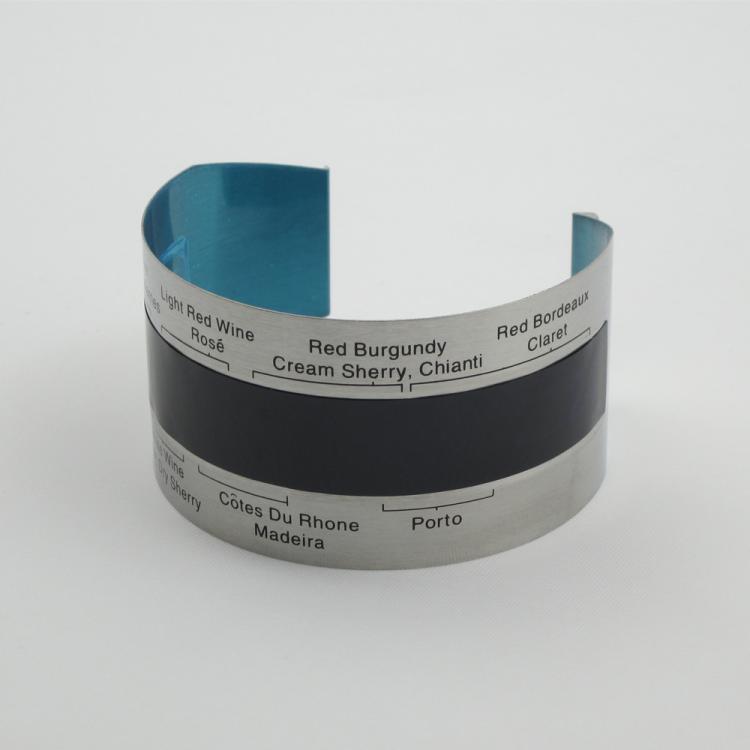
Choose a strip whose active range includes your intended storage temperature, with useful coverage above and below it.
A strip designed only for warmer serving conditions may not show meaningful information in a cooler operating around 12°C.
Also check the difference between display resolution and accuracy. Closely spaced numbers do not automatically mean that the product measures with equally fine accuracy.
Follow the supplier's application instructions.
Generally, the sensing area should contact bare glass rather than sit over a paper label, raised decoration, or an air gap. Position it over the liquid-filled portion of the bottle rather than the empty neck.
Check compatibility before attaching anything to a valuable presentation bottle.
Do not assess long-term storage immediately after loading warm bottles or leaving the door open.
Allow the cooler and bottle to settle. The required time depends on bottle temperature, loading, airflow, and appliance performance; there is no dependable universal waiting period.
Holding the strip can influence its local temperature. Whenever practical, inspect it before picking up the bottle.
Use adequate light and follow the specified color-reading convention.
Check at a consistent time and record unusual circumstances, such as adding several bottles or returning after a power interruption.
This creates a more useful comparison than alternating between random touch checks and isolated temperature readings.
The following is a suggested household screening procedure, not a laboratory validation or a promise of a particular result.
Its purpose is to identify questions worth investigating.
Place a strip-equipped bottle in a normal storage position. If available, use an independent thermometer according to its instructions.
Record observations over two days:
| Observation | What to note |
|---|---|
| Cooler display | Setting or displayed reading, as defined in the manual |
| Bottle strip | Visible indication and whether it is readable |
| Independent thermometer | Reading and sensor location |
| Recent activity | Door openings, new bottles, or setting changes |
| Room conditions | Unusual heat, sunlight, or nearby cooking |
Avoid expecting different instruments to match exactly when they measure different locations or respond at different speeds.
A persistent mismatch deserves attention, but it does not immediately identify the cause.
Possible explanations include sensor placement, inadequate strip contact, different measurement tolerances, or an appliance operating outside its recommended conditions.
If you suspect overnight excursions, use a minimum–maximum thermometer or logger. A reversible strip normally shows the present condition, not the highest temperature reached while you were away.
Monitoring is useful only when paired with appropriate cooler installation and operation.
Follow the appliance manual's ventilation and clearance requirements. Do not assume that a freestanding unit can operate safely or effectively inside a tightly enclosed cabinet.
A strip may reveal an unexpected bottle temperature. It cannot correct an unsuitable installation.
One monitored bottle does not prove that every shelf has identical conditions.
If you suspect uneven cooling, compare positions systematically using similar bottles and consistent procedures. Do not move a warm bottle between shelves and treat the immediate readings as a temperature map.
A thermometer strip does not monitor light exposure, humidity, closure condition, or vibration.
Temperature is one part of wine care. It should not become a substitute for choosing a suitable storage location and following the cooler manufacturer's instructions.
From a product-development perspective, the most useful question is not simply, "Does the label change color?"
It is, "Will the finished product provide an understandable indication under its intended conditions?"
Before ordering, request clarification on:
- Active temperature range and scale spacing.
- Accuracy specifications and verification conditions.
- Reading instructions.
- Adhesive suitability for glass.
- Condensation resistance and cleaning limitations.
- Storage conditions and shelf life.
- Whether the label is removable or reusable.
- Batch inspection and sample evaluation arrangements.
A removable label is not necessarily reusable. Similarly, attractive printing does not establish measurement performance.
Qingdao Focus On Color Industry & Trade Co., Ltd. brings more than 13 years of manufacturing experience across photochromic, thermochromic, liquid crystal thermometer, and fragrance product categories. We provide OEM/ODM and personalized customization services.
For a wine accessory project, we recommend defining the measurement function before finalizing the artwork. Range, readability, adhesion, and intended use should guide the design—not follow it.
For small apartment coolers, choose a wine thermometer strip over touch when you need a repeatable visual reference. Add electronic monitoring when your question concerns temperature history or persistent instability.
For distributors, wine accessory brands, and cooler suppliers, contact Qingdao Focus On Color Industry & Trade Co., Ltd. with your intended temperature range, bottle dimensions, artwork requirements, and order quantity. Request an OEM/ODM consultation and samples for evaluation before committing to production.
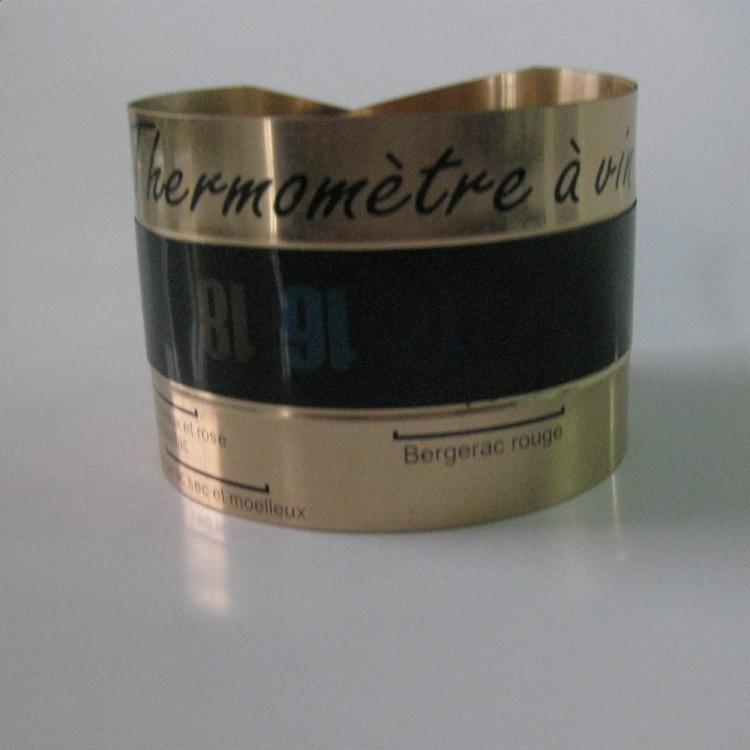
Yes, for routine temperature checks. It provides a visible indication that can be compared over time. Touch gives only a subjective impression and cannot reliably confirm a numerical storage temperature.
No. An externally attached strip senses local bottle-surface conditions. It can provide a useful indirect indication after stabilization, but it does not directly measure the liquid throughout the bottle.
Check the product's specifications. Suitability depends on its operating range, adhesive, moisture resistance, and intended service conditions. Do not assume that every temperature strip tolerates prolonged cooler use.
The devices may measure different locations and respond at different rates. Installation, recent door openings, instrument tolerances, and bottle cooling time can also matter. First establish what the cooler display represents in its manual.
Usually not. A standard reversible liquid crystal strip shows current conditions rather than temperature history. Historical monitoring requires a suitable logger, memory thermometer, or purpose-designed exposure indicator.
Check whether the bottle temperature is outside the active range. Then review lighting, reading instructions, surface contact, and product condition. Do not interpret a blank display as confirmation that storage is acceptable.
- CUNY, *Sensation and Perception: Thermal Receptors*. Explains thermal touch, skin–object heat transfer, and the factors affecting temperature perception. [pressbooks.cuny]
- SpotSee, *Sensor Materials*. Describes thermochromic technologies, liquid crystal temperature responses, and differences from leuco-dye applications. [spotsee]
- SpotSee / LCR Hallcrest, *Digi-Temp: Reversible Thermochromic Liquid Crystal Thermometers*, technical data sheet, PDS002 Rev 03. Provides product-specific reading conventions, accuracy ranges, construction, and storage information. Its specifications are not attributed to Qingdao Focus On Color products. [helpcenter.spotsee]
- Sonal Holland Wine Academy, *How To Store Wine Correctly: A Simple Guide*, October 8, 2026. Provides the 10–15°C storage guideline and guidance on stable, protected storage. [academy.sonalholland]
- Wine Australia, *Maximising Quality During Bulk Wine Transport*. Reports findings from monitored bulk shipments; cited with the limitation that transport results do not directly validate domestic cooler conditions. [wineaustralia]


