


Views: 264 Author: Focus Color Publish Time: 2026-10-24 Origin: Site


Content Menu
● Why Microwaved Baby Food Can Burn an Infant's Mouth
>> Heating Safety and Feeding Safety Are Different
● How a Color Changing Spoon Detects Heat
>> Why the Activation Temperature Matters
● What Finger Testing Actually Tells You
● Color Changing Spoon vs. Finger Testing: Side-by-Side Comparison
● Which Method Is Better for Preventing Infant Mouth Burns?
>> Where a Color Changing Spoon Adds Value
>> Where Finger Testing Falls Short
● A Practical Routine for Checking Microwaved Baby Food
>> 1. Transfer a Separate Serving
>> 2. Follow Suitable Heating Instructions
>> 3. Stir Throughout the Portion
>> 5. Use the Heat-Warning Spoon Correctly
>> 6. Confirm That the Food Is Lukewarm
● Three Manufacturing Checks That Make This Comparison More Useful
>> Check One: Test the Finished Spoon, Not Just the Pigment
>> Check Two: Check Visibility in Real Foods
>> Check Three: Reassess After Cleaning and Repeated Use
● What OEM/ODM Buyers Should Ask Before Ordering
● When Neither Method Is Enough
● Develop a Better-Specified Temperature-Sensitive Product
>> Is a Color Changing Spoon More Accurate Than Finger Testing?
>> Does No Color Change Mean Baby Food Is Safe?
>> What Temperature Should Baby Food Be Before Feeding?
>> Can I Microwave a Temperature-Sensitive Baby Spoon?
>> Can a Color Changing Spoon Detect Harmful Bacteria?
>> Can I Use a Cold-Changing Novelty Spoon Instead?
A color changing spoon and finger testing offer two ways to check warmed baby food, but neither can guarantee protection against infant mouth burns. In the color changing spoon vs. finger testing comparison, the most important difference is how each method communicates heat: one provides a visual signal, while the other depends on an adult's perception.
From our manufacturing perspective at Qingdao Focus On Color Industry & Trade Co., Ltd., a temperature-sensitive product should support careful feeding—not replace it. With more than 13 years of production experience across thermochromic, photochromic, liquid crystal thermometer, and fragrance products, we approach this comparison through material performance, practical usability, and clear product limitations.
The central principle is verification: stir microwaved food thoroughly, allow standing time, and check that it is lukewarm before feeding.

Microwaves can heat food unevenly. A bowl may feel comfortable to hold while part of its contents remains excessively hot.
This is particularly important with baby food because touching the container does not establish the temperature of the food inside. A quick surface check also cannot rule out a hotter pocket elsewhere.
Food warmed in a jar presents an additional problem: cooler food near the glass can conceal hotter food toward the center. Transferring a serving to a suitable dish makes thorough stirring and temperature checking easier.
Food must first be prepared or reheated appropriately for food safety. It must then cool sufficiently for comfortable feeding.
These are separate checks.
A color changing baby spoon cannot confirm that reheating destroyed harmful microorganisms. Equally, food that has reached an appropriate reheating temperature may still be far too hot for an infant's mouth.
Do not use a feeding-temperature indicator as a substitute for cooking instructions or an appropriate food thermometer.
A thermochromic baby spoon contains temperature-responsive material that changes appearance when its temperature crosses a designed transition range.
Depending on the product, the spoon tip may fade, become lighter, or change to a contrasting color. The change provides a visible warning that the contacted food may require further cooling.
However, "color changing" does not automatically mean "heat warning." Some novelty utensils respond to cold temperatures. Buyers need a product specifically designed and documented for warm-food checking.
There is no universal activation temperature for every temperature-sensitive feeding spoon.
For example, the Institute of Making describes a particular spoon that changes from green to white above 43°C. That figure describes that specimen; it is not a universal safe-feeding limit or a specification for our products.
For any proposed spoon, establish:
- Its stated activation temperature or transition range.
- The tolerance around that specification.
- Required food-contact time.
- Which part of the spoon responds.
- How the warning appears and reverses.
- Its cleaning and replacement instructions.
An unchanged spoon is not proof that an entire bowl is safe.
Finger testing usually means touching food briefly and judging whether it feels too hot.
Its advantages are straightforward: it requires no additional equipment and gives immediate sensory feedback. However, it provides a personal impression rather than a measured temperature.
A fingertip samples only the food it touches. Checking the cooler surface without stirring may therefore miss a hotter region underneath.
Directly dipping a finger into the serving also introduces an avoidable handling step. Hands should be washed before food preparation, regardless of the checking method.
For solid baby foods, the FDA's practical advice emphasizes stirring, standing time, and taste-testing. A quick finger dip should not replace that complete process.
| Comparison point | Color changing spoon | Finger testing |
|---|---|---|
| Type of feedback | Visible material response | Personal heat sensation |
| Numerical temperature reading | Usually none | None |
| Main advantage | Makes a temperature warning visible | Requires no additional tool |
| Main limitation | Depends on product specification and contact conditions | Depends on the adult's perception |
| Ability to detect every hot spot | Cannot establish whole-bowl temperature | Cannot establish whole-bowl temperature |
| Hygiene considerations | Requires proper cleaning | Requires clean hands; avoid dipping into the serving |
| Instructions needed | Activation, contact time, cleaning, and limitations | A consistent checking routine |
| Best role | Additional warning within a feeding routine | Supplementary sensory information, not a sole safeguard |
The practical conclusion is not that one method makes the other unnecessary. A well-specified spoon can add a visible cue, but safe handling remains the foundation.
A heat-warning spoon offers a useful design advantage: it can make a temperature-related change visible before feeding.
That does not establish that it prevents more burns than finger testing. The sources informing this article do not provide a direct clinical comparison demonstrating a reduction in infant mouth-burn rates.
We therefore would not describe either method as "burn-proof."
A visible warning may help caregivers pause and reassess food temperature. It also gives product instructions something concrete to demonstrate: what the warning looks like and what action should follow.
Its value depends on a simple response:
1. Notice the warning.
2. Stop feeding preparation.
3. Stir and allow further cooling.
4. Recheck before offering food.
The spoon supports the decision; it does not make the decision independently.
Finger testing alone does not provide a documented activation threshold, a numerical reading, or confirmation that food temperature is uniform.
An adult's ability to tolerate warmth also should not be treated as permission to feed food that feels hot.
The goal is lukewarm food—not food that an adult can briefly tolerate.
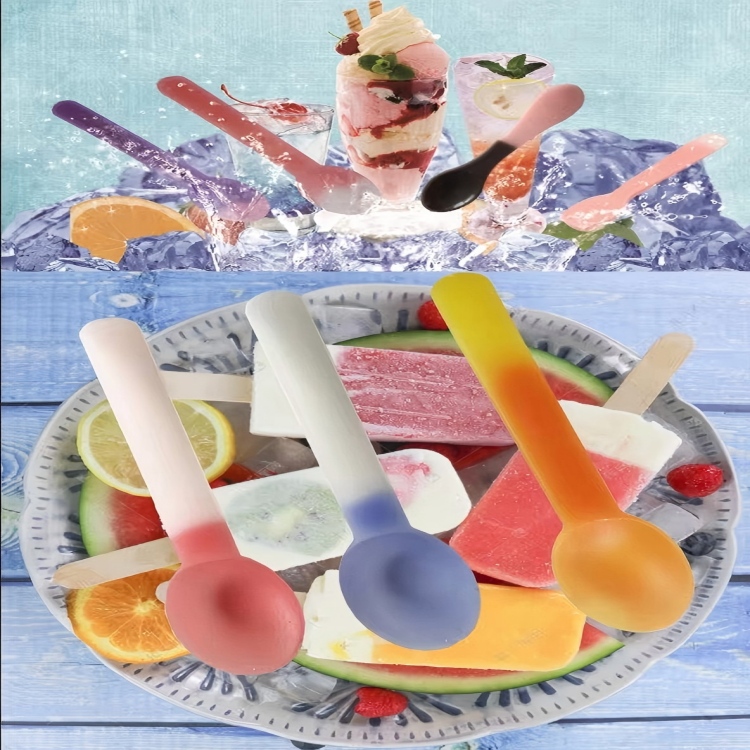
For suitable solid baby foods, use a repeatable process rather than relying on one quick test.
Place the portion into a microwave-safe dish instead of heating it in its original jar.
Keep the remaining food separate from the feeding portion.
Use the food's preparation directions and account for microwave power and portion size. Do not assume that one heating time works for every meal.
Keep the feeding spoon outside the microwave unless its manufacturer expressly permits microwave use.
Mix the center, edges, and bottom thoroughly. Move food between these areas rather than stirring only the surface.
This step addresses uneven heating before any temperature check.
For microwaved baby food, the FDA advises stirring, allowing 30 seconds of standing time, and taste-testing before feeding.
Standing time is part of the routine, not a guarantee that every portion has cooled enough.
Follow the specified contact time and observe the responsive area.
If the warning appears, allow more cooling and repeat the checking process. Never interpret a brief dip with no visible change as whole-bowl confirmation.
Taste a small sample with a separate clean utensil before feeding.
Avoid returning a utensil used in an adult's mouth to the baby's serving. If the food feels hot or the result is uncertain, wait and check again.
For brands sourcing OEM/ODM color changing spoons, attractive photographs are not enough. The useful questions concern performance, visibility, and durability.
The following are proposed evaluation priorities, not claims that every product has already passed these tests.
A pigment specification does not establish the performance of a complete utensil.
Evaluate finished samples against a suitable reference thermometer under controlled conditions. Document activation behavior, response time, and recovery after cooling.
Include temperatures on both sides of the intended transition range. This helps identify whether the warning is clear near the point where users must make a decision.
A dramatic change in clear water may be less obvious under orange carrot purée or dark-colored food.
Evaluate whether caregivers can recognize the warning with representative foods and ordinary kitchen lighting.
Instructions should show both appearances clearly. They should also explain what to do when food covers the responsive area.
Thermochromic materials can degrade under exposure to excessive heat, ultraviolet light, or certain chemicals.
Assess performance after the cleaning conditions the finished product will actually claim to tolerate. Dishwasher, sterilization, and boiling claims require their own support.
A responsible evaluation checks whether the warning still functions—not merely whether the spoon remains intact.
For importers, baby-product brands, and distributors, a sourcing brief should separate appearance preferences from safety-related requirements.
| Specification area | Questions to resolve |
|---|---|
| Intended function | Is this a warm-food warning spoon or a novelty color-changing utensil? |
| Thermal response | What activation range, tolerance, and contact time are specified? |
| Food-contact suitability | What documentation supports the finished product for its intended market and use? |
| Usability | Is the warning understandable in representative foods and lighting? |
| Durability | Which washing conditions have been evaluated? |
| Instructions | Do they explain stirring, cooling, rechecking, and product limitations? |
| Production control | How will samples and production batches be checked against the agreed specification? |
A generic "food-grade" statement does not answer every question. Documentation should match the material, finished article, intended use, and destination market.
Neither a spoon indicator nor finger testing resolves every feeding risk.
For example:
- Food has not been stirred after microwaving.
- The indicator's instructions are missing.
- The warning is difficult to see.
- The spoon is damaged or performs inconsistently.
- Food preparation or storage safety is uncertain.
In these situations, stop and resolve the uncertainty rather than combining two incomplete checks and assuming they guarantee safety.
This article concerns suitable solid baby foods. Breast milk and infant formula require separate handling: they should not be heated in a microwave because uneven heating can create scalding hot spots.
At Qingdao Focus On Color Industry & Trade Co., Ltd., our OEM/ODM and personalized customization services provide a starting point for discussing temperature-responsive product concepts.
For your next inquiry, share your target market, intended application, proposed activation range, preferred materials, cleaning expectations, and packaging requirements. Ask us to discuss feasibility, sample evaluation, and the documentation available for the proposed design.
The objective should be a clearly specified product that supports careful feeding—not a color effect presented as a safety guarantee.

Not necessarily. A spoon may offer a more clearly defined warning if its transition range and response are documented. Neither method supplies a numerical reading unless the product specifically includes that capability.
No. The spoon may not have contacted a hot area, may need more contact time, or may not be functioning correctly. Stirring, standing, and checking that food is lukewarm remain essential.
The practical guidance used here is lukewarm rather than hot. A spoon's activation temperature is a product specification, not a universal boundary between safe and unsafe feeding.
Only if its manufacturer explicitly permits it. Food-contact suitability does not establish microwave compatibility. Otherwise, heat the food separately and use the spoon afterward as instructed.
No. It responds to temperature, not microorganisms. Follow appropriate preparation, storage, and reheating instructions independently of the spoon's color.
Do not assume it provides a heat warning. Cold-responsive promotional spoons can have a different function. Select a product documented for the intended feeding-temperature application.
1. U.S. Food and Drug Administration. "Once Baby Arrives (Food Safety for Moms-to-Be)." Sections on safe microwaving of solid foods, handwashing, separate serving portions, and avoiding microwave heating of breast milk or formula. [fda]
2. U.S. Department of Agriculture, Food Safety and Inspection Service. "Cooking with Microwave Ovens." Guidance on uneven heating and checking food temperature in several places. [fsis.usda]
3. U.S. Department of Agriculture, Food Safety and Inspection Service. "Cooking Safely in the Microwave Oven." Guidance on stirring, standing time, and variation in microwave power and heating performance. [fsis.usda]
4. Institute of Making, University College London. "Thermochromic Spoon." Description of a specific 43°C color-changing spoon, thermochromic mechanisms, and material degradation factors. This example does not establish specifications for other products. [instituteofmaking.org]


