+86 18560646018

Views: 228 Author: Focus Color Publish Time: 2026-10-26 Origin: Site


Content Menu
● How Does a Fish Tank Thermometer Strip Work?
● How to Read a Fish Tank Thermometer Strip Step by Step
>> 1. Identify the Temperature Scale
>> 2. Find the Green Indicator
>> 3. Interpret Neighboring Colors Correctly
>> 4. Handle Two Visible Numbers Carefully
>> 5. Let the Reading Stabilize
● Where Should You Place a Stick-On Aquarium Thermometer?
>> Attach It Outside, Below the Waterline
>> Avoid Local Heating and Cooling
● Are Aquarium Thermometer Strips Accurate?
● A Practical Cross-Check for Questionable Readings
>> Step 1: Check the Installation
>> Step 2: Use a Suitable Reference Thermometer
>> Step 3: Repeat Under Different Conditions
● Troubleshooting an Unclear Thermometer Strip
>> The Strip Is Completely Black
>> Several Numbers Are Visible
>> The Strip and Heater Dial Disagree
>> The Strip Changes When the Room Temperature Changes
● What Temperature Should Your Fish Tank Be?
● Manufacturer's Perspective: What Makes a Better Thermometer Strip?
>> Clear Instructions and Legible Scales
>> Specifications That Match the Application
>> Evaluation in Representative Conditions
● Choose Clear Readings and Application-Focused Customization
>> What Color Should I Read on a Fish Tank Thermometer Strip?
>> Why Are Two Temperatures Showing at Once?
>> Does a Fish Tank Thermometer Strip Go Inside or Outside?
>> Can I Move an Aquarium Thermometer Sticker?
>> Can a Thermometer Strip Replace a Digital Thermometer?
>> How Often Should I Read My Aquarium Thermometer?
To understand how to read a fish tank thermometer strip, look for the number that appears green on its temperature scale. On many traditional liquid crystal strips, green indicates the rated temperature, while neighboring numbers may appear blue or tan as the temperature moves between increments. Always check the product's color key, because display designs vary.
The important distinction is that a strip shows temperature—not whether your aquarium is suitable for every fish species. Correct interpretation also depends on placement, lighting, and the difference between the tank's exterior surface and the water inside.
This guide explains how to read the colors, resolve unclear displays, and verify questionable readings. It also offers a manufacturer-oriented perspective on choosing clear, practical aquarium temperature labels.
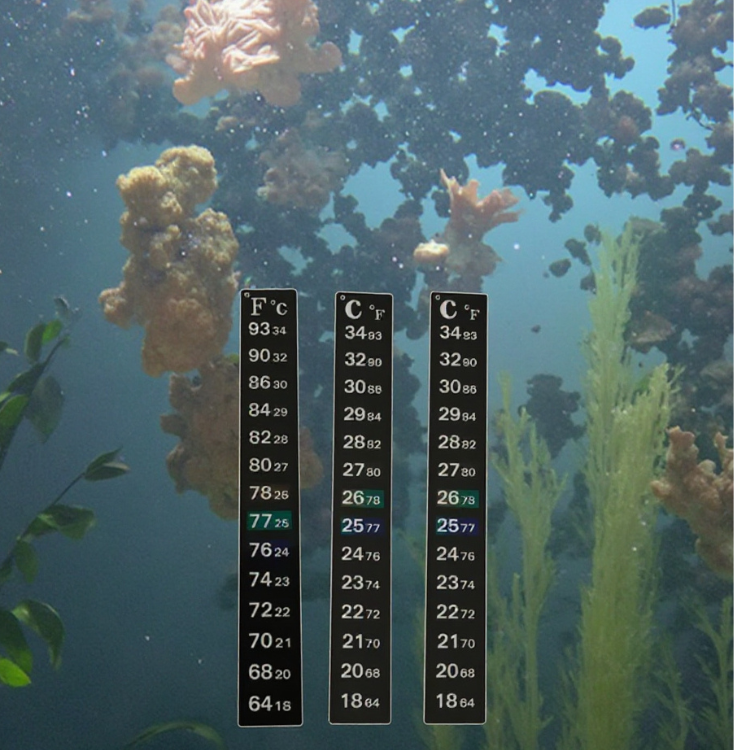
A typical stick-on aquarium thermometer contains thermochromic liquid crystals: temperature-sensitive materials that change color reversibly as they warm or cool.
Each temperature indicator is formulated to respond around a particular value. In a traditional multicolor design, an individual indicator passes through tan, green, and blue as its temperature rises through its active range.
These strips need no battery. Their temperature-sensitive material provides the visible response directly.
However, an exterior strip does not sit in the aquarium water. It responds to its own temperature while attached to the tank wall. Heat passes between the water, the wall, the strip, and the surrounding air.
That explains both its convenience and its limitations: it offers a quick visual check, but installation conditions can influence what it displays.
Look for °C, °F, or both before interpreting a number.
For example:
- 25°C equals 77°F.
- 26°C equals 78.8°F.
- 28°C equals 82.4°F.
A dual-scale thermometer may use different spacing or rounded values between its Celsius and Fahrenheit markings. Read the printed units carefully rather than assuming that aligned numbers are exact equivalents.
On many conventional liquid crystal aquarium strips, the green number represents the indicated temperature.
If 25°C appears clearly green, read the strip as approximately 25°C, subject to the product's stated accuracy and installation conditions.
Use the manufacturer's instructions as the deciding reference. Some temperature labels use single-color transitions rather than the familiar multicolor sequence.
The following guide applies to traditional tan–green–blue liquid crystal displays.
| Appearance of an individual indicator | Typical meaning |
|---|---|
| Green | The indicator is near its printed temperature |
| Tan or brownish | The indicator is slightly below its printed temperature |
| Blue | The indicator is slightly above its printed temperature |
| Black or inactive | The indicator is outside its visible response band |
Notice the wording: the colors describe the relationship between an indicator and its printed number.
Blue does not automatically mean "the aquarium is too cold," and tan does not automatically mean "the aquarium is too hot."
Two adjacent indicators can appear together when the temperature falls between their rated values.
For example, a lower-numbered indicator may appear blue while the next higher indicator appears tan. That suggests a temperature between those markings.
Do not automatically report an exact midpoint. If the scale shows 24°C and 26°C, an intermediate display does not prove that the water is precisely 25.0°C.
Treat it as an approximate interval unless the supplied instructions describe a specific interpolation method.
After installation, a water change, or a significant room-temperature change, allow the display to settle.
Follow the product's specified response time. There is no single waiting period that applies to every strip, tank material, and installation.
Avoid warming the strip with your hand immediately before reading it.
Correct placement makes the display easier to interpret and helps reduce avoidable measurement errors.
For a conventional exterior aquarium strip:
1. Choose a smooth, compatible tank surface.
2. Clean and dry the outside mounting area.
3. Position the strip below the normal waterline.
4. Remove the backing.
5. Press it firmly against the wall without trapping bubbles.
Below-waterline placement matters because that section of the wall is in contact with aquarium water on the inside.
Do not assume an adhesive strip is submersible. Use it underwater only when the manufacturer explicitly approves that application.
Choose an easily visible position away from:
- Prolonged direct sunlight.
- Strong drafts or air-conditioning outlets.
- Concentrated heat from nearby equipment.
- Locations immediately beside the heater.
- Areas above the waterline.
A location away from the heater helps avoid interpreting a local warm spot as representative of the whole aquarium.
For acrylic tanks, unusually thick walls, or special coatings, confirm compatibility with the supplier rather than assuming identical performance.
A thermometer strip can be useful for routine visual monitoring, but its suitability depends on the product and the measurement task.
Three concepts deserve separate attention:
| Measurement term | What it means |
|---|---|
| Scale interval | The spacing between printed temperature values |
| Accuracy | How closely the indication agrees with a suitable reference under stated conditions |
| Response time | How quickly the display reacts to a temperature change |
A strip with closely spaced numbers is not automatically more accurate. Likewise, a highly temperature-sensitive liquid crystal material does not guarantee the same accuracy once incorporated into a finished adhesive product.
The complete assembly matters: sensing material, printing, backing, adhesive contact, tank wall, and room conditions all contribute.
From a manufacturing perspective, the useful question is not simply, "How sensitive is the material?" It is, "How reliably can a user interpret the finished product in its intended application?"
For sensitive livestock, breeding, or treatment-related decisions, confirm important readings with an appropriate immersed thermometer.

If a strip looks wrong, verify the temperature before changing the heater.
Confirm that the strip is below the waterline, attached firmly, and away from direct sunlight or drafts.
Look for lifting edges, trapped air, discoloration, or physical damage.
Place an aquarium-safe probe or immersed thermometer in the water near the strip's location.
Keep the sensing element away from direct heater contact and follow its immersion requirements. Allow both devices to stabilize before comparing them.
Remember that two thermometers disagreeing does not establish which one is correct. The reference instrument also needs an appropriate accuracy specification.
Compare readings during a stable period, then repeat later.
A simple observation log can help:
| Check | Strip indication | Reference reading | Conditions |
|---|---|---|---|
| Morning | Record value or interval | Record value | Note room conditions |
| Afternoon | Record value or interval | Record value | Note lighting and sunlight |
| After maintenance | Record after stabilization | Record after stabilization | Note water changes |
This is a troubleshooting check, not a formal calibration.
A changing discrepancy can point toward environmental influence or poor contact. A persistent discrepancy requires further investigation rather than an assumed correction factor.
An inactive display does not automatically mean that the aquarium is cold.
Possible explanations include:
- Temperature outside the strip's printed operating range.
- Poor lighting or an unfavorable viewing angle.
- Insufficient time to stabilize.
- Deterioration or physical damage.
Check the water independently before deciding what the blank display means.
Neighboring active numbers may reflect normal transition behavior.
Read the display under neutral lighting, look for the green indication, and consult the color key. If the pattern remains ambiguous, use a second thermometer.
Avoid choosing whichever number best matches the heater setting.
A heater dial is a control setting, not independent proof of the actual water temperature.
Confirm the water reading before adjusting the heater. Repeatedly changing settings in response to uncertain measurements can create unnecessary fluctuations.
Because an exterior strip exchanges heat with room air as well as the tank wall, environmental conditions can affect its indication.
Check for drafts, sunlight, poor adhesion, or an unsuitable mounting surface. Compare against an immersed thermometer before attributing the entire change to the aquarium water.
There is no universal correct aquarium temperature.
Many tropical freshwater fish are commonly maintained around 24–27°C, or approximately 75–80°F, but this is a broad guide—not a prescription for every species.
Temperate-water fish may require cooler conditions. Breeding, life stage, and particular species can also change the appropriate target.
Before selecting a temperature:
1. Identify every species in the aquarium.
2. Check their recommended temperature ranges.
3. Confirm that those ranges overlap.
4. Monitor temperature consistently.
5. Investigate unexpected changes before making large adjustments.
A printed "safe zone" on a strip cannot account for every livestock combination.
Temperature also affects fish physiology and oxygen conditions. If fish show distress, check temperature alongside aeration and other water-quality parameters rather than treating temperature as the only possible cause.
A useful aquarium strip should be easy to understand, not merely visually attractive.
For retailers and private-label buyers, three design decisions deserve particular attention.
Packaging should explain:
- Which color indicates the temperature.
- How to interpret neighboring colors.
- Where the strip should be attached.
- Whether the product is exterior-only.
- What to do when no number appears.
Readable type, clear unit labels, and sufficient contrast reduce interpretation errors.
Buyers should request a stated measuring range, scale interval, accuracy conditions, and response-time guidance.
They should also clarify surface compatibility, storage requirements, adhesive performance, and any relocation limitations.
Avoid treating a generic liquid crystal material specification as proof of finished-product performance.
A practical product-evaluation plan should include installation on the intended tank material and comparison with a suitable reference thermometer.
Assess readability under normal indoor lighting, contact quality, packaging instructions, and performance across the intended temperature range.
This application-focused approach is more useful than judging quality from a product photograph alone.
Reading a fish tank thermometer strip starts with the color key, but dependable monitoring also requires correct placement and sensible verification.
Qingdao Focus On Color Industry & Trade Co., Ltd. manufactures photochromic, thermochromic, liquid crystal thermometer, and fragrance products, with more than 13 years of production experience and OEM/ODM customization services.
For an aquarium thermometer project, send your target temperature range, preferred units, strip dimensions, branding, packaging requirements, and intended installation conditions. These details provide a practical starting point for discussing a customized product and evaluating samples against your application.

On many traditional liquid crystal strips, read the green number. However, color systems vary, so the instructions supplied with your particular product take priority.
The temperature may fall between adjacent indicators. A lower number appearing blue and a higher number appearing tan can indicate an intermediate temperature. Do not assume an exact midpoint without product guidance.
Conventional stick-on strips are generally designed for the outside of the aquarium, below the waterline. Only immerse a strip explicitly designed and approved for underwater use.
Only if the product allows repositioning. Peeling can damage the strip or reduce adhesive contact. A strip that no longer sits flat may become harder to interpret reliably.
It can provide convenient everyday checks, but important or questionable readings should be verified with an appropriate immersed instrument. A digital display alone does not guarantee accuracy; specifications and correct use still matter.
Check the temperature daily as part of routine aquarium care. Additional checks are useful after water changes, heater adjustments, equipment problems, or unusual room-temperature conditions.
1. LCR Hallcrest / ThermometerSite. "Temperature Monitoring Without Batteries or Glass." Technical explanation of reversible thermochromic liquid crystals, their tan–green–blue transition, green calibration point, and alternative single-color designs. [thermometersite]
2. Thermographics. "Aquarium Thermometers: Instructions for Use," document SM204 Rev00. Installation guidance specifies exterior placement below the waterline, firm adhesive contact, and avoidance of prolonged direct sunlight. [thermographics]
3. Merck Veterinary Manual. "Special Considerations for Fish." Veterinary guidance on aquarium conditions, species compatibility, and differences between tropical and temperate fish temperature requirements. [merckvetmanual]
4. Merck Veterinary Manual. "Essential Maintenance." Aquarium maintenance checklist identifying fish, water-temperature, and equipment checks as daily tasks. [merckvetmanual]
5. The Spruce Pets. "Correct Aquarium Water Temperature for Your Fish Tank." Guidance on broad tropical-fish temperature ranges, species-specific requirements, temperature stability, placement, and water-change considerations. [thesprucepets]
6. AllPondSolutions. "How Temperature Change Affects Your Fish." Explanation of relationships among water temperature, fish metabolism, respiration, and dissolved oxygen. [allpondsolutions.co]


