+86 18560646018

Views: 243 Author: Focus Color Publish Time: 2026-10-25 Origin: Site


Content Menu
● Spain's Position in the Thermometer Strip Supply Chain
● How the Suppliers Were Selected
>> 1. Relevant Product Availability
>> 2. Manufacturing and Development Capability
>> 3. Quality-Control Transparency
>> 4. Capacity and Delivery Evidence
>> 5. Application-Specific Compliance
● Understanding the Main Thermometer Strip Technologies
● Six Thermometer Strip Manufacturers and Suppliers Serving Spain
>> 1. Qingdao Focus On Color Industry & Trade Co., Ltd.
>>> Overseas OEM/ODM Option for Customized Liquid Crystal Products
>> 2. RS Spain
>>> Established Channel for Standard Industrial Temperature Labels
>>> Useful for Buyers Consolidating Electronics and Temperature-Indicator Procurement
>>> Relevant for Laboratory Purchasing and Testoterm Strip Procurement
>> 5. OMEGA Engineering / DwyerOmega
>>> Manufacturer-Brand Option for Industrial Threshold Indicators
>> 6. Digiytal
>>> Spanish-Market Source for Promotional Thermometer Strips
● Supplier Comparison: Capacity, MOQ, and Certification Visibility
● Technical Specifications Buyers Should Put in the RFQ
>> Define Performance Before Materials
>> Treat CE and RoHS Correctly
>> Make Material Substitution Detectable
● Buyer's Guide: Factory Verification, Sampling, and Logistics
>> Verify Who Actually Makes the Product
>> Use a Three-Stage Sampling Process
>> Calculate Landed Cost, Not Just Unit Price
>> Protect the Product During Transit
● An Overlooked Procurement Trap: Testing the Air Instead of the Installed Strip
>> 1. How Can We Check Whether a Supplier's ISO Certificate Has Expired?
>> 2. Can a Supplier Provide CE and RoHS Documents for Every Thermometer Strip?
>> 3. How Do We Compare Accuracy When Suppliers Use Different Claims?
>> 4. What Should We Do if Samples Pass but the First Bulk Order Fails?
>> 5. Is Direct Factory Sourcing Always Cheaper Than Buying Through Spain?
Choosing a thermometer strip supplier requires more than comparing prices and temperature ranges. Professional buyers need to understand who manufactures the sensing material, how each production batch is tested, whether the adhesive suits the application, and which regulatory requirements actually apply.
Spain offers accessible purchasing channels for industrial temperature indicators, laboratory thermometer strips, and promotional liquid crystal products. However, buyers should distinguish Spanish distributors from manufacturers supplying Spain: a local sales office does not establish local production.
This guide examines six sourcing options serving Spanish buyers, including international manufacturers and Spanish-market distributors. Qingdao Focus On Color Industry & Trade Co., Ltd. appears first as an overseas customization option—not as a Spanish manufacturer. The remaining companies offer different routes to industrial, laboratory, and promotional temperature-monitoring products.
The central purchasing principle is traceability: every important claim should connect to an identifiable manufacturer, product specification, production batch, or current compliance document.

Spain's strongest advantage is its surrounding industrial and scientific customer base rather than a publicly documented concentration of thermometer strip factories.
Catalonia provides a useful example. ACCIÓ's life sciences and healthcare sector report, drawing on the BioRegion Report 2025 and other sources, identifies 1,650 companies, approximately €29.23 billion in turnover, and 84,781 employees. These figures describe the broader healthcare and life sciences ecosystem—not the thermometer strip market. Nevertheless, they help explain the region's demand for laboratory supplies, temperature-control products, and specialist distribution services.
Catalonia's official investment and trade agency also reports €9.23 billion in life sciences exports in 2025, representing 41% of Spain's total in that sector. Again, these are life sciences exports, not exports of liquid crystal thermometer strips. Using them as a thermometer strip market-size estimate would be misleading.
For buyers, the practical advantages of sourcing through Spanish channels include access to Spanish-language catalogs, identifiable local commercial entities, and established industrial or laboratory purchasing routes. RS, Farnell, and Fisher Scientific all publish Spanish-market listings for temperature-indicating products.
The sourcing decision therefore often comes down to two models:
- Purchase standard products through a supplier serving Spain.
- Work directly with an overseas manufacturer when proprietary graphics, dimensions, packaging, or temperature ranges matter.
Neither model is automatically superior. The appropriate choice depends on the application, order size, documentation requirements, and level of customization.
This is an application-based shortlist, not an audited ranking by market share, factory size, or production output. Inclusion reflects relevant product evidence and usefulness to professional buyers.
The assessment framework covers six areas.
A supplier should demonstrate actual thermometer strips or temperature-indicating labels. Selling digital thermometers alone is insufficient.
The shortlist includes both reversible liquid crystal products and irreversible threshold indicators. These categories serve different purposes and should not be treated as interchangeable.
For OEM projects, buyers should establish whether the supplier controls:
- Temperature-sensitive formulation or material sourcing.
- Coating, printing, lamination, and die-cutting.
- Artwork and temperature-scale development.
- Adhesive selection and packaging.
- Engineering-change approval.
A distributor may provide excellent service without performing any of these manufacturing operations.
Useful evidence includes incoming-material checks, batch identification, temperature-response testing, appearance inspection, and documented handling of nonconforming products.
A certificate alone does not explain how an individual thermometer strip batch was released.
Buyers should request realistic output figures for the relevant product—not total factory output across unrelated product lines.
Where production capacity is not publicly disclosed, this guide states that limitation rather than inventing a monthly volume.
The review distinguishes management-system certification, chemical-compliance evidence, and product-specific regulatory obligations.
These are separate subjects. An ISO certificate does not establish medical-device compliance, and a material test report does not establish temperature accuracy.
For standard industrial products, pack size and replenishment may dominate. For private-label projects, development support, artwork control, and communication responsiveness may matter more.
No supplier in this guide should be assumed to offer a particular MOQ, lead time, or certification unless confirmed for the quoted product.
Before comparing suppliers, define what the strip must do.
| Product category | Main function | Typical buying consideration |
|---|---|---|
| Reversible liquid crystal thermometer strip | Displays temperature through a reversible color response | Readability, viewing conditions, mounting surface, scale and adhesive |
| Irreversible temperature strip | Permanently records exposure to specified temperature thresholds | Activation tolerance, exposure conditions and storage history |
| Single-point temperature label | Indicates whether one threshold has been reached | Threshold selection, placement and interpretation |
| Promotional thermometer strip | Combines temperature indication with branded print | Functional performance plus artwork, dimensions and packaging |
RS's Spanish catalog explicitly distinguishes reversible and irreversible labels. Its reversible products return toward their original condition as temperature decreases, whereas irreversible indicators retain the change.
OMEGA's TL-3 series illustrates the importance of model-specific specifications: its published accuracy varies by temperature range. A generic statement such as "all strips are accurate to ±1°C" would therefore be inappropriate even within one product family.
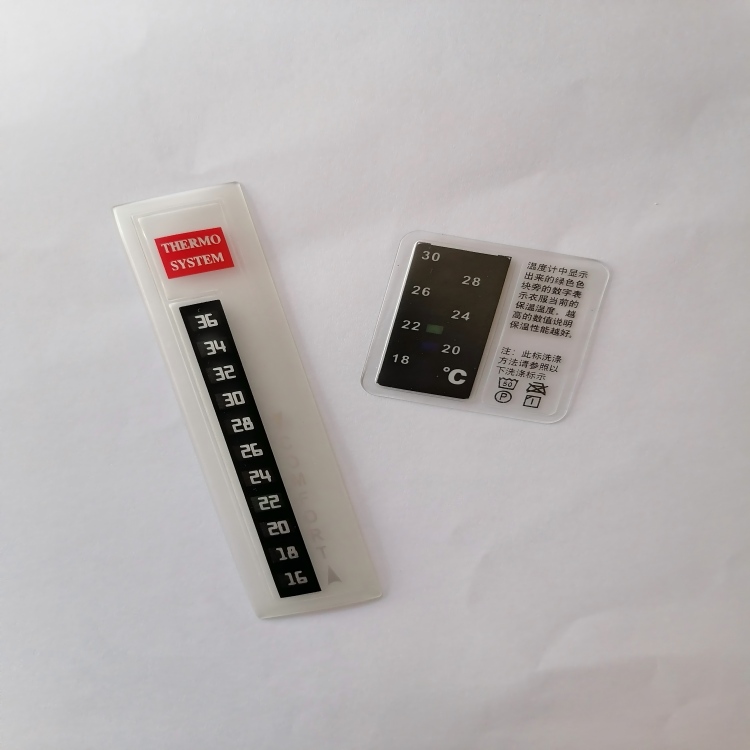
Qingdao Focus On Color Industry & Trade Co., Ltd. is a China-based sourcing option for Spanish importers, private-label brands, and businesses developing customized temperature-indicating products.
According to the company information supplied for this article, it has more than 13 years of production experience and offers photochromic, thermochromic, liquid crystal thermometer, and fragrance products. Its public supplier storefront also lists liquid crystal thermometer stickers or cards alongside thermochromic, photochromic, and fragrance-related products.
- Location: Qingdao, China.
- Establishment: Exact incorporation year was not independently verified; the company reports more than 13 years of production experience.
- Intended markets: Global customers, according to the supplied company profile; country-level sales distribution was not independently established.
- Relevant products: Liquid crystal thermometer stickers and cards.
- OEM/ODM scope: Personalized product development and customization, according to the supplied company information.
For smaller brands, its potential value lies in combining temperature-indicating functionality with customer-specific presentation. Relevant discussions may include printed scales, product dimensions, branding, packaging, and application-specific configurations.
The company should be evaluated as a potentially cost-effective development partner rather than automatically described as the lowest-priced supplier. Buyers should compare landed cost, development charges, sample quality, and repeat-order consistency.
Its stated flexibility and OEM support are commercially relevant, but communication efficiency should be tested during the inquiry stage. A useful test is whether the supplier returns a complete specification review—including unresolved technical questions—rather than only a unit price.
One public room-temperature card listing shows a minimum order of 5,000 pieces. This is a listing-specific figure, not a verified MOQ for every thermometer strip or custom project. Production capacity, current certifications, and project-specific minimums require direct confirmation.

RS is relevant for maintenance teams, industrial purchasing departments, and buyers who need clearly identified catalog products rather than a proprietary strip design.
Its Spanish catalog includes reversible and irreversible temperature labels. Published examples include an RS PRO nine-level product covering 40–71°C and a reversible 11-level product covering 0–50°C, both listed in packs of 10.
- Establishment: RS Group dates to 1937; this is the group's founding year, not a verified founding date for its Spanish entity.
- Spanish-market role: Industrial distributor.
- Relevant markets: Industrial maintenance, automation, and related technical purchasing.
- Core strength: Comparing standard temperature-indicator formats through an established catalog.
- OEM/ODM scope: Custom strip manufacturing is not established by the reviewed listings.
RS is a practical candidate when a buyer already knows the required threshold range, label size, and reversible or irreversible behavior.
Some catalog entries display RoHS information. Buyers should still obtain the underlying product-specific documentation and determine whether that information satisfies the application's actual requirements. A catalog symbol is not a substitute for a complete compliance review.
Farnell serves electronic and industrial design, maintenance, and repair purchasing. Its Spanish website identifies the local business as Farnell Components, S.L., with a registered office in Barcelona.
Its Spanish catalog includes OMEGA temperature labels, such as the TL-S-140-50 non-reversible round indicator and the 21-100 temperature-indicator label.
- Establishment: A.C. Farnell Limited was founded in 1939; the date refers to Farnell's corporate heritage rather than the Spanish entity's incorporation.
- Spanish-market role: Electronic and industrial products distributor.
- Relevant markets: Electronics development, industrial maintenance, and repair.
- Core strength: Purchasing temperature indicators alongside other technical components.
- OEM/ODM scope: Custom thermometer strip production is not verified.
Farnell is worth considering when a procurement department wants named manufacturer part numbers and a consolidated purchasing route.
However, buyers must inspect the actual product format. A single-point round label is not equivalent to a multi-level strip. Compare threshold count, dimensions, activation behavior, and packaging before treating two listings as alternatives.
Fisher Scientific's Spanish catalog includes Testo Testoterm self-adhesive foil thermometer strips. One reviewed listing specifies a 116–154°C range and describes a color change after threshold exposure within two or three seconds.
- Establishment: The Fisher Scientific brand traces its origins to 1902. Thermo Fisher Scientific is a later corporate entity and should not be assigned the same founding date.
- Spanish-market role: Laboratory supply channel.
- Relevant markets: Laboratories, scientific research, and associated industrial applications.
- Core strength: Access to temperature strips through a laboratory procurement catalog.
- OEM/ODM scope: Private-label strip manufacturing is not established by the reviewed listing.
This route may suit laboratories that already buy consumables through Fisher Scientific and want to add temperature indicators to an existing purchasing process.
The principal procurement issue is technical suitability. A high-temperature irreversible strip intended to record surface exposure should not be substituted for a reversible liquid crystal strip intended for continuous visual reading.
Buyers should request the current manufacturer datasheet, pack quantity, storage conditions, and remaining shelf life before ordering.
OMEGA's catalog includes several irreversible temperature-label configurations. Its Spanish-language site lists a six-point horizontal temperature label, while its TL-3 technical page describes a three-point irreversible strip with an adhesive backing.
- Establishment: Founding date was not verified in the sources reviewed for this guide.
- Supply role: International instrumentation brand with Spanish-language product access and products listed through Farnell Spain.
- Relevant markets: Industrial temperature monitoring and instrumentation.
- Core strength: Documented industrial temperature-label configurations.
- OEM/ODM scope: Bespoke strip development and private labeling require direct confirmation.
The TL-3 page publishes temperature-dependent accuracy information rather than one tolerance for the entire range. That is useful for buyers building an acceptance specification because it makes clear that performance must be assessed against the selected model and threshold.
OMEGA is a relevant candidate for industrial exposure checks, but purchasing its products through a Spanish distributor does not establish Spanish manufacture.
Also confirm the contracting seller, dispatch location, applicable commercial terms, and available technical support before placing an order.
Digiytal lists adhesive thermometer strips for calendars, cards, rulers, and related printed products. Its product page describes horizontal formats in several sizes and temperature ranges, including a commonly used 7.7 × 0.8 format for calendars. Buyers should confirm the measurement unit directly rather than infer it from the listing.
- Establishment: Not verified in the reviewed public source.
- Supply role: Spanish-market supplier listing promotional thermometer strips.
- Relevant markets: Printed promotional products and stationery applications.
- Core strength: Product relevance to integrating temperature strips into printed items.
- OEM/ODM scope: Different sizes and ranges are advertised; bespoke sensing-material development is not established.
Digiytal is a useful option to investigate when the thermometer strip is one component of a larger printed product rather than a stand-alone industrial sensor.
Before commissioning work, establish whether the company supplies strips, performs integration, or arranges production through another manufacturer. Request an assembled sample that includes the intended card stock, adhesive, print finish, and packaging.
The table below separates published facts from information that still requires a quotation or document review.
| Supplier | Primary sourcing fit | Public capacity information | MOQ or pack information | Certification and compliance visibility |
|---|---|---|---|---|
| Qingdao Focus On Color | Customized liquid crystal stickers/cards and OEM projects | Relevant monthly output not independently verified | One room-temperature card listing shows 5,000 pieces; custom-project MOQ must be quoted | Current certificates and model-specific reports require verification |
| RS Spain | Standard reversible and irreversible industrial labels | Distributor inventory is not manufacturing capacity | Several reviewed products are sold in packs of 10 | Some listings display RoHS information; request supporting documents |
| Farnell Spain | Named-brand temperature indicators alongside technical components | Manufacturing capacity not disclosed in reviewed listings | Confirm the selected SKU's order multiple | Manufacturer and SKU-specific documents require review |
| Fisher Scientific Spain | Laboratory purchasing of Testoterm strips | Strip manufacturing capacity not disclosed | Confirm pack quantity for the chosen product | Obtain current manufacturer documentation |
| OMEGA / DwyerOmega | Industrial irreversible threshold labels | Relevant production output not verified | Confirm configuration and pack quantity | Technical specifications are published; regulatory evidence remains application-specific |
| Digiytal | Promotional print integration | Production capacity not verified | Request project quotation | Request material, performance, and applicable compliance evidence |
Product and order examples come from the reviewed supplier listings; none establishes guaranteed stock availability or universal minimum order quantities.
A request for "high-quality PET thermometer strips" is incomplete. The substrate matters, but it does not define the sensing performance.
Ask suppliers to identify:
- Substrate and protective-layer materials.
- Total construction thickness.
- Adhesive grade and intended mounting surfaces.
- Temperature range and scale increments.
- Indication tolerance and response conditions.
- Reversible or irreversible operation.
- Storage limits and shelf life.
- Lot identification and change-control procedures.
For customized liquid crystal products, also agree how color transitions will be interpreted. A printed numerical increment should not be accepted as proof of measurement accuracy.
CE marking is not a universal quality mark. It applies only when the product falls under relevant legislation, and products outside applicable categories should not receive it simply to satisfy a purchasing checklist.
Similarly, RoHS concerns restrictions on hazardous substances in electrical and electronic equipment. A passive, non-electronic temperature strip is not automatically within its scope merely because it is used near electronic equipment. Buyers may still request restricted-substance evidence contractually, but that is different from establishing a legal RoHS obligation.
If a strip is marketed for a medical purpose, obtain a specialist assessment of the intended use and applicable medical-device requirements. Do not assume that a promotional forehead strip and a medical thermometer require the same documentation.
Low-price quotations can conceal differences in adhesive, laminate, substrate, or sensing construction. Rather than relying on phrases such as "premium material," specify the approved construction and require notification before substitutions.
A practical supply agreement should link the approved sample to:
1. A controlled drawing.
2. A material or construction specification.
3. A defined test method.
4. A batch acceptance record.
5. A written engineering-change process.
This creates a basis for investigating quality differences on repeat orders.
Ask the supplier to identify the legal manufacturer and production site. Then establish which operations occur there and which are subcontracted.
For a factory-focused audit, request a live walkthrough of the relevant process, recent anonymized batch records, and a demonstration of the release test.
For a distributor, focus instead on manufacturer identity, authorized sourcing, storage control, complaint handling, and the availability of batch information.
A structured sample program reduces the risk of approving appearance while overlooking function.
1. Functional samples: Evaluate the proposed sensing technology and temperature range.
2. Pre-production samples: Check the final artwork, adhesive, construction, and packaging.
3. Pilot-order samples: Confirm that routine production matches the approved design.
Agree the test procedure before comparing suppliers. Otherwise, different mounting surfaces, heating methods, or reading conditions can make results difficult to interpret.
A useful comparison includes development charges, tooling, packaging, freight, customs handling, applicable taxes, inspection, and expected rejects.
For overseas supply, clarify the Incoterm, importer responsibilities, product classification, and dispatch point. Do not assume every temperature strip shares the same customs treatment.
For European distributors, confirm whether stock is physically available in the advertised market or supplied from another warehouse.
Ask the manufacturer for storage and transport limits, especially for irreversible indicators. Define remaining shelf life at delivery and a procedure for handling products that arrive pre-activated or visibly degraded.
Where the shipment is sensitive, agree how transport conditions will be recorded and who bears responsibility for excursions.
A particularly useful qualification check is to reproduce the final mounting arrangement.
A strip attached to a thin metal plate, a plastic bottle, or a laminated promotional card may not follow the surrounding air temperature in the same way. OMEGA describes its products as surface-temperature indicators, reinforcing the need to evaluate the temperature at the installed sensing location rather than assume ambient air is the reference.
For acceptance testing:
- Mount the strip on the intended substrate.
- Position the reference measurement close to the sensing area.
- Define stabilization time and exposure method.
- Avoid treating direct hot-air exposure as equivalent to uniform surface heating.
- Repeat the test on representative production units.
This is best treated as a procurement test-design principle, not as an allegation about any listed supplier.
A visually successful demonstration can still be a poor predictor of field performance if the test assembly differs from the customer's application.
Spain offers credible purchasing routes for temperature-indicating products, but buyers should distinguish local distribution from manufacturing origin.
RS, Farnell, and Fisher Scientific provide identifiable Spanish-market catalog channels. OMEGA offers documented industrial threshold-label configurations, while Digiytal addresses promotional thermometer-strip integration. Qingdao Focus On Color Industry & Trade Co., Ltd. is an overseas option for buyers exploring customized liquid crystal products and OEM/ODM development.
The strongest purchasing decision will come from a controlled specification, verified documentation, application-representative samples, and a clear repeat-order quality process—not from a supplier's position in a list.
For a customized program, send Qingdao Focus On Color or another shortlisted manufacturer a structured brief covering the temperature range, mounting surface, artwork, dimensions, annual demand, packaging, and target market. Request a technical proposal and sample-validation plan alongside the commercial quotation.
Obtain the complete certificate, including its number, legal entity, site address, scope, issuing certification body, and validity dates.
Check its status through the issuing body and, where available, IAF CertSearch. The database distinguishes statuses such as active, suspended, withdrawn, and expired. A PDF with a future expiry date is insufficient if the certificate has subsequently been suspended.
Also verify that the certified scope and site relate to the business supplying the strips. Certification of an unrelated office or product line does not answer the same question.
A buyer should not demand identical documents for every product category.
First determine the intended use and applicable legislation. CE marking is required only for products within relevant categories, while RoHS addresses electrical and electronic equipment. A passive industrial label may therefore require a different compliance approach from an electronic thermometer or a medical device.
Ask the supplier to explain the basis of each declaration and identify the exact products covered.
Request the complete test conditions behind each claim:
- Temperature range or activation threshold.
- Allowed deviation.
- Exposure method and duration.
- Reference instrument and its uncertainty.
- Reading or activation criteria.
- Number of samples tested.
Do not compare a reversible strip's displayed increment directly with an irreversible label's activation tolerance. OMEGA's published range-dependent tolerances illustrate why model-level specifications matter.
Start with the agreed acceptance method and the approved construction.
Compare retained samples, batch records, packaging, storage history, and test conditions. Establish whether the difference comes from manufacturing, material substitution, transit exposure, or a mismatch between the qualification test and the real application.
The purchase agreement should define investigation deadlines, access to supporting records, replacement or credit arrangements, and approval requirements for corrective changes.
Not necessarily.
Direct manufacturing may be attractive for customized or repeat-volume programs, but development charges, freight, import administration, inventory, and quality-control costs can change the result.
A distributor may be commercially preferable for a small quantity of standard strips. For branded programs, a manufacturer may offer more relevant customization. Compare both routes using the same specification, delivery requirement, and landed-cost assumptions.
- Qingdao Focus On Color's public supplier storefront: product categories and a listing-specific MOQ. The company's stated production experience and OEM/ODM positioning were supplied for this article; its requested About Us page could not be retrieved during research. [fo-color.en.alibaba]
- RS Spain: reversible and irreversible temperature-label categories, example ranges, pack sizes, and catalog compliance information. [es.rs-online]
- Farnell Spain: local commercial identity and OMEGA product availability. [es.farnell]
- Farnell corporate history: 1939 founding of A.C. Farnell Limited. [no.farnell]
- Fisher Scientific Spain: Testoterm self-adhesive thermometer-strip listing. [fishersci]
- Fisher Scientific brand history and historical corporate context. [fishersci]
- OMEGA: industrial strip configurations and model-specific performance information. [dwyeromega]
- Digiytal: promotional adhesive thermometer-strip listing. [digiytal]
- ACCIÓ, Government of Catalonia: life sciences and healthcare sector report using BioRegion Report 2025 and related sources. These figures describe the broader ecosystem, not thermometer strip sales. [accio.gencat]
- Catalonia Trade & Investment: official life sciences sector overview and 2025 export figures. [catalonia]
- U.S. International Trade Administration: explanation of European CE marking applicability. [trade]
- European Parliament: scope and purpose of restrictions on hazardous substances in electrical and electronic equipment. [europarl.europa]
- IAF CertSearch: certification-status definitions and verification resources. [support.iafcertsearch]


