+86 18560646018

Views: 238 Author: Focus Color Publish Time: 2026-09-17 Origin: Site


Content Menu
● Why Window Tint UV Testing Matters
● UV Test Card vs. Digital UV Intensity Meter: Core Differences
● How a UV Test Card Works Behind Window Tint
>> Advantages of UV Test Cards for Window Tint Demonstrations
>> Limitations of UV Test Cards
● How Digital UV Intensity Meters Measure Tint Performance
>> The Most Important Meter Question: What Wavelength Does It Measure?
>> Advantages of Digital UV Intensity Meters
>> Limitations of Digital UV Intensity Meters
● Side-by-Side Decision Guide for Tint Shops and Manufacturers
● A Practical Window Tint Testing Workflow
>> Step 1: Define the Question
>> Step 2: Record the Window System
>> Step 3: Use the UV Test Card for a Visual Baseline
>> Step 4: Use the Meter for Numerical Comparison
>> Step 5: Present Results Responsibly
● Expert Insight: Why Visible Darkness Is Not a UV Measurement
● Industry Use Case: Creating a More Convincing Window Tint Sales Kit
● Choose the Right UV Testing Solution
● FAQ
>> 1. Can a UV test card accurately measure window tint UV rejection?
>> 2. Is a digital UV meter better than a UV test card?
>> 3. Can dark window tint be assumed to block more UV?
>> 4. What UV wavelength should be tested for window tint?
>> 5. Can sunlight be used to test window tint with a UV card?
>> 6. How often should a digital UV intensity meter be calibrated?
>> 7. Can UV test cards be customized with a company logo?
When evaluating window tint efficiency, the key question is not simply whether a film looks dark. The important question is how effectively the completed glass-and-film system reduces ultraviolet exposure under real conditions. Both a UV test card and a digital UV intensity meter can support this evaluation, but they serve very different purposes.
From my experience working with photochromic materials and visual UV-response products, a UV test card is often the fastest way to make UV-blocking performance visible. A digital UV intensity meter, by contrast, is the better tool when installers, product developers, distributors, or quality teams need repeatable numerical readings. The strongest testing process usually combines both: a visual UV test card for fast demonstration and a properly specified meter for measurement, records, and comparison.

Window tint is commonly selected for privacy, glare reduction, appearance, heat control, and interior protection. However, UV rejection performance is especially important for automotive glass, commercial buildings, residential windows, retail displays, museums, and other sun-exposed environments.
Ordinary window glass may block much of UVB radiation while allowing a meaningful amount of UVA radiation to pass through. UVA can contribute to material fading and long-term exposure through sun-facing glass. Research comparing different glass types found that ordinary smooth glass transmitted substantially more UVA than laminated or sunlight-control-film-treated glass, while the tested sunlight-control film blocked UVA transmission in that study.
For buyers, this makes UV testing more than a product demonstration. It helps answer practical questions:
- Does the installed tint reduce UV reaching the interior side of the window?
- Can a customer visually understand the difference before and after film installation?
- Does the film perform consistently across batches, colors, thicknesses, and glass types?
- Is the result suitable for sales demonstrations, installer checks, or technical documentation?
- Does the testing method measure the relevant UV range for the application?
A correct answer depends on using the right test tool for the right purpose.
A UV test card is a color-changing indicator card. It contains a UV-responsive area, usually based on photochromic technology, that changes color when exposed to ultraviolet radiation. When placed behind untreated glass, the card may show stronger color development. When placed behind high-performance window tint, the color response may be weaker or absent.
A digital UV intensity meter uses a sensor and electronics to measure ultraviolet irradiance. Depending on the instrument, it may display results in units such as µW/cm², mW/cm², W/m², or another specified measurement format. Advanced instruments may be designed for UVA, UVB, UVC, UV LED sources, or narrower wavelength bands.
| Comparison Factor | UV Test Card | Digital UV Intensity Meter |
|---|---|---|
| Main purpose | Visual UV demonstration | Numerical UV measurement |
| Output | Color change or color intensity | Digital irradiance value |
| Ease of use | Very easy | Requires correct setup and interpretation |
| Speed | Immediate visual response | Fast reading, but preparation is needed |
| Cost level | Low | Moderate to high |
| Portability | Extremely portable | Portable, but more delicate |
| Best for sales | Excellent | Useful but less visually engaging |
| Best for quality control | Basic screening | Stronger when calibrated and documented |
| Customer understanding | High | Moderate |
| Repeatability | Depends on light and viewing conditions | Higher when the meter is properly matched and calibrated |
| Suitable for technical claims | Limited | Better, but only within the meter's wavelength range and stated accuracy |
The table shows the central distinction: a UV test card communicates, while a digital UV intensity meter quantifies.
Neither tool should be treated as automatically superior in every situation. The right choice depends on whether the user needs a persuasive visual demonstration, a simple screening method, a documented numerical result, or a complete verification workflow.
A UV test card uses a UV-sensitive material that responds to ultraviolet exposure by changing color. In a typical window film demonstration, the card is exposed to direct sunlight or a suitable UV source in two conditions:
1. In an unshielded area or behind untreated glass.
2. Behind the window tint or film-and-glass combination being evaluated.
If the UV test card changes strongly without tint but changes weakly behind the tinted window, the result provides a clear visual indication that the tint is reducing the UV radiation reaching the card.
This method is especially effective because people can see the comparison immediately. A sales representative does not need to explain technical units before the audience recognizes the difference.
Fast visual communication. A color response can make UV-blocking performance understandable within seconds.
Low training requirement. Staff can use a card with minimal technical instruction.
Low cost per test. Test cards are suitable for dealerships, tint shops, exhibitions, promotional kits, and distributor training.
Ideal for customer-facing use. A customer can observe the result directly rather than relying only on a specification sheet.
Compact and customizable. Manufacturers can provide custom printing, branding, instructional graphics, package inserts, and different indicator designs for OEM or private-label programs.
For a window tint brand, an intelligently designed UV test card can become both a testing aid and a marketing tool. It can present a brand message while giving users a practical demonstration of film performance.
A UV test card does not provide a precise laboratory measurement of UV transmittance. Its response can vary based on:
- UV spectrum and source type
- Exposure duration
- Solar angle and time of day
- Card orientation
- Ambient temperature
- The specific photochromic formulation
- Color perception and lighting conditions
- Storage history and repeated use
This does not make a card unreliable. It means the card should be used for its intended role: comparative visual indication, not as a substitute for spectral laboratory testing or a calibrated irradiance instrument.
A card may tell a customer, "This side receives noticeably less UV." It should not automatically be used to claim, "This film blocks exactly 99.7% of all ultraviolet wavelengths."
A digital UV intensity meter measures the radiation that reaches its sensor. To test window tint, users typically take one reading in a reference condition and another reading after placing the meter behind the tested glass-and-film system.
The basic calculation is:
UV Transmission (%)=UV Reading Behind Tint/Reference UV Reading×100
Then:
UV Rejection (%)=100−UV Transmission (%)
For example, suppose a meter reads 2.0 mW/cm² in the reference position and 0.08 mW/cm² behind a tinted window.
UV Transmission=0.08/2.0×100=4%
UV Rejection=96%
This numerical approach is useful, but it is only meaningful when the meter's sensor is appropriate for the radiation being tested.
Not all UV meters measure the same wavelengths. A meter designed for UVC disinfection lamps is not automatically appropriate for sunlight or automotive window tint testing. Likewise, a meter designed around one UVA range may not describe total UV performance across the full solar UV spectrum.
Before using a digital UV intensity meter, confirm:
- The meter's specified spectral response range
- Whether the sensor is intended for sunlight, UVA, UVB, UVC, or a specific lamp type
- The measurement units
- Sensor cosine response or angular sensitivity
- Calibration date and calibration method
- Accuracy and repeatability specifications
- Whether the test compares the same geometry before and after tint installation
Many professional UV meter suppliers offer instruments tailored to different UV bands and sources, including UVA, UVB, UVC, and UV LED applications. Selecting the wrong band can create misleading readings even when the meter itself functions correctly.
Quantifiable results. A meter gives numerical data rather than a visual estimate.
Useful for records. Installers and quality teams can document readings across jobs, batches, or locations.
Better comparison capability. Multiple products can be compared using the same light source and test setup.
Supports process control. Manufacturers can establish internal acceptance limits or investigate changes between film lots.
More professional for technical audiences. Architects, procurement teams, laboratory staff, and commercial buyers may prefer data-supported demonstrations.
Digital meters require more discipline than test cards. Common sources of error include:
- Measuring at different angles before and after tint application
- Changing sensor distance from the light source
- Using unstable sunlight conditions
- Selecting a meter with the wrong spectral response
- Ignoring meter warm-up requirements
- Using an overdue or unverified calibration
- Blocking part of the sensor with a frame, hand, or film edge
- Comparing readings through different glass types without noting the substrate
Calibration matters because the sensor response must be checked against a known reference. Good practice includes controlling the measurement environment, allowing instruments and sources to stabilize, aligning the detector correctly, recording conditions, and verifying the result against a standard source after calibration.
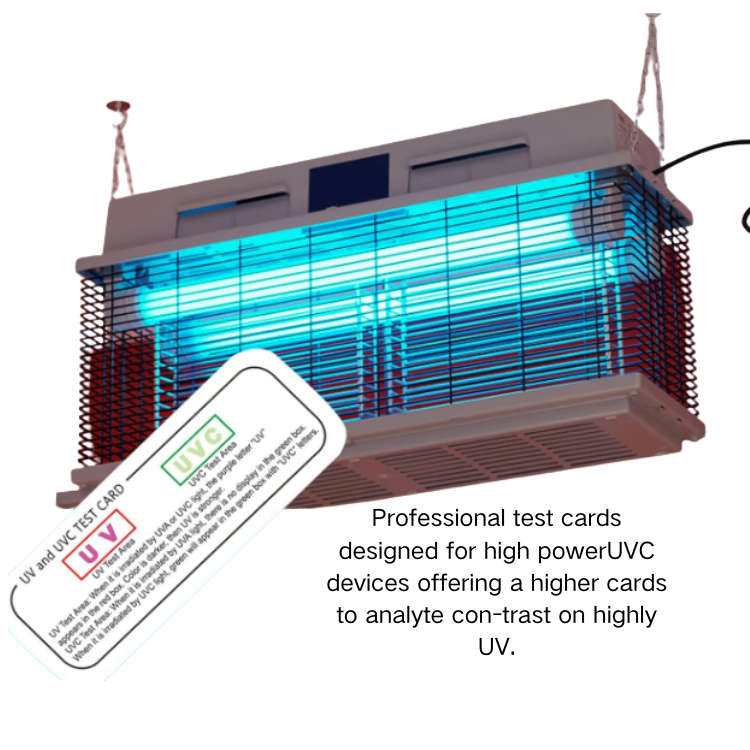
The following guide can help buyers choose the appropriate method.
| Business Need | Recommended Tool | Reason |
|---|---|---|
| Dealer counter demonstration | UV test card | Customers immediately see a color difference |
| Trade show promotion | UV test card | Lightweight, visual, and easy to distribute |
| Basic installer screening | UV test card plus meter | Card shows effect; meter adds a numerical check |
| Film batch comparison | Digital UV intensity meter | More suitable for repeatable internal records |
| Product development | Digital meter plus laboratory spectral testing | Supports engineering decisions and formal product claims |
| Consumer education package | Customized UV test card | Turns a technical benefit into an understandable experience |
| Warranty documentation | Meter with documented procedure | Produces traceable readings when used consistently |
| OEM/private-label program | Custom UV test card and user guide | Supports branded packaging and customer engagement |
For many businesses, the answer is not "UV test card or digital UV intensity meter." The best answer is UV test card for communication, meter for measurement.
A consistent process improves the usefulness of both visual and numerical results.
Start by deciding what you want to prove.
- Are you showing a customer that a tint reduces UV exposure?
- Are you comparing two film grades?
- Are you confirming performance after installation?
- Are you generating data for internal quality records?
- Are you validating a supplier's product claim?
The purpose determines the appropriate test tool and reporting standard.
Do not evaluate film as though it exists independently from glass. Record:
- Glass type
- Glass thickness
- Vehicle or building application
- Film brand and model
- Film shade or visible light transmission level
- Installation date
- Test location
- Light source type
- Time and weather conditions if sunlight is used
This matters because UV transmission depends on the entire glazing system, not just the tint. Laminated, coated, colored, and ordinary glass can have very different UV behavior. Published research has shown substantial variation in UVA transmission among glass types.
Place the card in a consistent position. Expose it behind untreated glass or an open reference area, then repeat behind the tinted area.
For the clearest demonstration:
- Use direct, consistent sunlight where possible
- Keep the card face perpendicular to incoming light
- Use identical exposure times
- Photograph both conditions under similar lighting
- Use a card with a high-contrast response color
- Explain that the result is comparative, not a laboratory certificate
Take a reference reading before the tint or through a comparable untreated glass area. Then take the reading behind the tinted glass at the same sensor angle and position.
For better consistency:
1. Allow the meter to stabilize according to its instructions.
2. Clean the sensor window.
3. Avoid shadowing the sensor.
4. Keep the same distance and orientation.
5. Take at least three readings in each condition.
6. Calculate the average.
7. Note the measurement wavelength range.
8. Keep a test record for future comparison.
A high-quality sales or technical report should distinguish between:
- Visual UV indication from a test card
- Instrument reading from a digital meter
- Published film performance data
- Certified or laboratory-tested results, where available
This distinction protects credibility. It also helps customers understand why a small, color-changing card and a calibrated instrument can both be useful without being interchangeable.
One of the most common misunderstandings in window tint selection is assuming that darker film always means stronger UV protection.
Visible Light Transmission, often called VLT or VT, describes the amount of visible light transmitted through the window system. A higher VT value means more visible light passes through. It does not, by itself, define UVA or UVB transmission. Window-film labels and rating systems may separately report visible transmittance and other solar performance values.
A nearly clear film may provide substantial UV reduction if it uses appropriate UV-absorbing technology. Conversely, a darker film should not be assumed to achieve a specific UV-rejection result without supporting product data or testing.
This is why a UV test card is helpful in customer education. It shifts the discussion from "How dark is the tint?" to "What does the tint actually do to UV exposure?"
Consider a distributor selling architectural or automotive window film to retail installers. A basic sample book may show color, reflectivity, and visible appearance, but it does not always demonstrate UV performance.
A more effective kit could include:
- A branded photochromic UV test card
- A transparent untreated reference sheet
- A tinted demonstration panel
- Clear instructions for direct-sunlight testing
- A simple explanation of UV transmission and UV rejection
- A QR code linking to product technical documentation
- Optional digital UV meter readings for premium film ranges
In this format, the UV test card helps attract attention and create confidence. The meter data supports conversations with buyers who want a technical comparison.
For Qingdao Focus On Color Industry & Trade Co., Ltd., customized photochromic UV test cards can be developed as part of an OEM or ODM program. With more than 13 years of manufacturing experience in photochromic, thermochromic, liquid crystal temperature indicator, and fragrance-related products, the company can support customized UV-responsive designs, branding, packaging concepts, and application-focused solutions for global customers.
Choose a UV test card when you need:
- A low-cost and highly visual UV-blocking demonstration
- Branded promotional materials for tint shops or distributors
- Customer-friendly education
- Fast comparison of untreated and tinted glass
- A portable addition to sales kits, packaging, or exhibitions
Choose a digital UV intensity meter when you need:
- Numerical UV readings
- Internal quality documentation
- Comparative product evaluation
- Repeatable test procedures
- Technical support for product selection
- A more data-driven approach to installation verification
Choose both tools when you need to sell, educate, test, and document. This combined approach gives customers a visual experience while giving technical teams a measurement process they can standardize.
For window tint efficiency, a UV test card makes protection visible, while a digital UV intensity meter makes performance measurable. The most credible program uses each tool for what it does best: visual education for customers, structured readings for technical validation, and clear product documentation for commercial decisions.
If you are developing a branded tint demonstration kit, testing accessory, private-label UV indicator card, or customized photochromic solution, contact Qingdao Focus On Color Industry & Trade Co., Ltd. to discuss OEM, ODM, and application-specific product development for global window-film and glazing markets.
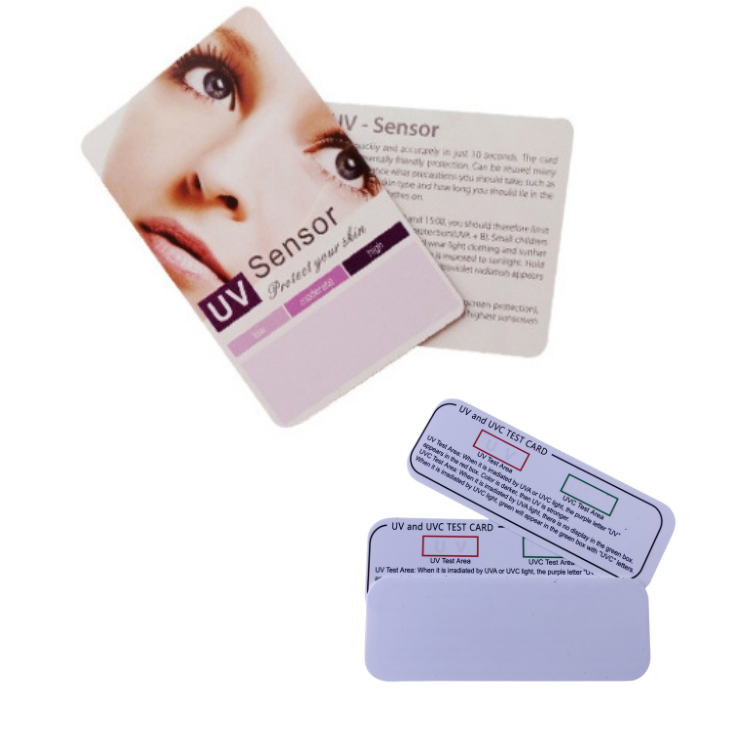
A UV test card can visually indicate whether UV exposure is reduced behind a window tint. However, it does not provide a precise percentage of UV rejection. For numerical data, use a properly specified and calibrated digital UV intensity meter or laboratory spectral testing.
Not in every situation. A digital meter is better for numerical readings and records. A UV test card is better for fast visual demonstrations and customer education. Many tint businesses benefit from using both.
No. Visible darkness and UV performance are different properties. Visible light transmission describes how much visible light passes through, while UV reduction depends on the materials and construction of the glass-and-film system.
The answer depends on the application and product claim. Because common window glass generally blocks most UVB while allowing more UVA transmission, UVA performance is often especially relevant for window-film demonstrations. The meter's specified spectral range must match the test objective.
Yes. Direct sunlight is commonly used for visual demonstrations, but results can change with time of day, cloud cover, angle, and location. Keep the reference and tinted tests as consistent as possible.
Follow the meter manufacturer's recommended calibration interval and your organization's quality requirements. Calibration should be traceable when readings are used for formal comparisons, quality control, or technical claims.
Yes. Custom UV test cards can be designed with logos, instructions, product messaging, packaging, color response areas, and private-label artwork. This makes them valuable for dealers, window-film brands, promotional campaigns, and OEM programs.
1. U.S. Environmental Protection Agency. "UV Index Scale." [https://www.epa.gov/sunsafety/uv-index-scale-0]
2. Duarte, I., Rotter, A., Malvestiti, A., and Silva, M. V. "The Role of Glass as a Barrier Against the Transmission of Ultraviolet Radiation: An Experimental Study." *Photodermatology, Photoimmunology & Photomedicine*. [https://pubmed.ncbi.nlm.nih.gov/19614895/]
3. Health Physics Society. "Does Solar UV Penetrate Window Glass?" [https://hps.org/publicinformation/ate/q12082/]
4. American Cancer Society. "How to Protect Your Skin from UV Rays." [https://www.cancer.org/cancer/risk-prevention/sun-and-uv/uv-protection.html]
5. National Fenestration Rating Council Consumer Guide. "Window Film." [https://efficientwindows.org/window-film/]
6. American Society for Health Care Engineering. "Install Low-Emissivity Window Films." [https://www.ashe.org/system/files/media/file/2023/08/low_e_window_film.pdf]
7. Linshang Technology. "UV Light Intensity Measurement Products." [https://www.linshangtech.com/productlist3/]
8. Sisco. "How to Calibrate a UV Meter." [https://www.sisco.com/how-to-calibrate-uv-meter]


