+86 18560646018

Views: 219 Author: Focus Color Publish Time: 2026-10-23 Origin: Site


Content Menu
● When Were Scratch and Sniff Stickers Invented? A Historical Timeline
● Who Invented Scratch-and-Sniff Technology?
>> How Carbonless Paper Led to Scented Printing
>> Why "Invented" and "Introduced" Mean Different Things
● How Do Scratch-and-Sniff Stickers Work?
>> The Main Parts of a Scented Sticker
>> Why Scratching Releases More Fragrance
● Why Did Scratch-and-Sniff Stickers Become Popular?
>> Classroom Rewards Created a Clear Use Case
>> Collecting Extended the Experience
● Scratch-and-Sniff Stickers vs. Other Scented Products
● A Manufacturer's Perspective: Three Details That Matter More Than Scent Strength
>> 1. Match the Fragrance to the Message
>> 2. Evaluate the Finished Printed Construction
>> 3. Establish Storage Expectations Before Production
● How to Develop Custom Scratch-and-Sniff Stickers
>> Step 1: Define the Application
>> Step 2: Specify the User Interaction
>> Step 3: Set Material and Adhesive Requirements
>> Step 4: Approve Representative Samples
>> Step 5: Review Safety and Market Requirements
● Turn a Familiar Idea into a Purpose-Built Scented Product
>> Were scratch and sniff stickers invented in 1965 or 1977?
>> Who invented scratch-and-sniff stickers?
>> What makes scratch-and-sniff stickers smell?
>> How long do scratch-and-sniff stickers last?
>> Can a scratch-and-sniff sticker be used repeatedly?
>> Can manufacturers create custom scratch-and-sniff stickers?
When were scratch and sniff stickers invented? The answer involves two milestones: scratch-and-sniff technology debuted in 1965, while Creative Teaching Press introduced its Scratch 'n Sniff reward stickers in 1977. The first date concerns the scented-printing technology; the second marks a documented commercial introduction of the classroom stickers that became widely collected.
That distinction matters. The invention of a fragrance-release process, its application to adhesive stickers, and its rise as a cultural favorite did not happen simultaneously.
From our manufacturing perspective at Qingdao Focus On Color Industry & Trade Co., Ltd., this history illustrates an important principle: an interactive product succeeds when its material technology matches a clear user experience.
Below, we explore where scratch-and-sniff stickers came from, how they work, and what their development teaches today's buyers of custom scented products.

The history of scratch-and-sniff stickers begins with an unexpected application: carbonless copy paper.
Researchers were developing ways to hold small quantities of liquid inside microscopic capsules. Pressure could rupture those capsules and release their contents. Although the original application concerned copying documents, the same principle could release fragrance.
| Period | Development | Why it matters |
|---|---|---|
| Early 1960s | Gale Matson at 3M worked on microencapsulation for carbonless copying. | This work helped establish the technical foundation for scented printing. |
| 1965 | Scratch 'N Sniff technology debuted, according to the manufacturing history published by Encyclopedia.com. | This is the commonly cited starting point for the fragrance-release technology. |
| 1970s | Scented printing appeared in products including books and stickers. | The technology moved into consumer experiences. |
| 1977 | Creative Teaching Press introduced Scratch 'n Sniff reward stickers. | The company documents this milestone in its own history. |
| Late 1970s–1980s | Scented stickers became associated with classroom rewards and collecting. | The format developed a recognizable cultural identity. |
The most accurate short answer is therefore: scratch-and-sniff technology dates to 1965, with a documented milestone for commercial reward stickers in 1977.
Neither date alone tells the complete story.
Gale Matson, an organic chemist working at 3M, is widely credited with developing the microencapsulation process behind the company's scratch-and-sniff technology.
However, saying that one person invented every aspect of scented stickers would oversimplify the history.
Microencapsulation also developed through work at other organizations, including the National Cash Register Company. Turning encapsulated fragrance into a successful sticker additionally required printing, coatings, adhesive materials, artwork, and commercial distribution.
Carbonless copying and scratch-and-sniff printing share a useful concept: keep a substance enclosed until mechanical force releases it.
In copying applications, pressure releases materials involved in producing a visible mark. In scented printing, friction breaks fragrance-containing capsules.
The important innovation was recognizing that the enclosed liquid did not have to serve a copying function. It could carry an aroma.
This changed paper from a purely visual surface into an interactive material.
Historical accounts sometimes mix up:
- The development of an underlying process.
- A patent application or grant.
- The first commercial launch of a product.
- The period when consumers made that product popular.
These events can occur years apart.
Creative Teaching Press provides clear evidence for its 1977 reward-sticker launch. That does not establish that the company invented microencapsulation or that no scented adhesive product existed earlier.
For accurate product storytelling, a documented milestone is more useful than an unsupported claim of being first.
Scratch-and-sniff stickers use microencapsulation: fragrance is enclosed inside microscopic shells incorporated into a printable coating.
When someone rubs or scratches the coated area, some capsules rupture and release their contents. Volatile fragrance components then enter the surrounding air.
A typical construction includes several functional elements:
1. A face material, such as paper or a suitable film.
2. Printed artwork that communicates the theme or product.
3. A coating containing fragrance microcapsules.
4. An adhesive for attachment.
5. A release liner that protects the adhesive before use.
The exact construction varies by application and printing process.
From a manufacturing standpoint, fragrance is only one part of the system. The coating must also work with the substrate, artwork, converting process, and intended handling.
The fragrance is already present before activation. Scratching does not create it through a new chemical reaction.
Instead, friction opens capsules that previously helped contain it.
A useful way to picture the surface is as a collection of tiny fragrance reservoirs. One scratch activates part of that collection rather than necessarily emptying the entire coating.
This explains why a sticker may release scent more than once—but not indefinitely.
Scratch-and-sniff stickers combined a familiar object with a surprising action.
A printed strawberry could smell like strawberry. A reward sticker offered something to touch and discover, rather than simply something to look at.
Creative Teaching Press describes its 1977 introduction as a significant company milestone, attracting teachers, parents, and students who bought and collected the stickers.
The sticker format suited classroom reward systems because it was compact, distributable, and easy to attach to schoolwork.
The scented feature added an extra interaction.
That commercial success should not be confused with proof that scented stickers universally improve learning outcomes. Their documented role as reward products is clearer than any broad educational claim.
Different pictures and fragrances gave users reasons to compare, exchange, and collect stickers.
The historical lesson is relevant to modern product development: a technically interesting feature becomes more compelling when people immediately understand what to do with it.
A simple instruction—scratch here—can be more effective than a complicated explanation.
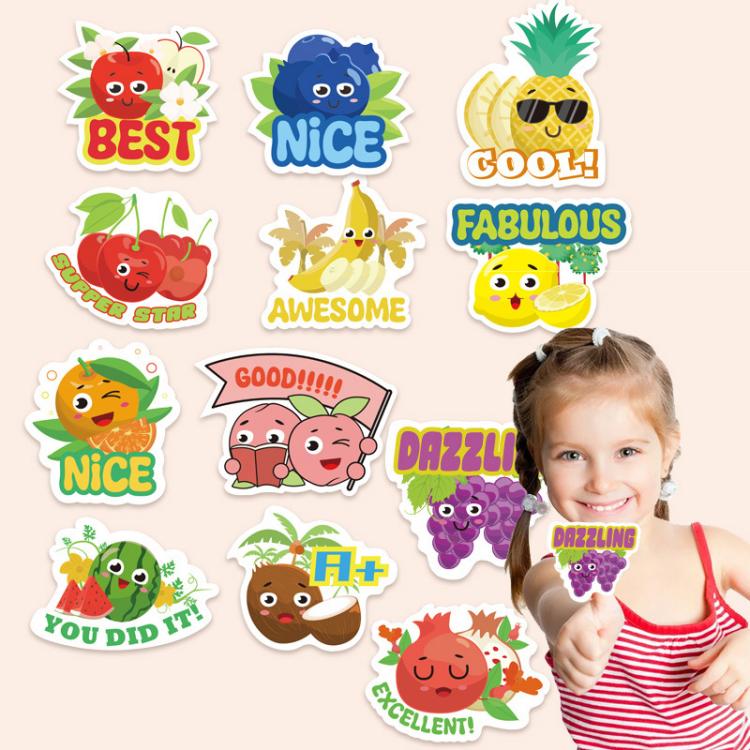
Not every scented sticker uses the same release mechanism.
The difference matters when choosing a product for packaging, promotion, or fragrance sampling.
| Product format | Main interaction | Important buying consideration |
|---|---|---|
| Scratch-and-sniff sticker | Rub or scratch a coated area | Activation strength and repeat-release performance |
| Openly scented material | Smell fragrance without deliberate activation | Unwanted scent transfer and pre-use fragrance loss |
| Peel-open fragrance sample | Open a sealed or folded structure | Seal integrity and resemblance to the intended fragrance |
| Scented hanging product | Allow fragrance to enter the surrounding air | Release profile and intended environment |
These formats should not be treated as interchangeable.
For example, a label intended to reveal a scent only when touched needs a different user experience from a product designed to fragrance an enclosed space.
Start with the desired interaction, then select the construction.
A strong first impression is useful, but it is not a complete quality specification.
For custom scented products, we recommend evaluating the full experience rather than approving a sample solely because it smells powerful.
The scent should support the artwork and intended application.
For a novelty fruit sticker, immediate recognition may be the priority. For a fragrance sample, resemblance to a reference fragrance may matter more.
Those are different development goals.
A practical approval brief should identify:
- The reference scent or intended fragrance direction.
- Whether accuracy or a recognizable impression takes priority.
- The intended user and setting.
- The acceptable intensity after activation.
- Any unwanted background odor.
This makes feedback more specific than "please make it stronger."
A fragrance approved on its own is not the same as an approved finished sticker.
Assess the actual combination of fragrance, coating, substrate, printing, adhesive, and packaging.
Recommended checks include:
- Appearance before and after activation.
- Scent before scratching.
- Fragrance character after a consistent rubbing action.
- Coating damage or visible residue.
- Adhesive performance on the intended surface.
- Unwanted odor transfer between differently scented items.
These are proposed development checks, not claims that every product requires an identical test method.
There is no universal shelf-life figure for all scratch-and-sniff stickers.
Capsule construction, formulation, handling, packaging, and storage conditions can influence performance.
Rather than relying on an unsupported promise of "years of fragrance," agree on:
1. The intended shelf life.
2. The storage conditions associated with that claim.
3. The packaging configuration.
4. The assessment method.
5. The minimum acceptable performance at the end of storage.
This turns a vague marketing statement into a requirement that can be evaluated.
A structured brief helps buyers compare proposals and reduces avoidable revisions.
Explain whether the product is intended for educational rewards, promotional giveaways, retail packaging, or another purpose.
Also identify the destination market and expected users.
Decide where users should scratch, how that area will be identified, and whether repeated activation is important.
Avoid leaving the functional area unclear within decorative artwork.
Provide the sticker dimensions, application surface, intended removability, packaging format, and relevant environmental conditions.
A sticker that performs well on one surface may not meet the requirements of another.
Approve samples that reflect the intended finished construction.
Record the approved artwork, fragrance reference, material specification, packaging, and assessment criteria. A retained reference sample can make later discussions more objective.
Request documentation appropriate to the formulation, intended use, and destination market.
An IFRA Certificate of Conformity concerns a fragrance mixture's conformity for a specified use. It does not replace a finished-product safety assessment.
Do not assume that a pleasant smell establishes suitability for children, direct food contact, or every consumer application.
The history of scratch-and-sniff stickers shows how a materials innovation became successful through a simple, memorable interaction.
At Qingdao Focus On Color Industry & Trade Co., Ltd., our 13-plus years of manufacturing experience span photochromic, thermochromic, liquid crystal thermometer, and fragrance product series. We offer OEM, ODM, and personalized customization services.
Send our team your intended application, target market, artwork, dimensions, fragrance direction, and estimated order quantity. We can discuss the project's feasibility and the sampling requirements for a suitable custom solution.
Both dates refer to important but different milestones. Scratch-and-sniff technology debuted in 1965, while Creative Teaching Press documents introducing its Scratch 'n Sniff reward stickers in 1977.
Gale Matson at 3M is associated with the underlying microencapsulation technology. Creative Teaching Press introduced a documented line of classroom reward stickers in 1977. The technology's development and the sticker product's commercialization should be distinguished.
They contain fragrance enclosed in microscopic capsules. Scratching ruptures some capsules, allowing fragrance components to escape into the air.
There is no single reliable duration for every formulation. Buyers should request shelf-life evidence relevant to the finished construction, packaging, and stated storage conditions.
It may release fragrance across several activations because each scratch can break additional capsules. Eventually, the available fragrance decreases as capsules are depleted or the coating becomes worn.
Custom development can involve artwork, dimensions, fragrance direction, substrates, adhesives, and packaging. Feasibility should be confirmed through sampling rather than assumed from a design concept alone.
1. Encyclopedia.com. "Scratch and Sniff." Manufacturing overview covering microencapsulation, Gale Matson's work, the 1965 debut, and production principles. [Read the source]. [encyclopedia]
2. Creative Teaching Press. "About Us." Company history documenting its 1977 introduction of Scratch 'n Sniff reward stickers. [Read the source]. [creativeteaching]
3. Mental Floss. "Scratch and Sniff: The Fad That Was Destined to Fade." June 5, 2023. Historical account of the technology's origins and consumer applications. [Read the source]. [mentalfloss]
4. University of Delaware, Anomalous Books. "Scratch-and-Sniff Books." Historical discussion of scented publications and the microencapsulation process. [Read the source]. [sites.udel]
5. International Fragrance Association. "Using the IFRA Standards." Guidance on fragrance conformity documentation and its limitations. [Read the source]. [ifrafragrance]
6. Print-A-Scent. Manufacturer information on microencapsulation, custom fragrance oils, and scented printing. [Read the source]. [print-a-scent]


