+86 18560646018

Views: 237 Author: Focus Color Publish Time: 2026-10-21 Origin: Site


Content Menu
● Why Source Photochromic Products from China?
>> What the Latest Market Evidence Actually Shows
● Selection Criteria: How This Shortlist Was Built
● Comparison Table: Product Focus, Capacity, MOQ, and Certification Evidence
● The Top 10 Photochromic Manufacturers and Specialist Suppliers in China
>> 1. Qingdao Focus On Color Industry & Trade Co., Ltd.
>> 4. Dongguan Qiansebian New Material Co., Ltd.
>> 5. iSuoChem
>> 6. Hali Industrial / Hali Pigment
>> 7. Smarol Industry Co., Ltd.
>> 8. Qingdao Topwell Chemical Materials Co., Ltd.
>> 9. New Color Chemical Co., Limited
>> 10. Shenzhen Crystal-Star Tech Co., Ltd.
● Buyer's Guide: How to Qualify a Photochromic Supplier
>> Start by Defining the Product You Actually Need
>> Specify Performance Instead of Buying an Undefined "Grade"
>> Use a Three-Stage Sampling Process
>> Verify Compliance by End Use
>> Confirm Logistics Before Approving the Order
● Common Purchasing Traps—and How to Avoid Them
>> Comparing Price per Kilogram Instead of Cost per Approved Product
>> Accepting a Strong UV-Lamp Demonstration as Outdoor-Life Evidence
>> Allowing Unapproved Material Substitution
● An Overlooked Insider Check: Test Through the Final Product Stack
● Conclusion: Choose the Supplier That Fits Your Manufacturing Responsibility
>> 1. How Can I Check Whether a Supplier's ISO Certificate Is Expired or Suspended?
>> 2. Can an Approved Pigment Fail After Printing or Molding?
>> 3. How Should We Compare Suppliers That Test Color Change at Different Temperatures?
>> 4. Can One Compliance Report Cover Every Color and Custom Design?
>> 5. How Can We Prevent Quality Drift After the First Successful Order?
China offers a broad sourcing base for photochromic pigments, dyes, inks, labels, and finished optical components. However, choosing a dependable supplier requires more than comparing color-change videos or requesting the lowest quotation.
For professional buyers, the strongest evaluation starts with five questions: Does the supplier control the relevant manufacturing process? Can its technical team match the material to your application? Are quality checks measurable? Does compliance documentation cover the exact product? Can production remain consistent after the first approved sample?
This guide reviews ten China-based businesses across the photochromic supply chain, starting with Qingdao Focus On Color Industry & Trade Co., Ltd. for customized functional printing and finished products. It also distinguishes pigment suppliers from specialist converters and lens manufacturers—businesses that serve different purchasing needs.

China's practical advantage lies in the connections between specialty colorants, printing, plastics processing, packaging, and optical manufacturing. Buyers can source an active material, develop an application-specific formulation, or purchase a finished private-label product within the same national supply network.
The companies reviewed here illustrate several regional concentrations:
- Guangdong: Shenzhen and Dongguan suppliers working with functional pigments, polymer applications, and optical components.
- Jiangsu, Zhejiang, and Anhui: Effect-pigment and specialty-material businesses serving coatings, printing, and plastics.
- Shandong: Functional printing, customized labels, cards, and specialty-material sourcing.
- Fujian: Specialty pigments and related export-oriented supply businesses.
These locations provide useful starting points for sourcing visits, although geography alone does not prove manufacturing capability.
MarketsandMarkets' April 2025 report estimates that the global chromic materials market will grow from USD 4.64 billion in 2025 to USD 6.37 billion by 2030, representing a 6.5% compound annual growth rate. It forecasts Asia-Pacific as the fastest-growing region, at 7.1%. Importantly, these figures cover several technologies—including photochromism, thermochromism, and electrochromism—not photochromic pigments alone.
Official Chinese statistics provide broader export context: China's goods exports reached RMB 26.99 trillion in 2025, increasing 6.1% year on year. This demonstrates the scale of the country's export infrastructure, but it must not be presented as photochromic industry sales or exports.
For buyers, the useful conclusion is narrower than a headline market forecast: China offers multiple sourcing routes, but each supplier still needs application-specific qualification.
The review considers public product portfolios, company histories, technical positioning, customization scope, and the transparency of purchasing information. No factory inspections or comparative laboratory tests were conducted for this article.
The following framework is recommended for buyers evaluating these suppliers.
| Evaluation area | Evidence to request | Why it matters |
|---|---|---|
| Manufacturing identity | Business license, factory address, process map, subcontractor disclosure | Distinguishes production ownership from distribution |
| Technical development | Application trials, formulation guidance, technical data sheets | Tests whether support extends beyond selling powder |
| Quality control | Incoming inspection, batch records, retained samples, release criteria | Helps control repeat-order variation |
| Production planning | Product-specific output, utilization, maintenance and contingency plans | Establishes realistic delivery capability |
| Compliance | Relevant certificates, test reports, declarations and safety documentation | Connects claims to the actual product and market |
| Customization | Artwork control, substrate selection, packaging development, pilot procedures | Clarifies OEM/ODM responsibilities |
| Commercial communication | Written technical responses, revision tracking, escalation contacts | Reduces misunderstandings during development |
A company's overall pigment capacity is not automatically its photochromic capacity. Likewise, a low sample MOQ does not establish the minimum quantity for a custom formulation or printed product.
"Not verified" means that current, product-specific evidence was not established from the public sources reviewed. It does not mean that a supplier lacks the capability or documentation.
| Company | Main sourcing focus | Public capacity evidence | MOQ evidence | Certification position |
|---|---|---|---|---|
| Qingdao Focus On Color | Customized photochromic labels, cards, and functional printing | Photochromic-specific output not disclosed | Custom-project quotation required | Request current factory and product-specific documents |
| Kolortek | Photochromic and other effect pigments | About page reports an 18,000 m² workshop; no verified photochromic tonnage | Grade-specific confirmation required | Website states ISO 9001; current certificate verification required |
| KingChroma | Photosensitive and other functional pigments | Photochromic-specific output not verified | Grade-specific confirmation required | Website states ISO 9001 certification; verify entity, scope, and status |
| Dongguan Qiansebian | Photochromic materials for inks, coatings, and plastics | Photochromic-specific output not verified | Formulation and quantity confirmation required | Current certificate and application-test package required |
| iSuoChem | Effect pigments and application-oriented raw-material sourcing | Broader capacity claims exist; dedicated photochromic output not verified | Website lists 1 kg for certain high-value pigments, including photochromic powders | Request documents for the quoted entity and grade |
| Hali | Specialty pigments for coatings, inks, and plastics | Photochromic-specific output not verified | Grade-specific confirmation required | Current certification and test scope require verification |
| Smarol Industry | Sunlight-reactive and other color-changing materials | Photochromic-specific output not verified | Application-specific quotation required | Current documentation requires verification |
| Qingdao Topwell | Photochromic dyes and specialty chemical sourcing | Manufacturing ownership and dedicated capacity require clarification | Chemistry-specific quotation required | Request batch, safety, and relevant compliance documentation |
| New Color Chemical | Photochromic and other specialty pigments | Photochromic-specific output not verified | Grade-specific confirmation required | Current documentation requires verification |
| Shenzhen Crystal-Star | TAC photochromic polarized lenses | Photochromic lens output not verified | Lens specification and quantity confirmation required | Request finished-lens reports appropriate to intended use |
The disclosed workshop, certification, and MOQ statements above come from supplier pages and should be verified before purchase. Public portfolios establish the remaining companies' relevant product categories, but do not establish comparable production capacity.
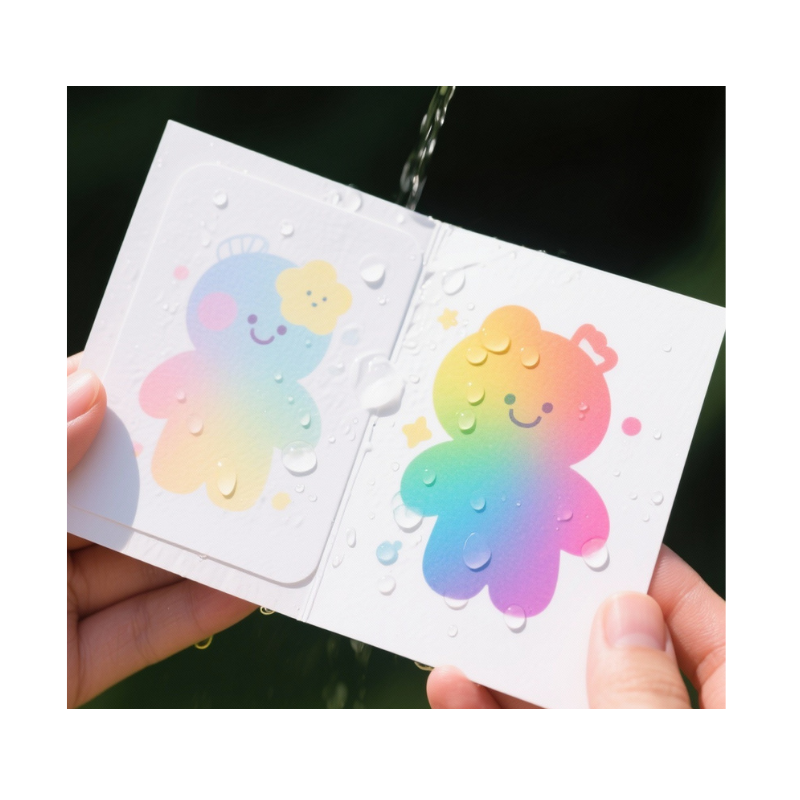
Suitable for: Small and medium-sized brands seeking customized photochromic labels, promotional cards, UV-reactive stickers, and related functional printed products.
Qingdao Focus On Color reports more than 13 years of manufacturing experience across photochromic, thermochromic, liquid-crystal thermometer, and fragrance-related products. Its website identifies an owned factory, OEM/ODM services, personalized customization, and a product range that includes color-changing stickers and UV stickers. An exact legal incorporation year was not established from the reviewed material.
Its sourcing proposition is finished-product development rather than simply supplying a bag of pigment. This is relevant to buyers that need the photochromic effect combined with artwork, dimensions, substrate selection, adhesive requirements, and retail presentation.
The company positions itself around competitive pricing, responsive communication, and product development support. For an emerging brand, those priorities can make it a practical candidate for cost-conscious OEM projects. However, response speed and development flexibility should be tested during the quotation and sampling stages rather than assumed from positioning alone.
- Markets disclosed: Japan, Germany, the United Kingdom, Russia, France, and Australia.
- OEM/ODM scope: Customized functional printing, stickers, cards, and related creative products.
- Core advantage: Combining several functional-product categories with finished-product customization.
- Qualification priority: Request a production-intent sample, written performance criteria, confirmed MOQ, and the documents applicable to the intended end use.
For brands without an internal ink-formulation team, this converter-led approach may offer a more manageable development route than buying raw photochromic materials separately.

Suitable for: Established formulators and manufacturers purchasing photochromic pigments alongside other effect pigments.
Kolortek's company profile states that it was established in 2002 in Huaian, Jiangsu. Its portfolio includes pearlescent, holographic, thermochromic, and photochromic pigments, as well as cosmetic color additives and fillers. Its about page reports an 18,000 m² workshop, more than 150 workers, and ISO 9001 certification. These are company-reported figures, not independently audited findings for this guide.
Its main advantage is portfolio breadth. A coatings, plastics, or printing business purchasing several specialty effects may find value in qualifying one supplier across multiple material categories.
- Markets: International customers; a current geographical sales breakdown was not verified.
- OEM/ODM discussion scope: Application-specific pigment selection, color requirements, supply packaging, and formulation support; confirm which custom services are available.
- Qualification priority: Obtain the exact photochromic grade specification, current certificate, particle-size information, and production-lot consistency data.
Kolortek's stated overall scale should not be interpreted as dedicated photochromic output.
Suitable for: Buyers developing photochromic effects for coatings, plastics, and other functional-color applications.
KingChroma states that its brand was founded in 2006 and is headquartered in Shenzhen. Its published history describes work on thermochromic and photochromic materials, including cooperation with university research institutes and efforts to improve powder–ink compatibility.
This application-oriented positioning is relevant where the buyer already manufactures the finished article but needs help selecting a compatible color-changing material.
- Markets: The reviewed pages did not establish a country-level sales breakdown.
- OEM/ODM discussion scope: Pigment selection, color effects, and application compatibility; confirm custom-development ownership and deliverables.
- Core advantage: A functional-material portfolio extending beyond a single photochromic product.
- Qualification priority: Validate the exact grade under your real processing temperature, dwell time, binder, and curing conditions.
KingChroma publishes response-time and heat-resistance claims for particular products. Buyers should treat those as grade-specific statements, not universal performance limits for every photosensitive formulation.
Suitable for: Manufacturers integrating photochromic materials into printed, coated, or molded products.
Qiansebian's company page states that it was established in 2006. Its photochromic material literature describes uses in coatings, printing inks, injection molding, and extrusion, with applications across plastics, textiles, paper, synthetic films, glass, and other substrates.
Its relevance lies in the connection between material supply and downstream processing. A supplier serving several application routes can be worth evaluating when a project involves more than one substrate or manufacturing method.
- Markets: A reliable geographical sales split was not established.
- OEM/ODM discussion scope: Application-specific material selection and integration into ink, coating, or polymer systems.
- Core advantage: Broadly described compatibility across printing and plastics applications.
- Qualification priority: Request evidence for the exact resin, solvent system, processing conditions, and desired activated shade.
A statement that a pigment is "suitable for plastics" is insufficient for a specific molding project. The purchase specification should identify the polymer and processing window.
Suitable for: Coatings and printing businesses seeking photochromic pigments within a broader raw-material sourcing relationship.
iSuoChem traces its business beginnings to 2007. Its development history distinguishes those beginnings from later business expansion, which is useful because brand history, parent-company history, and legal-entity incorporation dates are not necessarily identical.
The company supplies effect pigments for coatings, printing inks, and plastics. Its website describes international customers and European support, while its public profile combines manufacturing, export supply, and broader sourcing activities.
- Markets: Global markets, including a stated European support presence.
- OEM/ODM discussion scope: Application-oriented pigment supply and OEM-manufactured specialty raw materials; establish which operations apply to the quoted photochromic grade.
- Core advantage: Combining specialty pigments with broader coatings and ink raw-material knowledge.
- MOQ evidence: Its website lists 1 kg for certain high-value pigments, including photochromic powders; custom grades may differ.
Ask which plant produces the selected material and whether the order concerns stock pigment, a custom formulation, or externally sourced chemistry.
Suitable for: Industrial buyers sourcing photochromic pigments for coatings, inks, plastics, and decorative applications.
Hali's public profiles state a founding year of 2004 and describe research, production, and marketing of several specialty pigments, including photochromic materials. Reported export destinations include Europe, America, Southeast Asia, the Middle East, and Russia.
Hali materials also appear in a peer-reviewed study examining photochromic UV-indicating devices and substances. That establishes research use of particular materials, but it does not independently validate every commercial grade or performance claim.
- OEM/ODM discussion scope: Industrial pigment selection and supply for application-specific formulations.
- Core advantage: An established specialty-pigment portfolio and publicly described export activity.
- Qualification priority: Reconcile the exact legal name across the quotation, invoice, business license, certificate, and test reports.
"Hali" appears under several business names in public sources. Buyers should verify the contracting entity rather than assume that similarly named profiles represent identical manufacturing operations.
Suitable for: Buyers evaluating sunlight-reactive materials alongside other color-changing technologies.
Smarol's website lists sunlight-reactive color-changing materials and identifies a Hangzhou address. A trade-directory profile for a similarly named Smarol business reports establishment in 2005, but the precise legal-entity relationship should be confirmed before using that date in a supplier qualification file.
Smarol also appears in the competitive landscape of the 2025 chromic materials report, supporting its relevance to this sourcing category.
- Markets: China-based supply with international trade listings; a geographical sales breakdown was not verified.
- OEM/ODM discussion scope: Sunlight-reactive material selection and application development; confirm whether the offer covers powder, formulated material, or finished products.
- Core advantage: Focus on stimulus-responsive color materials.
- Qualification priority: Request up-to-date technical sheets, sample identification, formulation responsibilities, and repeat-order acceptance criteria.
Do not use specifications for a supplier's thermochromic material as substitutes for photochromic specifications.
Suitable for: Buyers investigating photochromic dyes for optical, film, and specialty chemical applications.
Topwell states that it was established in 2014 and describes itself as a professional supplier engaged in research, sales, and customization of specialty pigments and dyes. Its portfolio includes photochromic materials for optical lenses, window films, and automotive films.
The distinction between supplier and factory owner is important here. Topwell's public positioning supports inclusion as a specialist sourcing candidate, but buyers should clarify which chemistry is produced internally and which is sourced through manufacturing partners.
- Markets: International supply is advertised; a dependable country-level breakdown was not established.
- OEM/ODM discussion scope: Customized dyes and pigments for specialty optical and film applications.
- Core advantage: A portfolio spanning UV, visible-light, and near-infrared-related materials.
- Qualification priority: Confirm chemical identity where disclosable, purity requirements, solubility, binder compatibility, and the manufacturing location.
For transparent applications, haze, residual tint, and optical consistency may matter as much as the intensity of the activated color.
Suitable for: Formulators comparing photochromic powders within a broader specialty-pigment portfolio.
New Color Chemical's public company profile lists Xiamen, Fujian, and a founding year of 2011. Its listed specialties include photochromic and thermochromic pigments. A product marketplace also lists an identified photochromic pigment grade, GGFY-02.
The existence of named grades is useful for sample control: buyers can reference a defined product rather than an unspecified "UV powder."
- Markets: Export-oriented supplier listings are available; a current geographical sales distribution was not verified.
- OEM/ODM discussion scope: Grade selection, formulation compatibility, and supply packaging; confirm the availability of bespoke chemistry.
- Core advantage: A specialty-pigment portfolio that allows comparison across functional effects.
- Qualification priority: Establish continuity between the sample grade, technical data sheet, compliance report, and bulk shipment.
Marketplace descriptions are starting points for qualification, not substitutes for a signed specification.
Suitable for: Buyers sourcing finished or semi-finished photochromic polarized lenses rather than pigment powders.
Crystal-Star's public supplier profile states that it was established in 2004 and lists TAC photochromic polarized lenses among its products. Its broader range includes polarized sunglasses lenses, dyed lenses, oleophobic treatments, and mirrored lens products.
This is a different purchasing category from the pigment suppliers above. It belongs on the shortlist because searches for photochromic manufacturers frequently include optical-component sourcing, but its output should not be compared directly with pigment production.
- Markets: A verified country-level sales breakdown was not established.
- OEM/ODM discussion scope: Lens specifications, tint, coating combinations, geometry, and branded supply arrangements; confirm available customization.
- Core advantage: Integration of photochromic functionality with polarized lens products.
- Qualification priority: Request finished-lens optical and durability reports relevant to the intended product category.
A successful color-change demonstration alone does not qualify a lens for its intended optical or protective use.
Photochromic dyes, encapsulated pigments, formulated inks, printed labels, and finished lenses are not interchangeable purchasing categories.
Encapsulated photochromic pigments disperse within a compatible system, while dyes are selected for systems in which they can dissolve appropriately. QCR's technical guidance distinguishes these material formats and emphasizes matching them to the finished product and manufacturing process.
Your inquiry should therefore identify:
1. Finished application and substrate.
2. Raw material, formulated ink, or finished-product requirement.
3. Indoor appearance and activated color.
4. Intended exposure conditions.
5. Manufacturing and curing process.
6. Destination market and end-user category.
7. Annual forecast and initial production quantity.
Terms such as "premium," "industrial," or "export quality" do not create a measurable acceptance standard.
A practical qualification specification should include:
| Parameter | What to define |
|---|---|
| Activation conditions | Light source, wavelength range, irradiance, and exposure duration |
| Test temperature | Sample temperature during activation and recovery |
| Color response | Instrumental color difference or an agreed reference method |
| Recovery | Time to a defined percentage of the original appearance |
| Appearance | Residual tint, background color, haze, or transparency as relevant |
| Durability | Exposure method, cycle conditions, and minimum retained response |
| Processing compatibility | Binder, solvent, curing conditions, and relevant thermal history |
| Traceability | Grade code, lot number, production date, and retained sample |
A supplier should agree to the method before samples are compared. Otherwise, two apparently different results may simply reflect different test conditions.
A recommended procurement sequence is:
1. Material screening: Compare candidate grades under controlled conditions.
2. Production-intent prototype: Use the actual substrate, adhesive, coating, printing, and finishing route.
3. Pilot production: Confirm that routine manufacturing reproduces the approved effect.
Retain an approved reference from the final stage and link it to a written specification. A hand-prepared laboratory sample should not become the only acceptance reference for mass production.
CE marking is not a universal environmental or quality certificate. It applies only where specific European legislation requires it; products outside those requirements must not carry it. A general photochromic pigment should therefore not be purchased on the strength of a generic "CE certificate."
RoHS concerns restricted substances in electrical and electronic equipment. A RoHS test may be useful for a customer's material-control program, but it does not establish compliance for every non-electronic photochromic product. REACH has a different, broader chemical-regulatory scope.
The documentation package should follow the intended application. Toys, skin-contact labels, optical products, packaging, and industrial coatings do not share one universal approval route.
Include packaging, storage, and transport questions in supplier qualification:
- What storage conditions and shelf life apply to the exact grade?
- Is the quoted material classified as dangerous goods?
- Does an ink contain solvents that affect shipping arrangements?
- What packaging protects the material or printed effect during transit?
- Which customs classification applies to the actual product form?
- Who is responsible for import clearance, duties, and local documentation?
Use product-specific safety documentation and a customs broker's classification advice. Do not assume that a pigment powder, solvent-based ink, printed sticker, and lens share the same transport or tariff treatment.
A cheaper powder may require a different loading level or process adjustment to achieve the intended effect. Evaluate cost at the finished-product level, using a common substrate and acceptance test.
For printed products, include rejected units, setup costs, coating requirements, and inspection costs in the comparison.
A rapid response under a concentrated lamp shows activation under those conditions. It does not establish long-term outdoor durability.
The 2025 chromic materials report identifies limited durability under prolonged environmental exposure as a market constraint. Require an agreed weathering method and a retained-performance threshold rather than an unsupported "long-lasting" statement.
Specify that changes to the active material, binder, substrate, adhesive, or protective layer require written approval and requalification.
This helps prevent a production batch from retaining the same appearance while changing the functional performance that the original sample established.
One easily missed qualification issue is stack-up: the complete combination of substrate, photochromic layer, adhesive, varnish, laminate, and any protective covering.
Photochromic materials respond to particular light conditions. A material that activates convincingly before finishing may behave differently when the activating light must pass through additional layers. Material suppliers' guidance emphasizes selecting a suitable format for the finished system, while published research shows that photochromic responses depend on exposure conditions and can saturate at relatively low UV levels.
The practical safeguard is straightforward: test the fully assembled product, not only the uncoated pigment drawdown.
For example, if a sticker will sit behind a transparent window or protective film, include that window or film in the approval test. Also freeze the approved laminate and coating specifications in the bill of materials.
A related warning concerns UV-indicator claims. In one peer-reviewed study, the tested devices and substances saturated at relatively low UV levels, limiting their ability to distinguish stronger exposure. A visible color change should not automatically be marketed as a calibrated UV-index measurement or a reliable sunscreen-reapplication signal.
The right photochromic partner depends on what your business needs to purchase.
Pigment and dye suppliers suit buyers with formulation and production capabilities. Functional-printing manufacturers suit brands that need finished labels, cards, or promotional products. Optical-component manufacturers require a separate lens-focused qualification process.
For small and medium-sized brands developing customized functional printed products, Qingdao Focus On Color Industry & Trade Co., Ltd. is a relevant starting point because of its reported manufacturing experience, OEM/ODM services, and range of photochromic and related products. Its suitability should ultimately be established through technical communication, production-intent samples, transparent quotations, and application-specific documentation.
Send your artwork, substrate requirements, intended light exposure, destination market, and forecast quantity with the initial inquiry. Ask for a documented sampling plan and a quotation tied to agreed performance—not simply a color name and unit price.
Request the complete certificate, including the legal entity, site address, certificate number, scope, issuing body, and validity dates.
Search the number or company name in IAF CertSearch and compare the result with the document. The platform can show active, suspended, withdrawn, or expired status, together with certification and accreditation information. If the record cannot be resolved, contact the issuing certification body directly rather than accepting a screenshot as proof.
Also check that the certified scope and site are relevant to the operation supplying your order. A valid management-system certificate is not a product-performance approval.
Yes. Approval of the raw material does not establish suitability for every downstream system.
Suppliers distinguish dyes, encapsulated pigments, slurries, and formulated inks because compatibility depends on the application. Require confirmation for the actual binder, solvent, thermal history, curing method, and finished construction.
Make a production-intent prototype part of qualification, and retain records of the processing conditions used to make it.
Do not compare their headline response times directly.
Use one agreed light source, irradiance, exposure period, sample temperature, material loading, substrate, and measurement method. Define recovery as a measurable endpoint rather than "looks clear."
Published testing of photochromic devices used controlled irradiation and instrumental CIE L*a*b* color measurements, illustrating why objective methods are more informative than photographs alone.
Do not assume that it can.
Check the report's sample description, tested materials, color references, model coverage, and applicable requirements. A change in ink, adhesive, substrate, or end use may change the assessment needed.
For CE-marked products, the manufacturer must identify the applicable legislation and maintain the required conformity documentation. The presence of a supplier report alone does not transfer that responsibility or establish coverage for every customized item.
Build change control into the supply agreement:
- Identify the approved grade and production construction.
- Set measurable release criteria.
- Require lot traceability and retained samples.
- Define when independent testing is required.
- Prohibit unapproved substitutions.
- Agree on corrective-action deadlines and remedies.
- Requalify after meaningful material or process changes.
For recurring programs, compare periodic production samples with the approved reference under the same test conditions. This turns "consistent quality" into a documented purchasing requirement.
- MarketsandMarkets, Chromic Materials Market, published April 2025: Market estimates, technology distinctions, regional forecasts, and supplier coverage. The figures concern the broader chromic materials market. [marketsandmarkets]
- Frontiers in Photobiology, "Qualitative and quantitative analysis of colorimetric response in different UV solar radiation level indicator bracelets based on photochromic substances," published August 2024: Controlled testing, saturation behavior, and limitations of UV-indicating devices. [frontiersin]
- QCR Solutions, Photochromic Dyes, Pigments & Inks: Material-format distinctions and application-selection guidance. [qcrsolutions]
- QCR Solutions, Photochromic Pigments Solvent Compatibility Chart: Technical background on encapsulated pigments and formulation formats. [qcrsolutions]
- State Council of the People's Republic of China, 2025 foreign-trade statistics: Official export figures published in January 2026. [english.www.gov]
- General Administration of Customs, Customs Statistics Query Platform: Official trade-data research portal; classifications must match the actual product. [stats.customs.gov]
- European Commission, CE Marking: Applicability and manufacturer responsibilities. [europa]
- European Commission, RoHS Directive and guidance: Restricted substances and the distinction between RoHS and REACH. [environment.ec.europa]
- IAF CertSearch: Accredited management-system certificate verification. [iafcertsearch]
- Qingdao Focus On Color: Company background, product categories, customization, and disclosed export destinations. [focolor]


