+86 18560646018

Views: 218 Author: Focus Color Publish Time: 2026-08-21 Origin: Site


Content Menu
● Why Zero Glass Risk Matters in Breeding Tanks
● Fish Tank Sticker vs. LCD Thermometer: Core Differences
● Fish Tank Sticker: Advantages for Daily Breeding-Tank Checks
>> Key Benefits of Fish Tank Sticker Thermometers
>> Limitations of Fish Tank Stickers
>> Best Applications for Fish Tank Stickers
● LCD Thermometer: Better for Numeric Temperature Control
>> Key Benefits of LCD Thermometers
>> Limitations of LCD Thermometers
● What Breeders Should Actually Compare
>> Practical Accuracy Hierarchy
● How to Get More Reliable Readings
>> How to Install a Fish Tank Sticker
>> How to Install an LCD Thermometer
● Expert Approach: Use Two Levels of Monitoring
>> Recommended Monitoring Strategy
● OEM and ODM Considerations for Aquarium Brands
>> Customization Options for Fish Tank Stickers
>> What Buyers Should Confirm Before Ordering
● Fish Tank Sticker vs. LCD Thermometer: Which Should You Choose?
● Request a Custom Aquarium Temperature Indicator
>> Is a fish tank sticker safe for breeding tanks?
>> Are fish tank sticker thermometers accurate?
>> Is an LCD thermometer better than a fish tank sticker?
>> Where should I place a fish tank sticker thermometer?
>> Where should an LCD thermometer probe be placed in a breeding tank?
>> Should breeders use more than one thermometer?
For breeding tanks where zero glass risk is a priority, both a fish tank sticker and an LCD thermometer can avoid the breakage hazards associated with traditional in-tank glass thermometers. However, they solve different problems: a liquid-crystal fish tank sticker offers a simple external visual check, while an LCD thermometer can provide a clearer and potentially more precise temperature reading when its sensor is correctly positioned.
For professional breeders, hatchery operators, aquarium brands, and pet-product distributors, temperature monitoring is not a minor accessory decision. It affects spawning conditions, egg development, fry survival, feeding response, disease pressure, and consistency across multiple tanks. The best choice depends on whether the priority is maximum simplicity, easy visual inspection, better reading resolution, or a scalable monitoring solution for a breeding operation.

A breeding tank is different from a decorative display aquarium. It often contains vulnerable eggs, newly hatched fry, shrimp larvae, small fish species, or isolated breeding pairs. In these conditions, every unnecessary in-tank object creates another potential cleaning, contamination, or safety concern.
Traditional glass thermometers can provide useful readings, but they also introduce a clear risk: glass can crack during maintenance, shipment, handling, water changes, or accidental contact with aquarium tools. Broken glass may create sharp fragments and require an immediate, stressful tank clean-out.
A fish tank sticker thermometer is attached to the outside of the aquarium wall. It keeps the temperature indicator completely outside the water. An LCD thermometer can also be designed with an external display and a separate probe, allowing the display unit to remain outside the aquarium.
For breeding-tank applications, zero-glass monitoring options offer several practical benefits:
- No breakable glass body inside the tank
- No mercury-style liquid concern
- Less disruption during water changes and cleaning
- Lower risk to fry, eggs, shrimp, and delicate aquatic animals
- Simpler packaging and lower breakage loss during transport
- More convenient temperature checks for multi-tank breeding rooms
For many buyers, the key question is not "Which thermometer is best overall?" It is: Which non-glass temperature indicator provides enough confidence for this breeding stage?
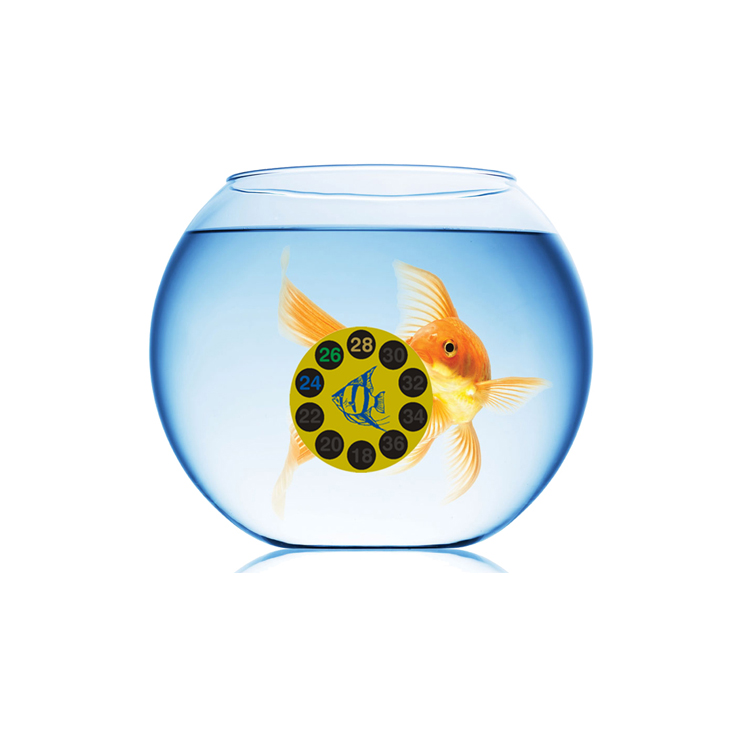
A fish tank sticker usually refers to a liquid-crystal temperature strip applied to the outside surface of aquarium glass or acrylic. The strip changes color according to temperature. Many products display a range of temperature values, with one segment becoming the most visible color at the approximate current temperature.
An LCD thermometer generally uses an electronic sensor and a digital screen. Depending on the product design, the sensor may be integrated into the unit, connected by a cable, or installed as a waterproof probe. In breeding tanks, the most practical version is often an external display with a water-contact probe.
| Feature | Fish Tank Sticker | LCD Thermometer |
|---|---|---|
| Main technology | Thermochromic liquid crystal | Electronic temperature sensor |
| Glass risk | Zero | Zero, if designed without glass |
| Water contact | Normally no water contact | Probe may contact water |
| Display style | Color-changing temperature scale | Numeric digital display |
| Power requirement | No battery | Usually battery powered |
| Installation | Peel and stick | Mount display and position probe |
| Reading resolution | Usually broader temperature bands | Often more detailed numeric readings |
| Best use | Quick visual monitoring | Routine precision checks |
| Maintenance | Very low | Battery, probe, and display checks |
| Cost position | Usually lower | Usually higher |
| Breeding-room scalability | Excellent for fast visual scanning | Better for critical tanks and records |
The decision is not always either-or. In well-managed breeding facilities, the most dependable approach is often a layered monitoring system: use fish tank stickers for rapid daily scanning and LCD thermometers for tanks where temperature tolerance is narrower or breeding value is higher.
A fish tank sticker is one of the simplest aquarium temperature products available. It is commonly used as an external liquid-crystal strip that adheres to the outer tank wall below the waterline.
The temperature-sensitive liquid crystals respond visually to changes in surface temperature. This allows users to identify the approximate operating range without placing equipment inside the aquarium.
No internal equipment. The strip stays outside the tank, which is valuable when breeders want to minimize objects around eggs, fry, or breeding pairs.
No batteries. A fish tank sticker works without charging, wiring, batteries, or electronic components. This makes it especially suitable for retail packs, emergency use, and basic aquarium kits.
Fast visual scanning. In a fish room with dozens of tanks, a breeder can walk past each aquarium and quickly identify a strip showing an unusually cool or warm color band.
Low product complexity. There is no probe cable to tangle, no suction cup to loosen, and no electronic display to fog or fail.
Strong private-label potential. The strip can be customized with brand names, temperature scales, icons, care instructions, packaging artwork, and regional temperature units. For aquarium brands, this creates an affordable product with high logo visibility.
The main limitation is that an external strip measures temperature through the tank wall. It does not directly measure the water at the center of the aquarium. Room temperature, sunlight, airflow, heater placement, and cabinet design can influence the displayed result.
Commercial liquid-crystal temperature strips may have accuracy around ±2°C, depending on the design and application conditions. That level of accuracy can be acceptable for a visual trend check, but it should not be the only control point for sensitive breeding programs or narrow temperature targets.
A fish tank sticker is best viewed as a visual operating indicator, not a laboratory-grade measurement instrument.
A fish tank sticker works especially well for:
- Entry-level aquarium kits
- Fry grow-out tanks
- Quarantine tanks needing visual observation
- Retail aquarium starter packs
- Temporary transport or display tanks
- Breeding rooms with many similar tank setups
- Backup temperature visibility when electronic units lose power
- Promotional aquarium accessories and private-label programs
For a tropical breeding system, the sticker can quickly show whether a tank appears to be near the general 24–27°C range commonly used by many tropical freshwater species. However, the exact target should always follow the requirements of the species being bred.
An LCD thermometer provides a numerical reading, which makes it easier to identify small changes and document tank conditions. In a breeding environment, that visibility becomes important when a breeder is adjusting a heater, comparing tanks, responding to weather changes, or investigating lower hatch rates.
A well-designed LCD aquarium thermometer typically includes an easy-to-read display, a temperature sensor, and—on many models—a cable-connected waterproof probe. The display remains outside the aquarium while the probe measures water temperature.
Clear numerical readings. Instead of interpreting a color band, users can read a specific temperature value. This is especially useful for staff training and routine tank records.
Better control during critical stages. Egg incubation, spawning conditioning, fry rearing, and disease treatment may require closer temperature observation than a sticker can provide.
Flexible sensor placement. A probe can be installed in the water column, away from direct heater discharge. This helps it represent the actual tank environment more closely than an external strip.
Useful for troubleshooting. When a heater appears unstable, a digital reading can help identify daily swings, overheating, or underheating trends.
Higher perceived product value. For brands serving advanced hobbyists, breeders, and aquarium specialists, an LCD thermometer can support a more premium accessory range.
LCD thermometers are more complex. They rely on batteries, electronics, cable connections, probe sealing, and proper installation. A poorly made probe may allow moisture intrusion. A weak battery can cause a faint screen or incorrect reading. A sensor placed too close to the heater can create a misleadingly warm result.
An LCD unit is also not automatically "more accurate" simply because it is digital. Product accuracy depends on sensor quality, calibration, response time, manufacturing consistency, and correct placement.
For breeding operations, buyers should request clear specifications for:
- Measurement range
- Accuracy tolerance
- Sensor type
- Probe waterproofing method
- Cable length
- Battery type
- Screen size and viewing angle
- Temperature unit options
- Calibration or verification guidance
The most important comparison is not the display format. It is whether the reading reflects the water conditions that affect the fish.
A sticker mounted on the outside of glass responds to the temperature of the tank wall. A probe-based LCD thermometer can measure water directly. That gives the LCD design an advantage when temperature precision matters, especially in rooms with changing ambient conditions.
External strip thermometers can be affected by direct sunlight, air-conditioning vents, and other room-temperature influences. Fish keepers are commonly advised to use a second thermometer to verify a questionable reading rather than relying on a single device.
For most breeding applications, the following hierarchy is useful:
1. Calibrated digital probe thermometer for critical tanks and temperature-sensitive species
2. Reliable LCD aquarium thermometer for routine numeric monitoring
3. Fish tank sticker for quick visual checks and backup indication
4. No thermometer or a damaged thermometer which is not an acceptable option
A fish tank sticker is not inferior in every situation. It simply serves a different role. If a breeder needs to monitor 50 grow-out tanks at a glance, external color-change strips can be remarkably efficient. If the breeder is managing a high-value spawning pair or sensitive egg batch, an LCD thermometer with a correctly positioned probe is the more responsible choice.
Even a high-quality product can provide poor information if it is installed in the wrong place. Placement is especially important in small breeding tanks, where a heater, filter outlet, or room draft may create localized temperature differences.
1. Clean and dry the outside tank surface thoroughly
2. Apply the sticker below the waterline
3. Choose a location away from direct sunlight
4. Avoid placing it immediately beside the heater
5. Avoid strong air-conditioning or heating vents
6. Press firmly to remove air bubbles and ensure full contact
7. Allow the strip to stabilize before judging the reading
8. Verify the result against a second thermometer when accuracy matters
A side-panel location away from direct heat and sunlight is commonly recommended for external strip thermometers. Good adhesive contact is also important because air gaps can reduce response quality.
1. Mount the display where it can be read easily without opening the tank
2. Place the probe in a well-circulated part of the water
3. Keep the probe away from direct heater output
4. Avoid filter outlets that create unusually warm or cool localized flow
5. Secure the cable to prevent fry or fish from becoming entangled
6. Wait for the reading to stabilize after installation
7. Check the display routinely for battery condition or moisture damage
8. Compare it periodically with a known reliable reference thermometer
For professional or breeding setups, regular verification is more important than the thermometer style. A recommended practice is to position a sensor in an area with good circulation, around the middle of the water column, rather than directly beside the heater or in a stagnant corner.
In practical breeding operations, I would not treat a fish tank sticker and an LCD thermometer as direct substitutes in every tank. I would assign each product a role based on biological risk and operational value.
| Tank Type | Recommended Product Strategy | Reason |
|---|---|---|
| New fry tanks | Fish tank sticker plus periodic LCD verification | Easy daily checks with added confidence |
| High-value breeding pairs | LCD thermometer with probe | More precise numeric monitoring |
| Egg incubation tanks | LCD thermometer plus independent backup | Sensitive development stage |
| Retail display tanks | Fish tank sticker | Low-cost, visible, customer-friendly |
| Quarantine tanks | LCD thermometer | Temperature may influence treatment conditions |
| Large multi-tank fish rooms | Stickers on all tanks, LCD units on selected control tanks | Efficient visual scanning and targeted precision |
| Transport or temporary tanks | Fish tank sticker | No battery requirement and minimal setup |
This approach helps reduce product cost without compromising operational discipline. Not every aquarium requires the same measurement method, but every breeding tank should have a clear temperature-monitoring plan.
For importers, distributors, pet-supply brands, and aquarium accessory companies, product selection should also consider packaging, customization, production consistency, and end-user experience.
At Qingdao Focus On Color Industry & Trade Co., Ltd., we understand that the best aquarium temperature product is not defined only by its material. It must match the customer's market position, target user, branding requirements, and packaging strategy.
With more than 13 years of production experience in thermochromic products, liquid crystal temperature indicators, and customized solutions, we can support OEM and ODM development for fish tank sticker thermometers and related temperature-indication products.
- Custom temperature ranges in °C, °F, or dual units
- Brand logo and private-label printing
- Different strip lengths, shapes, and color designs
- Aquatic-themed graphics and care instructions
- Retail blister cards, paper boxes, polybags, and bundle packs
- Multi-language packaging for export markets
- Barcode, warning label, and instruction customization
- Bulk packaging for aquarium breeders and wholesalers
- Required temperature range for the target fish species
- Tank material: glass or acrylic
- Sticker adhesive performance requirements
- Desired display resolution and color design
- Climate conditions in the destination market
- Packaging format and retail hanging requirements
- Quantity, artwork approval process, and inspection standard
- Whether the item is intended as a primary or backup temperature indicator
A well-designed fish tank sticker can become more than a low-cost accessory. It can be a branded, easy-to-use product that encourages regular aquarium care and improves shelf appeal.
Choose a fish tank sticker if your priority is zero glass risk, simple installation, no battery dependence, low cost, and fast visual checks across multiple tanks. It is particularly suitable for retail kits, grow-out systems, basic aquarium maintenance, and backup monitoring.
Choose an LCD thermometer if your priority is a clear numeric reading, direct water measurement, closer temperature control, and monitoring during sensitive breeding stages. It is the stronger option for high-value breeding tanks, incubation systems, quarantine tanks, and operations that maintain temperature records.
The most professional answer is often to use both. Install a fish tank sticker for instant external visibility and use an LCD thermometer to confirm water temperature in the tanks where accuracy has a direct effect on breeding results.
Looking for a fish tank sticker, liquid crystal temperature strip, LCD temperature indicator, or customized aquarium accessory for your market?
Qingdao Focus On Color Industry & Trade Co., Ltd. can help you develop reliable OEM and ODM solutions with customized temperature ranges, artwork, branding, packaging, and export-ready production support. Share your target market, tank application, preferred design, and estimated order quantity to start your customized project.
Yes. A fish tank sticker is normally applied to the outside of the aquarium wall, so it does not place glass, electronics, or adhesive inside the breeding tank. It is a practical option for fry tanks and aquariums requiring minimal internal equipment.
They are useful for approximate temperature monitoring, but they are generally less precise than a well-made digital probe thermometer. External liquid-crystal strips can be influenced by room temperature, sunlight, and tank-wall conditions. Commercial liquid-crystal strips may have an accuracy around ±2°C.
An LCD thermometer is generally better when you need a numerical reading and more direct measurement of the water temperature. A fish tank sticker is better when you need a simple, low-cost, battery-free visual check.
Apply it to the outside of the tank below the waterline, preferably on a side panel away from direct sunlight, heater output, and strong air vents. Ensure the surface is clean and dry before application.
Place the probe in a well-circulated area around the middle of the water column. Keep it away from the heater and avoid stagnant corners, because those locations may not represent the tank's average temperature.
Yes. For valuable breeding stock, egg incubation, or tanks with sensitive fry, using a second thermometer is a sensible verification method. Comparing two independent readings helps identify placement problems, battery issues, or sensor drift.
1. [OMEGA Engineering — Reversible Multi-Temperature Liquid Crystal Strips]
2. [GAIMC — Aquarium Temperature Sensors: Complete Fish Tank Guide]
3. [Fish Laboratory — Aquarium Thermometer Guide]
4. [Environmental Literacy Council — Where to Stick an Aquarium Thermometer]
5. [Aquarium Life HQ — Best Aquarium Thermometers: Types and How to Use Them]


