+86 18560646018

Views: 298 Author: Focus Color Publish Time: 2026-10-05 Origin: Site


Content Menu
● How Does a Liquid Crystal Aquarium Thermometer Work?
● Are Aquarium Thermometer Stickers Accurate Enough?
>> Accuracy and Resolution Are Different
● When Is a Sticker Thermometer a Good Choice?
● Sticker Thermometer vs. Digital and Glass Aquarium Thermometers
● Where Should You Place an Aquarium Thermometer Sticker?
● How to Check a Sticker Thermometer Against an In-Water Reference
>> A Repeatable Comparison Procedure
>> An Illustrative Troubleshooting Example
● Choosing the Right Aquarium Temperature Range
● A Manufacturer's Checklist for Better Aquarium Thermometer Strips
>> 1. Specify the Application Before the Artwork
>> 2. Evaluate the Finished Product
>> 3. Make Instructions Part of Quality Control
● Maintenance and Warning Signs
● Choosing a Practical Monitoring Solution
>> Are Sticker Thermometers Good for Aquariums?
>> Do Aquarium Thermometer Stickers Go Inside or Outside?
>> Why Does My Sticker Thermometer Show Two Colors?
>> Can I Use a Sticker Thermometer on an Acrylic Aquarium?
>> Is a Digital Aquarium Thermometer Always Better?
>> Can I Adjust My Heater Based Only on the Sticker?
Are sticker thermometers good for aquariums? Yes—for convenient, battery-free temperature checks. However, an aquarium thermometer sticker measures temperature at the outside tank surface rather than directly in the water. That makes it useful for everyday monitoring, but less suitable as the only instrument when precise water-temperature control matters.
My recommendation is to treat a liquid crystal aquarium thermometer as a screening tool: easy to read during routine care, with unexpected results checked using a suitable in-water thermometer.
For fishkeepers, the important question is whether the reading supports a safe decision. For aquarium brands and distributors, it is whether the product's design, instructions, and performance claims match its intended application.
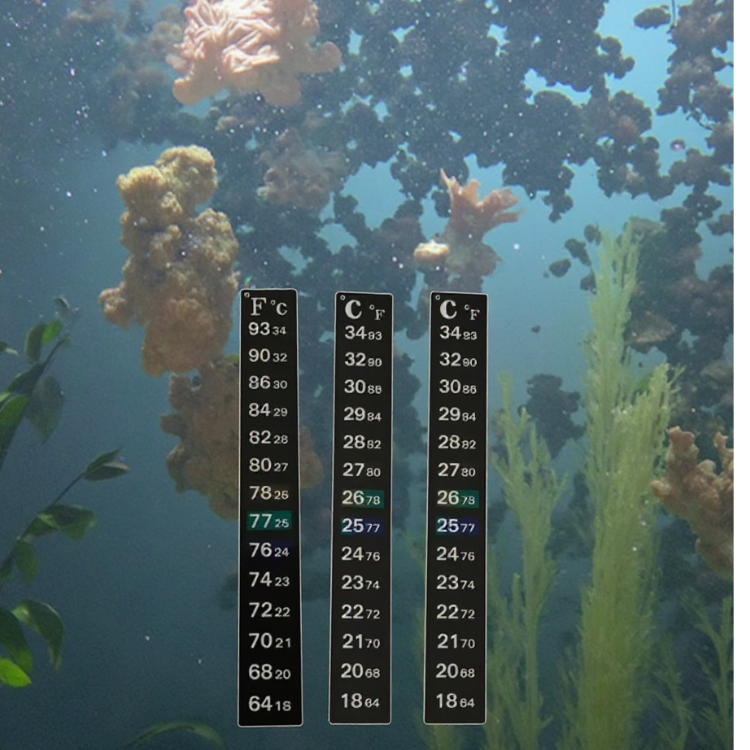
A typical stick-on aquarium thermometer contains temperature-sensitive liquid crystal material. Different areas change color as their temperature changes, allowing the user to identify a temperature on the printed scale.
It operates without batteries, cables, or an electronic display. Although these strips are sometimes called "digital thermometers," their colored indicators are not electronic digital readouts.
The strip attaches to the outside of the aquarium. Heat passes between the water, tank wall, and surrounding air, influencing the temperature at the strip.
This distinction explains both its convenience and its limitations. A thermometer can respond correctly to the surface touching it while still differing from the water temperature inside.
Follow the instructions supplied with the specific product. Some strips use green to identify the indicated temperature, with neighboring colors helping show a transition between values.
Do not assume every manufacturer uses the same color sequence.
When adjacent indicators appear together, check the product's reading guide. Avoid interpreting an intermediate color as an exact decimal temperature unless the instructions explicitly support that interpretation.
They can be adequate for general monitoring in a stable aquarium environment. However, there is no defensible universal accuracy figure for every aquarium thermometer strip.
Performance depends on the product and its installation.
Relevant factors include:
- The liquid crystal formulation and printed temperature intervals.
- Contact between the adhesive strip and tank surface.
- Tank-wall material and thickness.
- Differences between room and aquarium temperatures.
- Nearby sunlight, heating, or cooling airflow.
- Reading conditions and interpretation of colors.
A particularly cool room can make an externally mounted strip read below the actual water temperature. This is an installation-level limitation, not necessarily evidence that the liquid crystal material is defective.
Resolution is the smallest temperature interval that the scale displays. Accuracy describes how closely a reading agrees with a suitable reference under specified conditions.
A strip with closely spaced markings is not automatically more accurate.
Likewise, a digital thermometer showing decimal places does not necessarily measure temperature accurately to those decimal places. Compare documented specifications, not display appearance alone.
For buyers evaluating aquarium thermometer accuracy, the useful question is: "Under what conditions was this performance measured?"
An aquarium temperature strip is attractive when simplicity, visibility, and low maintenance matter.
Suitable applications include:
- Routine visual checks in stable home aquariums.
- A supplementary indicator alongside an in-water thermometer.
- Starter kits with clear placement and reading instructions.
- Retail displays where visible temperature information is useful.
- Private-label accessories designed for straightforward everyday use.
It is less suitable as the sole monitoring method when small temperature differences determine important husbandry decisions.
Examples include temperature-sensitive livestock, breeding projects with specific requirements, or diagnosing a suspected heater problem.
This is not a choice between "good" and "bad" thermometer types. It is a choice between different measurement functions.
A strip offers convenient visibility. An in-water instrument measures closer to the condition the fish experience.
| Thermometer type | Main advantage | Main limitation | Practical role |
|---|---|---|---|
| External liquid crystal strip | Battery-free, visible, easy to install | Surface reading can be affected by room conditions | Routine visual monitoring |
| Digital thermometer with submerged probe | Measures at the probe's location; clear numerical display | Requires power and appropriate probe placement | Direct water-temperature checks |
| Submersible glass thermometer | Direct water measurement without batteries | Readability, mounting, and breakage require attention | An alternative in-water instrument |
Do not buy by category alone. A poorly specified digital unit is not automatically preferable to a well-designed strip.
Look for readable markings, appropriate measurement range, understandable instructions, and credible performance information.
For many fishkeepers, an external strip plus a checked in-water thermometer provides a practical balance between convenience and verification.
Correct placement reduces avoidable reading problems.
Choose an external location corresponding to the water column: below the normal waterline but above the substrate.
Avoid positioning the strip beside the heater or where sunlight or room airflow directly affects the glass. It should also be readable straight on, without bending around the tank.
1. Check that the strip is suitable for the aquarium's surface material.
2. Select a flat, accessible position away from local heat sources.
3. Clean the outside surface using a tank-safe method.
4. Dry the application area completely.
5. Remove the backing and apply the strip according to its instructions.
6. Check for lifting edges or poor contact.
7. Allow the reading to stabilize before comparing temperatures.
Keep cleaning liquids away from aquarium water. Do not spray household cleaner near an open tank.
Unless the product is specifically designed for immersion, install it outside—not underwater.
A strip above the waterline mainly reflects a different thermal environment from one positioned against the water-filled section.
Placement below the gravel level is also unsuitable for representative monitoring.
Other avoidable problems include mounting near an air-conditioning vent, applying to a damp surface, or choosing a position where glare obscures the colors.

A simple comparison helps determine whether the installed strip is useful in your aquarium.
This is a practical performance check, not a laboratory calibration.
1. Install the sticker correctly.
2. Position a suitable in-water thermometer in a representative area, away from direct heater influence.
3. Let both readings stabilize under normal operating conditions.
4. Record the strip reading, reference reading, and approximate room temperature.
5. Repeat at different times, including when the room is warmer or cooler.
6. Look for recurring differences and changes associated with room conditions.
Do not treat a single matching reading as proof of accuracy across the entire scale.
Likewise, a consistent difference in one room condition does not justify applying a permanent correction in every season.
If the strip disagrees substantially with the reference, investigate placement and equipment before adjusting the heater.
Imagine a tank where the in-water thermometer remains steady, but the external strip reads lower when air conditioning blows toward the aquarium.
The sensible first response is to remove the airflow influence and repeat the comparison—not immediately increase heater output.
This is an illustrative scenario, not a reported customer test. It demonstrates why measurement location matters.
The thermometer's displayed range should cover the needs of the actual livestock, with room to recognize departures from normal conditions.
There is no single ideal temperature for every aquarium.
General guidance often places many tropical freshwater fish around 76–80°F. Coldwater species and fish with specialized requirements may need different conditions.
Research the species rather than treating a package's "tropical" label as a universal setting.
For mixed-species tanks, choose inhabitants with compatible requirements. A thermometer helps monitor conditions, but it cannot resolve incompatible husbandry needs.
For product developers, this means scale selection should begin with the intended aquarium category—not simply the most familiar temperature range.
From a product-development perspective, a useful aquarium thermometer sticker must do more than change color.
It should communicate a readable result, remain attached during intended use, and help the customer understand its limitations.
Define:
- Intended aquarium types and surface materials.
- Temperature range and scale intervals.
- Celsius, Fahrenheit, or dual-scale labeling.
- Installation orientation and available viewing space.
- Expected handling, storage, and exterior cleaning conditions.
Dual scales can support international sales, but crowded markings can reduce readability. Test the layout at its actual printed size.
Ask how the complete construction performs—not just the temperature-sensitive material.
Useful checks include adhesion, color readability, comparison against a reference, and behavior under realistic differences between room and tank temperatures.
Request the conditions behind any accuracy claim.
A specification measured under controlled surface conditions should not automatically become a promise about aquarium water temperature.
Packaging should explain:
- Where to install the strip.
- How to interpret its colors.
- What to do when adjacent indicators appear.
- Why environmental conditions can influence readings.
- When to verify temperature using an in-water instrument.
Clear instructions help prevent both user confusion and overstated expectations.
During routine aquarium care, check that the strip remains readable and firmly attached.
Replace it when lifting edges, damaged indicators, or faded markings prevent dependable interpretation.
Do not assume all aquarium thermometer stickers require replacement after the same fixed period. Follow the manufacturer's guidance and assess actual condition.
Verify water temperature independently if:
- The reading changes unexpectedly.
- The strip stops responding as expected.
- Room heating or cooling conditions change substantially.
- You suspect heater malfunction.
- Fish behavior suggests a broader husbandry problem.
Temperature is only one part of aquarium care. An apparently normal reading does not rule out water-quality or other environmental issues.
Sticker thermometers are useful when their role is clearly understood: convenient visual monitoring, supported by direct water measurement when the decision requires it.
Qingdao Focus On Color Industry & Trade Co., Ltd. manufactures photochromic, thermochromic, liquid crystal thermometer, and fragrance product series. With more than 13 years of production experience, the company offers OEM/ODM and personalized customization services.
For aquarium brands, distributors, and kit suppliers, start with a defined application brief. Share your target market, temperature range, scale preference, dimensions, branding, and packaging requirements with our team to discuss a custom aquarium thermometer strip and an appropriate sample-evaluation plan.
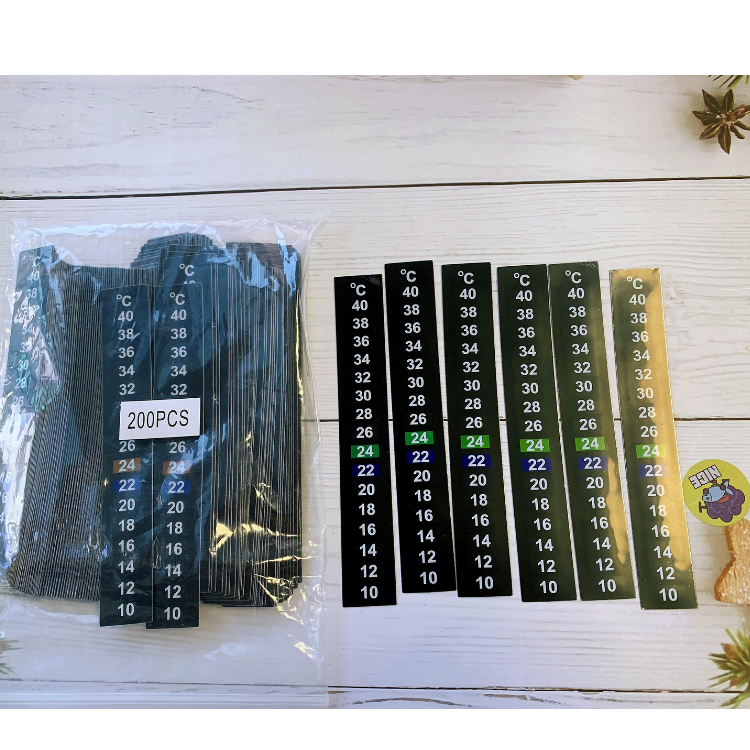
Yes, for convenient routine checks and supplementary monitoring. Their main limitation is that they respond at the outside surface, so room conditions can affect agreement with the water temperature.
Most adhesive liquid crystal aquarium strips go outside the tank. Follow the specific product instructions; do not immerse a strip unless it is designed for underwater use.
The temperature may be transitioning between printed indicators. Interpret the colors using the manufacturer's guide rather than assuming one universal color rule.
Only if the product is suitable for that surface. Confirm adhesive compatibility and evaluate the installed reading against an in-water reference. Do not assume performance verified on glass transfers unchanged to acrylic.
No. Quality, specifications, and placement matter. A suitable submerged probe offers direct water measurement, but decimal digits alone do not prove accuracy.
Avoid making significant adjustments from an unexpected strip reading alone. Verify the water temperature first, then follow the heater's instructions and reassess after conditions stabilize.
1. The Spruce Pets — "Aquarium Thermometer Pros and Cons." Supports the distinction between thermometer types, external-strip limitations, ambient-temperature effects, and placement guidance. [thesprucepets]
2. Tetra — "Maintaining Water Quality and the Ideal Aquarium Temperature." Supports the use of adhesive temperature strips outside aquarium glass and the need for livestock-appropriate temperature conditions. [tetra-fish]
3. Tetra — "How to Setup an Aquarium." Supports placing the thermometer away from the heater and checking temperature after equipment conditions stabilize. [tetra-fish]
4. Aqueon — "Frequently Asked Questions." Supports species-specific temperature requirements and the general 76–80°F guidance for many tropical fish. This range is not presented as universal. [aqueon]
5. Aqueon — "Instruction Manual: Fully Submersible Aquarium Heater." Supports checking aquarium water with a reliable thermometer before making heater adjustments. [aqueon]
6. American Thermal Instruments — "Liquid Crystal Solutions." Provides background on self-activating liquid crystal temperature indicators. Its product-specific accuracy figures are not applied to aquarium strips in this article. [americanthermal]


