+86 18560646018

Views: 277 Author: Focus Color Publish Time: 2026-10-07 Origin: Site


Content Menu
● How Do Scratch and Sniff Stickers Work?
>> Microencapsulation Keeps Fragrance Available Until Activation
>> Why the Same Sticker Can Release Scent More Than Once
● Scratch and Sniff Stickers vs. Other Scented Labels
● What Are Scratch and Sniff Stickers Used For?
>> Product Sampling and Promotional Packaging
>> Educational Materials and Interactive Print
>> Branded Merchandise and Specialty Labels
● How Long Do Scratch and Sniff Stickers Last?
>> Factors That Affect Scent Retention
● How to Evaluate Custom Scratch and Sniff Stickers Before Ordering
>> Step 1: Establish a Fragrance Reference
>> Step 2: Standardize the Activation Method
>> Step 3: Check the Finished Label Construction
>> Step 4: Approve Acceptance Criteria Before Production
● Are Scratch and Sniff Stickers Safe?
>> Fragrance Compliance Is Only One Part of Assessment
>> Children's Products Need Application-Specific Review
● How to Prepare an OEM/ODM Scented Sticker Brief
● Develop Custom Scratch and Sniff Stickers Around Your Application
● Frequently Asked Questions About Scratch and Sniff Stickers
>> What Makes Scratch and Sniff Stickers Smell?
>> Can Scratch and Sniff Stickers Be Reused?
>> Can I Order Custom Scratch and Sniff Stickers With My Own Scent?
>> Are Scratch and Sniff Stickers Waterproof?
>> How Should Scented Stickers Be Stored?
>> Can Scented Stickers Be Used on Food Packaging?
What are scratch and sniff stickers? They are adhesive labels with a fragrance-containing surface that releases scent when gently scratched or rubbed. Most commercial versions use microencapsulation: tiny protective capsules hold fragrance until friction breaks some of them open.
For brands, these stickers turn an ordinary printed surface into an interactive product experience. For buyers, however, a pleasant first impression is only the beginning. Scent accuracy, activation, adhesive performance, storage, and application-specific safety all deserve attention.
At Qingdao Focus On Color Industry & Trade Co., Ltd., we bring more than 13 years of manufacturing experience across photochromic, thermochromic, liquid crystal thermometer, and fragrance product series, with OEM/ODM and personalized customization services. Our perspective is straightforward: a custom scented label should be developed around its intended use, not selected by fragrance name alone.

Imagine many tiny sealed containers distributed across a printed coating. Each contains fragrance material. Their walls help limit premature release, while allowing mechanical action to open a portion of the capsules.
These microcapsules are incorporated into a compatible ink or coating and applied to a designated area. A light scratch breaks some capsules, releasing fragrance into the surrounding air.
The important distinction is that scratching does not create a smell. It releases fragrance already stored in the surface layer.
A single scratch usually activates only part of the available coating. Capsules elsewhere can remain intact, allowing subsequent activations.
However, the supply is finite. Repeated rubbing gradually consumes the fragrance reservoir. A sticker that still looks perfect may therefore smell weaker after extensive use.
This explains why appearance and scent performance need separate evaluation during sample approval.
"Scented sticker" is a broader description than "scratch and sniff sticker." Buyers should clarify the release mechanism before comparing quotations.
| Product type | How fragrance is experienced | Main purchasing consideration |
|---|---|---|
| Scratch and sniff sticker | Rubbing or scratching ruptures fragrance capsules | Activation reliability and remaining scent after repeated use |
| Continuously scented label | Fragrance is perceptible without deliberate scratching | Premature scent loss and protective packaging |
| Peel-open fragrance sample | Opening the sample exposes its fragrance system | Construction, sealing, and intended sampling experience |
These formats are not interchangeable. If the goal is consumer-controlled interaction, an activation-based coating is relevant. If the goal is immediate ambient fragrance, a different construction may be more appropriate.
Ask suppliers whether a proposed product releases scent before activation and how that behavior has been evaluated.
Custom scratch and sniff stickers can introduce a fragrance on a promotional card, mailer, or external package. Established fragrance-sampling manufacturers offer microencapsulated formats for postcards and direct mail.
For example, a home-fragrance brand could use a scented patch to introduce a citrus collection. This is an illustrative application, not a documented customer result.
The practical limitation matters: a printed sample is a representation of a fragrance, not necessarily an exact reproduction of how a candle, detergent, or perfume performs in use. Compare it with the intended reference before approval.
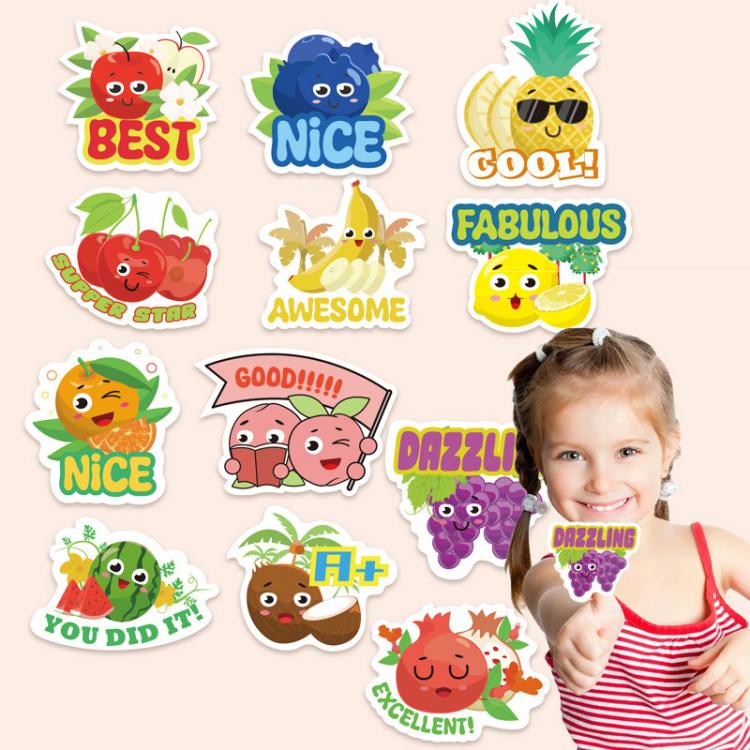
Scented stickers can also support matching activities, reward charts, and interactive books. Familiar aromas such as fruit provide an additional cue alongside printed illustrations.
For child-oriented projects, the starting point should be age suitability and product assessment—not a colorful design or a "non-toxic" marketing statement.
Collectible sticker sheets and promotional inserts offer other possible applications. A useful design connects the aroma with the artwork and includes a clear activation instruction.
Avoid treating novelty as proof of commercial success. If a campaign needs measurable results, test the scented version against an otherwise comparable unscented version.
There is no universal lifespan. Industry sources describe scent retention ranging from months to years, but this is not a guarantee for an individual formulation.
Separate three questions:
1. Shelf life: How long does an unused sticker remain acceptable under specified storage conditions?
2. Reactivation performance: How well does it release fragrance after repeated scratching?
3. Post-activation duration: How long is the released aroma noticeable after one use?
A supplier's answer to one question does not automatically answer the others.
- Capsule integrity: Damage during processing or handling can release fragrance prematurely.
- Coating formulation: Capsule loading and coating compatibility influence activation and scent delivery.
- Storage conditions: Heat and prolonged light exposure can reduce fragrance stability.
- Handling frequency: Repeated scratching uses up available capsules.
- Packaging: Protective packaging helps reduce unwanted handling and environmental exposure.
Ask for a storage recommendation and evidence supporting any claimed shelf life. Do not approve a long-term claim solely because a fresh sample smells strong.'
A purchasing specification should describe observable performance, not just "strong scent" or "premium quality." The following workflow is a proposed buyer-side evaluation framework, rather than a universal testing standard.
Select the fragrance to be represented and agree on an approval reference. Assess character as well as intensity: a strong lemon aroma is not useful if it smells unlike the intended product.
When comparing options, use coded samples to reduce expectations associated with fragrance names or artwork.
Define how evaluators will rub the patch, which area they will use, and when they will assess the aroma. Apply the same method to each sample.
Inconsistent scratching can make a satisfactory coating appear weak or make an unsuitable one appear acceptable.
Evaluate the complete label on its intended surface, not just a loose scented swatch.
| Evaluation area | Practical question |
|---|---|
| Fragrance recognition | Does the activated scent match the agreed reference? |
| Activation | Does normal rubbing release a noticeable aroma? |
| Print and coating | Does use damage artwork or transfer unwanted material? |
| Adhesive | Does the label remain attached to the intended surface? |
| Repeated use | Is performance acceptable after the agreed activation sequence? |
| Storage and transport | Does the packed product remain acceptable after relevant exposure? |
Print-testing laboratories use controlled rub and abrasion methods to assess coating wear and transfer. These can inform durability evaluation, but they do not by themselves establish fragrance accuracy or consumer safety.
Agree on the reference sample, inspection conditions, acceptable appearance, and scent evaluation procedure. Set rejection criteria before the production order rather than after delivery.
Retain approved samples and identify their version. This makes later discussions about fragrance changes or production variation more concrete.
Safety depends on the complete formulation, intended user, exposure, and destination-market requirements. Neither microencapsulation nor a familiar fragrance name establishes that a finished product is safe for every use.
Ask for relevant fragrance documentation, including conformity with applicable International Fragrance Association standards for the intended application.
An IFRA Certificate of Conformity does not replace a finished-product safety assessment. It should not be presented as blanket certification of the adhesive, substrate, coating, or entire sticker.
Fragrance ingredients can also cause allergic reactions in susceptible people. California public-health guidance identifies both skin and respiratory reactions as concerns associated with fragrance allergens.
For products marketed to children, clarify the intended age group, foreseeable handling, and applicable requirements before approving materials.
In the United States, children's products subject to applicable safety rules generally require appropriate third-party testing and a Children's Product Certificate. The precise requirements depend on product classification and applicable exceptions.
Do not assume that every sticker is subject to identical rules. Obtain a product-specific review, and avoid encouraging ingestion, licking, or direct skin application unless those uses have been separately assessed.
For food-related packaging, place fragrance labels externally unless the proposed construction has been specifically evaluated for the intended contact conditions. A food-like smell does not establish food-contact suitability.
A detailed brief helps manufacturers evaluate feasibility and produce relevant samples. Include:
- Intended application and end-user age group.
- Destination countries and applicable documentation needs.
- Fragrance description and reference sample, where available.
- Sticker dimensions, shape, artwork, and activation area.
- Application surface and adhesive requirements.
- Expected storage, shipping, and use conditions.
- Quantity, packaging format, and delivery schedule.
- Required sample approval and acceptance procedures.
From a manufacturing perspective, performance is a system-level outcome. The fragrance, capsule coating, printed design, substrate, adhesive, and packaging must work together.
For instance, a clear "Scratch Here" instruction helps users find the activation area. That area must also remain accessible: a proposed protective finish should be checked for compatibility rather than assumed suitable.
Qingdao Focus On Color Industry & Trade Co., Ltd. provides OEM/ODM and personalized customization services backed by more than 13 years of manufacturing experience.
Send your application, fragrance target, artwork, dimensions, quantity, and destination market to our team. Request a sample-development discussion to evaluate the appropriate label construction, documentation needs, and approval criteria before committing to production.
A clear brief turns an interesting scent concept into a product that can be evaluated, approved, and manufactured against agreed requirements.
Fragrance stored in microscopic capsules produces the aroma. Scratching opens some capsules and allows fragrance molecules to enter the surrounding air.
Often, yes. Unbroken capsules can provide additional activations. However, repeated rubbing gradually reduces the available fragrance, so reuse is limited rather than indefinite.
A custom fragrance can be proposed, but feasibility requires evaluation. The fragrance must work with the encapsulation and coating system, meet relevant application requirements, and perform acceptably in finished samples.
Not automatically. Water resistance depends on the substrate, adhesive, printed layers, and fragrance coating. Request testing under your actual exposure conditions rather than relying on the sticker material alone.
Follow the supplier's instructions. Generally, keep them protected from heat, direct sunlight, and unnecessary rubbing, and retain protective packaging until use. Storage recommendations should match the validated construction.
They may be considered for external packaging, subject to assessment. Do not assume suitability for direct food contact. Evaluate the actual materials, placement, and contact conditions before use.
1. HowStuffWorks. "How do scratch-and-sniff stickers work?" Explains microencapsulation, fragrance release through capsule rupture, and repeated activation. [science.howstuffworks]
2. Discount Labels. "How Do Scratch & Sniff Stickers Work?" Provides industry context on fragrance coatings, scent longevity, storage conditions, and the effects of repeated scratching. [discountlabels]
3. Orlandi. "Microencapsulated Products." Documents commercial microencapsulated fragrance-sampling applications, including postcards and direct mailers. [orlandi-usa]
4. Smithers. "Abrasion, Rub and Scuff Resistance." Describes controlled testing of printed coatings, label wear, abrasion, and material transfer. [smithers]
5. International Fragrance Association. "Certification of IFRA Standards." Explains the intended-use scope of a Certificate of Conformity and states that it does not replace a safety assessment. [ifrafragrance]
6. California Department of Public Health. "Fragrance Allergens." Provides public-health information about fragrance-related skin and respiratory allergic reactions. [cdph.ca]
7. U.S. Consumer Product Safety Commission. "Children's Product Certificate." Explains certification and third-party testing requirements for children's products subject to applicable safety rules, including relevant exceptions. [cpsc]
8. Alpine Packaging. "Scratch and Sniff Labels." Provides commercial guidance on fragrance coatings, storage, intended use, and limitations regarding direct food contact. [alpinepackaging]


