


Views: 289 Author: Focus Color Publish Time: 2026-10-09 Origin: Site


Content Menu
● Where to Put a Thermometer Sticker on an Aquarium
>> Why Place It Away From the Heater?
● Does an Aquarium Thermometer Sticker Go Inside or Outside?
● How to Install an Aquarium Thermometer Sticker
>> 1. Confirm the Product Specifications
>> 2. Choose the Location Before Removing the Backing
>> 3. Clean and Dry the Exterior Surface
>> 4. Apply Without Wrinkles or Gaps
>> 5. Let the Reading Stabilize
● How to Read an Aquarium Thermometer Sticker
>> What If Two Numbers Are Colored?
>> What If the Strip Is Completely Black?
● How Accurate Are Stick-On Aquarium Thermometers?
>> Resolution Is Not the Same as Accuracy
>> When Should You Use a Separate Water Thermometer?
● A Practical Method for Verifying Your Thermometer Sticker
>> Compare Under Stable Conditions
>> Look for Patterns, Not Just One Difference
● Common Placement Mistakes and How to Correct Them
● What Aquarium Brands Should Specify for Custom Thermometer Strips
>> Match the Scale to the Application
>> Make Instructions Part of the Design
>> Confirm Performance Before Approving Bulk Production
>> Can I Put a Thermometer Sticker on the Back of an Aquarium?
>> Should the Entire Sticker Be Below the Waterline?
>> Can a Thermometer Sticker Work on an Acrylic Tank?
>> How Often Should I Check Aquarium Temperature?
>> Can I Move a Sticker After Installing It?
>> Does a Thermometer Sticker Replace the Heater Thermostat?
>> What Should I Do if the Sticker Shows an Unexpected Temperature?
Knowing where to put thermometer sticker in aquarium setups starts with one simple rule: attach a standard adhesive liquid crystal strip to the outside of the tank, below the waterline and above the substrate. Choose a visible location away from the heater, direct sunlight, and heating or cooling vents.
That sounds straightforward, but placement affects what the sticker tells you. A strip attached beside the heater, above the water, or over an insulating background may give a misleading impression of your aquarium's temperature.
At Qingdao Focus On Color Industry & Trade Co., Ltd., we manufacture liquid crystal thermometers alongside photochromic, thermochromic, and fragrance products. Our practical approach is to consider the indicator, installation surface, and reading instructions together—not treat the sticker as an isolated accessory.
This guide explains how to position, install, read, and verify an aquarium thermometer sticker.
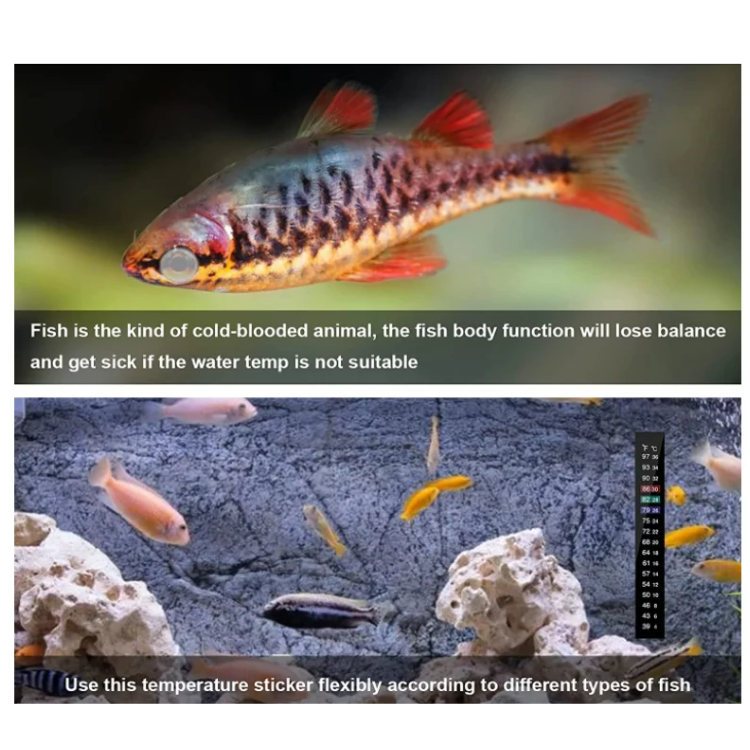
The best position is usually on the front or side glass, toward the opposite end from the heater. Keep the temperature-sensitive section below the lowest normal water level and above the gravel or sand.
The key principle is placement: the strip should contact glass backed by aquarium water, rather than air, substrate, or another material.
| Placement factor | Recommended approach | What to avoid |
|---|---|---|
| Installation surface | Outside glass, directly against the tank | Background film or another sticker underneath |
| Height | Below the normal waterline, above substrate | Air-backed glass or gravel-backed areas |
| Heater distance | Opposite end where practical | Glass immediately beside the heater |
| Visibility | Readable during routine feeding | Hidden corners or equipment |
| Room conditions | Away from sunlight and vents | Local heating or cooling of the glass |
There is no universal installation height in inches. Tank dimensions, substrate depth, and water level vary. Use the water-backed area of your aquarium as the guide.
Either can work.
Front glass makes the display easy to check when feeding fish. Side glass may provide a cleaner appearance without sacrificing visibility.
Choose the surface that offers:
- A flat, unobstructed contact area.
- Protection from direct sunlight.
- Convenient viewing at a normal angle.
- Enough space to keep the active scale below the waterline.
Avoid choosing a hidden location simply because it looks tidier. A thermometer only supports daily care when someone actually reads it.
The purpose of a separate thermometer is to check aquarium temperature independently of the heater setting.
A location close to the heater may represent a locally warmer area rather than conditions elsewhere in the tank. Mounting the strip toward the opposite end provides a more useful comparison.
However, placement cannot fix poor circulation. If different areas remain noticeably different in temperature, check water movement and heater positioning rather than repeatedly relocating the sticker.
A standard adhesive liquid crystal aquarium thermometer goes outside the tank.
It responds to the temperature of the surface beneath it. When mounted correctly, that surface is aquarium glass with water behind it.
Do not submerge an ordinary external strip unless the manufacturer explicitly identifies that model as suitable for underwater use. A sticker-like appearance does not establish waterproof construction.
Other thermometer designs work differently:
- Liquid crystal strips normally attach to the exterior.
- Submersible glass thermometers measure from inside the aquarium.
- Digital probe thermometers place the sensing probe in water while keeping the display outside, according to their instructions.
Confirm the product type before installation. Instructions for one design should not be applied to another.
Installation should create consistent contact between the adhesive strip and the tank surface.
Check the temperature range, measurement units, installation surface, and color-reading instructions.
The scale must cover your aquarium's intended operating temperatures. A strip with an unsuitable range may remain dark even when it is functioning normally.
For acrylic aquariums, choose a product explicitly described as compatible with acrylic rather than assuming every glass-tank strip will perform identically.
Hold the strip against the proposed position without attaching it.
Check that:
- The active scale is below the normal waterline.
- The strip remains above the substrate.
- The numbers are easy to read.
- Nearby equipment does not obstruct the view.
- Direct sunlight does not fall on the location.
Also consider routine evaporation. A strip that begins below the waterline may become partly exposed if the tank level drops.
Remove dust, fingerprints, moisture, and residue using a method suitable for the aquarium surface and label instructions.
Keep cleaning products out of the tank. Avoid strong solvents that could damage the strip or aquarium material.
Let the surface dry fully before application. Do not attach the strip over an existing label or decorative background.
Remove the release liner and press the strip smoothly against the glass.
Follow the manufacturer's orientation guidance. Do not fold, crease, or cut the temperature-sensitive area unless the product is designed for trimming.
Uneven adhesion can complicate interpretation because the strip no longer has consistent contact with its intended surface.
Do not judge performance immediately after handling or installation.
Warm fingers, recent water changes, and heater adjustments can temporarily affect the conditions being measured. Follow any stated response-time instructions and wait for a stable display before comparing readings.
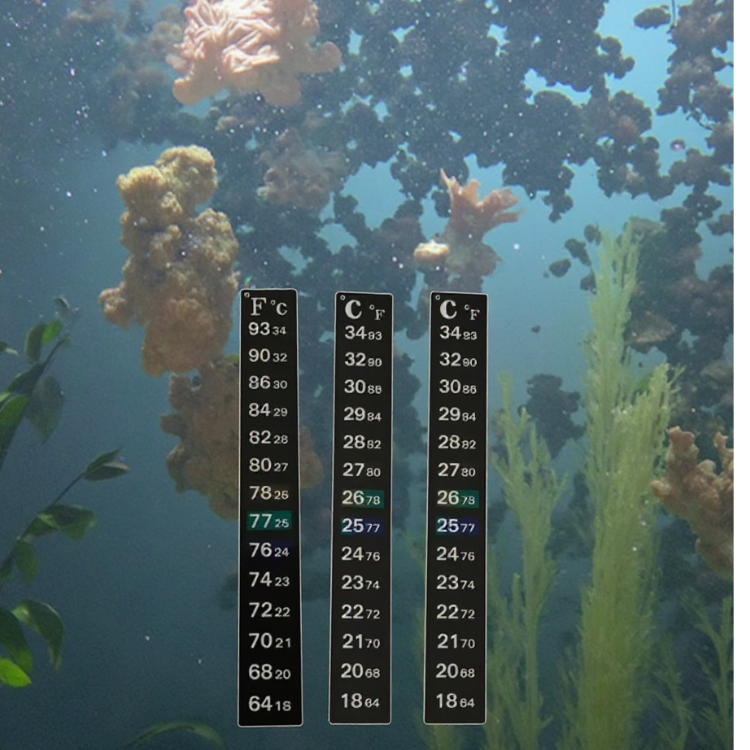
Liquid crystal thermometer strips use temperature-sensitive materials that change their reflected color.
On many numeric strips, the green indicator marks the current temperature. Adjacent indicators may appear tan or blue as the temperature falls between marked values.
However, the color guide supplied with your specific product takes priority.
Two adjacent colored indicators may represent a temperature between the printed values rather than a defective strip.
Some products instruct users to estimate the midpoint between tan and blue indicators when no green indicator is visible.
Do not automatically select the highest illuminated number. Read the product's color legend and consider the scale spacing.
A dark strip does not automatically mean the aquarium is cold.
Possible explanations include:
- Temperature outside the displayed range.
- Unsuitable lighting or viewing angle.
- Poor adhesion.
- Product damage or deterioration.
Check the aquarium with a separate water thermometer before adjusting the heater. A blank display is not sufficient evidence for increasing the temperature.
A thermometer sticker is convenient for routine visual checks, but it measures through the aquarium wall rather than placing its sensor directly in the water.
Outside air temperature can influence its reading. Sunlight, heating vents, and cold drafts can therefore make installation conditions especially important.
Published aquarium advice does not agree on which thermometer type is universally most accurate. A more defensible approach is to evaluate the specific product and verify its performance in the intended setup.
Resolution describes the size of the displayed temperature steps. Accuracy describes how closely a reading matches the actual temperature under specified conditions.
A strip with closely spaced numbers is not automatically more accurate.
For purchasing decisions, request:
- The stated accuracy or tolerance.
- The conditions under which it applies.
- The recommended mounting surface.
- The reading method.
- Storage and service-life guidance.
Do not apply another manufacturer's specifications to an untested product.
Use an appropriate water thermometer to confirm readings when:
- Installing a new strip.
- Investigating an unexpected temperature change.
- Adjusting a heater.
- Preparing replacement water.
- Keeping livestock with narrow temperature requirements.
- Observing signs that conditions may be unsuitable.
A sticker can make everyday monitoring easier. It should not be the sole basis for a consequential temperature adjustment when its reading is uncertain.
A comparison check helps distinguish installation problems from possible product problems.
This is a field check, not a substitute for controlled calibration.
1. Install the strip correctly.
2. Keep normal filtration and circulation operating.
3. Place a suitable reference thermometer in the water, away from direct heater influence.
4. Allow both readings to stabilize.
5. Record the strip reading, reference reading, and room conditions.
6. Repeat at different times under normal operation.
Avoid comparing one reading taken immediately after a water change with another taken after the aquarium has stabilized.
A consistent difference may require checking product tolerance and reference-instrument accuracy.
A difference that changes when sunlight reaches the tank or a vent starts operating points toward environmental influence.
If readings differ between locations inside the aquarium, investigate circulation. The issue may be uneven water temperature rather than the sticker alone.
Do not invent a permanent correction factor from one observation. Verify the pattern first.
| Problem | Why it matters | Better approach |
|---|---|---|
| Strip above the waterline | The glass is backed by air | Move it to a water-backed area |
| Strip behind deep substrate | It represents an unsuitable monitoring location | Position it above the substrate |
| Strip beside the heater | Local warmth may affect interpretation | Choose the opposite end |
| Direct sun on the strip | Solar heating can influence the surface | Select a shaded location |
| Strip over a background | The extra layer changes surface contact | Mount directly on the tank |
| Reading disagrees with heater dial | The dial is a setting, not independent confirmation | Check with a separate thermometer |
If relocation is necessary, check whether the product is reusable. Some labels are removable, but that does not mean every adhesive strip will retain its original adhesion after peeling.
Replace a damaged strip rather than forcing it back into service.
For aquarium brands, distributors, and accessory-kit suppliers, useful customization goes beyond adding a logo.
The product and its instructions should help customers install and interpret the strip correctly.
Define the intended temperature range, Celsius or Fahrenheit requirements, and preferred scale layout.
There is no single ideal temperature for every aquarium species. Avoid presenting one broad "safe zone" as universally appropriate unless its application is clearly defined.
Packaging should explain:
- External installation requirements.
- Correct positioning relative to water and substrate.
- Heater and sunlight avoidance.
- Color interpretation.
- When to verify with a separate thermometer.
Readable numbers and clear instructions can be more valuable than decorative graphics that obscure the active scale.
Ask the supplier to confirm the proposed accuracy, materials, mounting compatibility, storage conditions, and sample-evaluation method.
Qingdao Focus On Color Industry & Trade Co., Ltd. has more than 13 years of manufacturing experience and provides OEM, ODM, and personalized customization services.
For an aquarium thermometer project, contact our team with your target temperature range, preferred units, dimensions, branding requirements, installation surface, and expected quantity. Request a sample and agree on performance requirements before approving bulk production.
Yes, provided it attaches directly to a suitable exterior surface and remains easy to read. A rear location is less useful if the tank sits against a wall or the display is hidden.
Keep the temperature-sensitive scale against glass backed by water. Follow the product instructions if decorative or branding sections extend beyond that area.
Some products are sold for both acrylic and glass aquariums. Confirm compatibility for the specific model and verify the reading after installation.
Check it daily as part of routine observation. Also verify temperature after heater adjustments, water changes, or significant changes in room conditions.
Only if the product instructions allow it. Peeling can damage the indicator or reduce adhesion. Replace it if it no longer lies flat or displays clearly.
No. The heater thermostat controls heating; the thermometer provides a separate indication of temperature. Use independent measurement to confirm conditions rather than relying only on the heater dial.
Confirm the reading with a suitable water thermometer. Check placement, sunlight, room conditions, and circulation before changing the heater setting. Avoid sudden adjustments based on an unverified display.
1. [Aqueon — "Fish Tank Heater Tips for Cold Weather"]. Manufacturer guidance supporting exterior installation, positioning above gravel, avoiding sunlight and vents, placement opposite the heater, daily checks, and gradual temperature adjustments. Its blanket ranking of stick-on thermometer accuracy is not adopted here. [aqueon]
2. [NT Labs — "Do I Need a Thermometer When There Is a Heater in My Tropical Aquarium?"]. Published October 22, 2021. Supports independent temperature monitoring, opposite-end placement, thermometer-type distinctions, and the influence of external air temperature on adhesive strips. [ntlabs.co]
3. [SpotSee — "Liquid Crystal Thermometers"]. Technical background on reversible liquid crystal color changes, green-indicator interpretation, intermediate readings, product-specific specifications, and protection from ultraviolet light, high temperatures, and strong solvents. Its specifications are not presented as specifications for Qingdao Focus On Color products. [spotsee]
4. [Aqua Dreams — "Marina LCD Mini Digital Aquarium Thermometer"]. A product-specific example supporting outside-glass installation, green-indicator interpretation, midpoint interpretation between tan and blue, and avoidance of direct sunlight. [aqua-dreams]
5. [Pisces Pet Emporium — "Marina LCD Thermometer"]. A product-specific example of a liquid crystal thermometer described as suitable for acrylic or glass aquariums; compatibility should not be generalized to all strips. [piscespets]


