+86 18560646018

Views: 228 Author: Focus Color Publish Time: 2026-10-12 Origin: Site


Content Menu
● How to Read a Black Aquarium Thermometer Sticker Step by Step
>> 1. Identify the Temperature Scale
>> 2. Look Straight at the Strip
>> 3. Find the Green Indicator
>> 4. Interpret Adjacent Colors Carefully
>> 5. Allow the Reading to Settle
● What Do Aquarium Thermometer Sticker Colors Mean?
>> Why "Blue Means Cold" Can Be Misleading
● Why Is an Aquarium Thermometer Sticker Black?
● Where Should You Put an Aquarium Thermometer Sticker?
>> Why Placement Below the Gravel Is Unsuitable
● How Accurate Are Black Aquarium Thermometer Stickers?
>> Resolution Is Not the Same as Accuracy
>> Use an Independent Check for Important Decisions
● A Practical Verification Method for Aquarium Owners
>> Step 1: Check Under Stable Conditions
>> Step 2: Compare Nearby Measurement Locations
>> Step 3: Repeat Before Drawing Conclusions
● Troubleshooting a Black Aquarium Thermometer Sticker
>> The Entire Strip Stays Black
>> The Sticker and Probe Disagree
>> The Colors Become Difficult to See
● Manufacturer Insights: What Makes a Thermometer Sticker Easier to Use?
>> Specify the Reading Instructions, Not Just the Dimensions
>> Match the Product to Its Intended Role
● Request a Custom Aquarium Thermometer Sticker
>> 1. Which Color Shows the Temperature on an Aquarium Sticker?
>> 2. What If My Aquarium Thermometer Sticker Shows Blue and Tan?
>> 3. Does a Completely Black Sticker Mean the Aquarium Is Cold?
>> 4. Should the Sticker Go Inside or Outside the Aquarium?
>> 5. Can Room Temperature Affect the Reading?
>> 6. Is There One Correct Temperature for Every Aquarium?
>> 7. Can I Use the Sticker as My Only Temperature Check?
To understand how to read black aquarium thermometer sticker displays, look for the number that turns green. On many liquid crystal strips, this is the indicated temperature. If no number is green but two adjacent indicators show blue and tan, the temperature is approximately between those values. Always check your particular product's color guide because the appearance can vary between labels.
The black background is normal. It helps the temperature-sensitive colors stand out; it does not mean the thermometer is switched off.
For aquarium owners, the important task is not simply finding a colored number. It is understanding what that number represents, recognizing misleading readings, and knowing when to check the water with another thermometer.
This guide combines published liquid crystal reading instructions with a manufacturing-oriented perspective from Qingdao Focus On Color Industry & Trade Co., Ltd. The company background supplied for this article states more than 13 years of production experience and OEM/ODM capabilities.
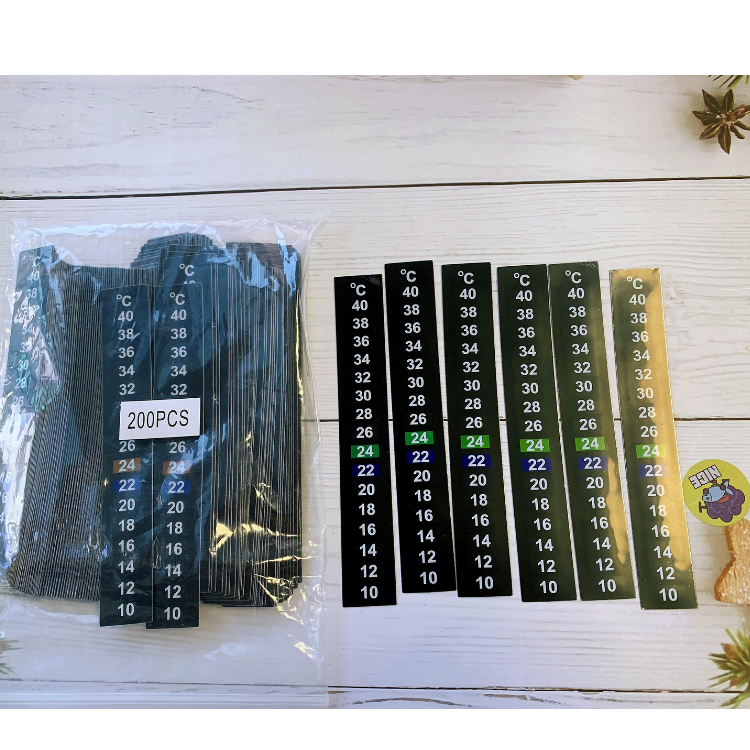
Check whether your sticker displays Celsius, Fahrenheit, or both.
Read the unit symbols before interpreting the colored numbers. A reading of 26°C means something very different from 26°F.
Some strips arrange the scales side by side. Others use a single vertical or horizontal scale. Product ranges also vary, so check the lowest and highest printed temperatures rather than assuming every aquarium sticker covers the same range.
View the thermometer from directly in front of the aquarium, under adequate light.
Avoid reading it from a sharp angle or through reflections. A liquid crystal strip can be difficult to interpret in poor lighting, and aquarium guidance recommends positioning it where a straight-on view is easy.
On a conventional green-reference liquid crystal thermometer, read the number associated with the green indicator.
For example, if the indicator beside 25°C appears green, the strip indicates approximately 25°C.
This is a reading of the temperature-sensitive label at the aquarium wall—not a guarantee that every part of the water has exactly that temperature.
More than one indicator may show color at the same time.
On strips using the conventional tan–green–blue sequence, neighboring colors help identify a temperature transition. When no green indicator appears, the manufacturer's guidance may direct you to estimate halfway between the illuminated tan and blue indicators.
For example:
- A green indicator at 25°C suggests approximately 25°C.
- Blue at 24°C and tan at 26°C, with no green visible, suggests approximately 25°C.
- An unclear display requires better viewing conditions or an independent temperature check.
These examples explain the reading method; they are not universal instructions for every brand.
After installation or a temperature change, follow the manufacturer's specified response time.
Do not assign a universal waiting period to every strip. Label construction, installation, and measurement conditions differ. Read the display after it has stopped visibly changing, and verify unexpected results before adjusting aquarium equipment.
The following table applies to common liquid crystal strips that use green as the reference color. Actual shades can differ by label type.
| Display appearance | Typical interpretation | Recommended action |
|---|---|---|
| One green indicator | Temperature is near that indicator's printed value | Read the associated number |
| Green with neighboring colors | Adjacent elements are also responding | Use the green value and follow the supplied legend |
| Blue and tan without green | Temperature is between the illuminated values | Estimate the midpoint if the product instructions specify this |
| Entire strip appears black | Temperature may be outside the active range, or the display may be unreadable | Check lighting, range, installation, and an independent thermometer |
Do not interpret blue and tan as universal cold-water and hot-water warnings.
Each numbered element responds around its own rated temperature. In the common liquid crystal sequence, an individual element changes from tan to green to blue as its temperature rises, before becoming black again above its active range.
Therefore, interpret the color together with the printed number. A blue indicator alone does not tell you whether the aquarium is suitable for your fish.
A typical liquid crystal thermometer contains temperature-sensitive elements printed over a black backing.
As temperature changes, the liquid crystal material reflects different wavelengths of visible light. The black background makes those reflected colors easier to distinguish. The elements can also appear black below or above their active temperature ranges.
This explains an important distinction:
- A black background is part of normal construction.
- A completely black display needs further investigation.
These strips do not require batteries to generate their temperature-dependent colors. Although listings sometimes describe them as "digital," they are not electronic probe thermometers merely because they display numbers.
Correct placement improves both readability and the usefulness of the reading.
For a conventional exterior adhesive strip, install it on the outside aquarium wall at a height corresponding to water inside the tank. Position it above the gravel level and where you can see it without bending around the aquarium. Avoid direct sunlight and nearby heating or cooling vents.
Use this practical sequence:
1. Confirm that the product is intended for exterior installation.
2. Select a visible position corresponding to the water column.
3. Check the label's compatibility and preparation instructions.
4. Clean and dry the exterior surface as directed.
5. Remove the backing and apply the strip without folds.
6. Check that the active area makes consistent contact.
7. Allow the display to stabilize before recording a reading.
Do not install a standard exterior sticker underwater unless its manufacturer explicitly approves that use. Aquarium guidance describes this category as an outside-mounted thermometer.
The substrate zone is not a good reference position for an exterior strip. Aquarium guidance advises against placing the thermometer below gravel level because water movement through that area is limited.
A convenient viewing position should also be a meaningful measurement position.

Stick-on liquid crystal thermometers are useful for routine checks, but their limitations matter.
They respond to conditions at the outside aquarium wall. Room air temperature and the material between the label and water can influence the relationship between the displayed value and actual water temperature. A substantially colder room can cause an exterior strip to indicate a lower temperature than the water.
Resolution describes the scale increments you can read.
Accuracy describes how closely a measurement agrees with the actual temperature under specified conditions.
A strip printed in 1°C steps does not automatically have an accuracy of ±1°C. Likewise, a digital display showing decimal places does not, by itself, prove superior accuracy.
For procurement, request the particular product's stated tolerance and test conditions. Do not transfer the specification of one manufacturer's label to another company's aquarium strip.
An immersed aquarium thermometer measures within the water rather than relying on an exterior label. Probe thermometers can also be positioned in different parts of the aquarium, and some models provide temperature alarms.
A sensible approach is to use the sticker for quick visual monitoring and an appropriate independent instrument to investigate unusual readings.
Avoid changing heater settings solely because one ambiguous color appears on the strip.
The following is a suggested checking procedure, not a laboratory calibration method.
Its purpose is to identify obvious disagreement and establish whether your sticker is useful under normal aquarium conditions.
Compare readings when the aquarium has settled after maintenance or a temperature adjustment.
Record:
- The sticker's indicated temperature.
- The independent thermometer's reading.
- The measurement locations.
- Whether room conditions have changed.
- Any uncertainty in interpreting the colors.
Place an aquarium-safe probe in the water near the sticker's height without resting it directly against a heater.
Then, if needed, check another area of the aquarium. Probe thermometers can be moved to investigate different locations, which helps separate a local temperature difference from a reading problem.
Do not treat one comparison as proof of accuracy or failure.
For illustration, a sticker indicating 24°C alongside a probe reading 25°C shows disagreement, but it does not establish which device is correct. Check the instruments' specifications, allow readings to stabilize, and repeat the comparison.
A consistent difference under one set of conditions should not be assumed to remain constant when room temperature or installation conditions change.
Check the following:
- Is the water temperature within the printed range?
- Is the display adequately lit?
- Are you viewing it straight on?
- Is the strip installed as instructed?
- Does another thermometer show an unexpected temperature?
Liquid crystal elements can appear black outside their active range. Consequently, an all-black strip cannot distinguish "too cold" from "too hot" by itself.
Multiple colored indicators do not automatically mean the thermometer is faulty.
Look for the green reference indicator. If none appears, use the product's instructions for interpreting adjacent colors. Conventional guidance specifies a midpoint estimate between illuminated tan and blue indicators.
Investigate placement, room conditions, and instrument specifications before deciding which reading to trust.
Exterior strips can be influenced by ambient air and aquarium-wall conditions, while immersed probes take their readings within the water. These are different measurement arrangements.
Inspect lighting, reflections, surface condition, and signs of label deterioration.
Liquid crystal product guidance recommends protecting the material from ultraviolet light, excessive heat, and strong solvents. Follow the specific label's cleaning and service-life instructions rather than applying a universal replacement interval.
From a manufacturing and packaging perspective, a good aquarium thermometer sticker needs more than an attractive layout.
The user should be able to identify the unit, interpret the color, and understand the installation requirements without guesswork.
For OEM/ODM projects, a practical specification brief should address:
- Temperature range and scale increments.
- Celsius, Fahrenheit, or dual-scale presentation.
- Clear numerals and unit symbols.
- A product-specific color legend.
- Intended aquarium-wall materials.
- Installation and cleaning instructions.
- Accuracy claims and their test conditions.
- Branding, packaging, and destination-market languages.
These are recommended procurement questions, not claims that every available model includes every option.
A routine visual indicator and an alarm-equipped monitoring instrument serve different purposes.
A sticker offers convenient viewing without an electronic display. A suitable probe-based system may provide more direct water measurement and, depending on the model, alerts when temperatures leave a selected range.
Define the intended application before choosing the display range or making performance claims.
Qingdao Focus On Color Industry & Trade Co., Ltd. supplies liquid crystal thermometer products alongside photochromic, thermochromic, and fragrance-related products, as reflected in its public company listings.
For an OEM/ODM inquiry, send your target temperature range, preferred units, sticker dimensions, intended installation surface, quantity, artwork, and packaging requirements.
Request samples and product-specific performance documentation before approving a bulk order. A clear specification helps connect the product's appearance with how customers will actually install and read it.

On many conventional liquid crystal strips, green identifies the indicated temperature. Check the supplied legend because actual colors and label designs can vary.
If no green appears, conventional instructions specify estimating halfway between the illuminated blue and tan values. Use that method only when it matches your product's instructions.
Not necessarily. Liquid crystal indicators can appear black both below and above their active temperature ranges. Verify the water temperature independently before taking action.
Conventional adhesive aquarium strips belong on the outside wall. Follow the manufacturer's installation instructions and do not assume an exterior label is suitable for immersion.
Yes. Outside-mounted strips can be influenced by room air temperature and the aquarium wall. A much colder room can produce a reading below the actual water temperature.
No universal target should be inferred from a green indicator. Green means the label is indicating that temperature; it does not establish whether that temperature meets your animals' requirements.
It can support routine visual checks, but investigate unclear or unexpected readings with an independent thermometer. Use a monitoring system appropriate to the consequences of a temperature problem.
- SpotSee. "Liquid Crystal Thermometers." Technical explanation of black backing, reversible color changes, green-reference readings, midpoint interpretation, and material-care considerations. [spotsee]
- The Spruce Pets. "The Pros and Cons of Every Type of Aquarium Thermometer." Guidance on exterior strip placement, ambient-temperature effects, scale formats, and comparisons with immersed and probe thermometers. [thesprucepets]
- Made-in-China. "Qingdao Focus on Color Industry & Trade Co., Ltd." Public supplier profile identifying the company's product categories. [made-in-china]
- Alibaba. "Company Overview — Qingdao Focus On Color Industry & Trade Co., Ltd." Public company profile listing liquid crystal thermometer, thermochromic, photochromic, and fragrance-related categories. [fo-color.en.alibaba]


