+86 18560646018

Views: 243 Author: Focus Color Publish Time: 2026-10-11 Origin: Site


Content Menu
● Why Source Color Changing Spoons from China?
● Selection Criteria: What Makes a Supplier Worth Shortlisting?
● Understanding Color Changing Spoon Technology
>> Cold-Activated and Heat-Activated Spoons Serve Different Purposes
>> Material Grade Is Only One Part of the Specification
>> Food-Contact Compliance Matters More Than Decorative Certificate Logos
● Seven Relevant Color Changing Spoon Manufacturers and Suppliers to Evaluate
>> 1. Qingdao Focus On Color Industry & Trade Co., Ltd.
>> 2. Ningbo Everfine Plastics Co., Ltd.
>> 3. Wenzhou Haocheng Plastic Products Co., Ltd.
>> 4. Ningbo Haishu Tianmei Industries Co., Ltd.
>> 5. Kingsun Baby Products Co., Ltd.
>> 6. Guangdong RoRo Baby Products Co., Ltd.
>> 7. Dongguan Dexuan Plastic Hardware Products Co., Ltd.
● Supplier Comparison: Capacity, MOQ, and Compliance Evidence
● Buyer's Guide: How to Qualify a Factory Before Ordering
>> 1. Confirm the Legal Entity and Manufacturing Site
>> 2. Develop a Sample Approval Sequence
>> 3. Validate Capacity Through the Actual Production Plan
>> 4. Calculate Landed Cost, Not Just Unit Price
● Common Purchasing Pitfalls—and How to Avoid Them
>> Generic Reports That Do Not Match the Spoon
>> Material Substitution After Sample Approval
>> Unsupported Reusable or Environmental Claims
● An Overlooked Procurement Safeguard: Sample Every Mold Cavity
● Select the Partner That Can Reproduce the Specification
>> 1. How Can I Verify Whether a Supplier's ISO Certificate Is Current?
>> 2. Can One Food-Contact Test Report Cover Every Color Changing Spoon Variant?
>> 3. Can We Sell Disposable Color Changing Plastic Spoons in the EU if They Pass Migration Tests?
>> 4. How Do We Confirm That a Heat-Sensitive Spoon Indicates the Agreed Temperature Range?
>> 5. What Should We Do if a Supplier Changes the Material but Says Performance Is Unaffected?
A color changing spoon can look convincing in a demonstration yet still fail a commercial purchasing program. The real differences emerge when buyers examine food-contact documentation, temperature-response consistency, material traceability, production capacity, and repeat-order reliability.
For professional procurement managers, the right Chinese supplier is not necessarily the company advertising the lowest unit price. It is the partner that can reproduce an approved specification, explain its manufacturing controls, and provide evidence appropriate to the destination market.
China offers several relevant sourcing options, including thermochromic-product specialists, disposable-tableware manufacturers, and infant-feeding product suppliers. These businesses serve different applications, so they should not be evaluated as interchangeable factories.

China's manufacturing advantage extends beyond molding a plastic spoon. Buyers can source product development, thermochromic materials, injection molding, printing, packaging, and export coordination through a broad supplier ecosystem.
The companies reviewed here illustrate several sourcing concentrations:
- Ningbo, Zhejiang: disposable plastic cutlery, ice cream spoons, and foodservice packaging.
- Wenzhou and Longgang, Zhejiang: customized plastic consumer products and promotional tableware.
- Dongguan and other Guangdong locations: plastic tableware and infant-feeding products.
- Qingdao, Shandong: specialized color-changing products and related temperature-sensitive applications.
Official trade statistics provide useful context for the scale of China's plastics industry. The General Administration of Customs reported plastic-product exports of $104,608.8 million in 2025, equivalent to approximately $104.61 billion. This was 1.3% below the 2024 figure. The report was published on January 8, 2026.
These figures cover plastic products broadly. They do not measure the color changing spoon market, and they should not be presented as a market-size estimate for thermochromic cutlery.
For this product category, the more useful purchasing question is whether a supplier combines suitable materials, controlled manufacturing, and destination-specific compliance—not whether the wider plastics market is growing.
The following framework is a recommended purchasing scorecard, not a claim that every company below has passed an independent audit.
| Evaluation area | Suggested weight | Evidence to request |
|---|---|---|
| Food-contact compliance and traceability | 30% | Product-specific reports, composition documentation, batch records |
| Temperature-response performance | 25% | Defined activation range, response-time method, repeatability results |
| Manufacturing and quality control | 20% | Process flow, inspection records, production-site details |
| OEM/ODM development support | 15% | Drawings, sampling plan, tooling terms, change-control procedure |
| Delivery and commercial reliability | 10% | Production schedule, capacity calculation, shipment references |
A supplier should explain what it manufactures internally and what it purchases or subcontracts. A specialist coordinating production can still be commercially useful, but buyers need visibility into the actual molding site and the party responsible for quality control.
Likewise, a management-system certificate is not proof that a particular spoon is suitable for food contact. Certification status, manufacturing scope, and product-test evidence require separate checks.
Cold-activated spoons typically create a visual effect when used with chilled desserts. Heat-activated feeding spoons are intended to indicate that food has become warmer than a specified transition range.
These are different development programs. A frozen-yogurt spoon should not automatically be marketed as an infant-feeding temperature indicator.
For example, the Institute of Making describes a thermochromic baby spoon whose head changes from green to white above 43°C and returns to green as it cools. That temperature applies to the documented example—not to every heat-sensitive spoon.
A purchase specification should define:
- Whether the product is cold-activated or heat-activated.
- The starting and activated colors.
- The agreed temperature-transition range.
- The test medium and exposure time.
- The required recovery behavior.
- Whether repeated use is intended.
A spoon's color response should not be described as an exact temperature measurement unless that claim has been validated.
Polypropylene is identified in several published cold-changing spoon listings. Infant-feeding spoon listings may describe combinations such as PP and TPE. Those descriptions establish the advertised construction, but they do not independently establish the compliance of the finished product.
Buyers should request documentation for the complete formulation and finished article, including the resin, color-changing additive, conventional colorants, and any food-contact coatings or decorations.
"Food-grade plastic" is not a sufficiently detailed purchasing specification. Neither is "BPA-free."
For EU-bound plastic spoons, the relevant framework includes Regulation (EC) No 1935/2004 and the specific plastics requirements under Regulation (EU) No 10/2011. The European Commission explains that a Declaration of Compliance is required under the plastics framework.
Commission Regulation (EU) 2025/351 updated that framework. Among its provisions, repeated-use articles must be designed and composed so that migration does not increase through subsequent use cycles under the documented conditions of intended use. This makes unsupported dishwasher-safe or reusable claims especially problematic.
CE or RoHS paperwork should not be accepted as a substitute for the food-contact evidence required for the spoon. Ask suppliers to identify the legislation and test methods that actually apply to the product and destination.
There is also a fundamental market-access issue: single-use plastic spoons are among the products prohibited from being placed on the EU market under its single-use plastics rules. A food-contact test report does not override that prohibition.
Qingdao Focus On Color Industry & Trade Co., Ltd. is a relevant first candidate for buyers seeking thermochromic product development rather than ordinary colored cutlery.
Its public supplier profile lists color changing spoons alongside liquid crystal thermometers, photochromic products, thermochromic products, and promotional items. A separate product listing explicitly offers both hot-sensitive and cold-sensitive spoons.
- Establishment: A third-party profile reports 2013. The company states that it has more than 13 years of production experience.
- Core advantage: A product portfolio centered on color-changing and temperature-sensitive applications.
- Market evidence: A commercial shipment-record service lists a 2020 shipment of color changing spoons to a US customer. This demonstrates a historical export reference, not its current market distribution.
- OEM/ODM scope: The company states that it supports personalized customization and OEM/ODM projects; its published listings include customized frozen-yogurt spoons.
- Published MOQ: One marketplace listing shows 5,000 pieces. Project-specific requirements may differ.
For small and midsized brands, its most relevant positioning is value-oriented specialist support: coordinating a color-changing effect, spoon format, and brand presentation within one development discussion.
Buyers should evaluate its flexibility and communication efficiency through a practical test. Request a written response covering activation behavior, available molds, custom colors, logo placement, packaging, sample timing, and required compliance documents.
A detailed response is more meaningful than a general promise of "full customization." Current spoon-specific capacity and certification validity still require confirmation.
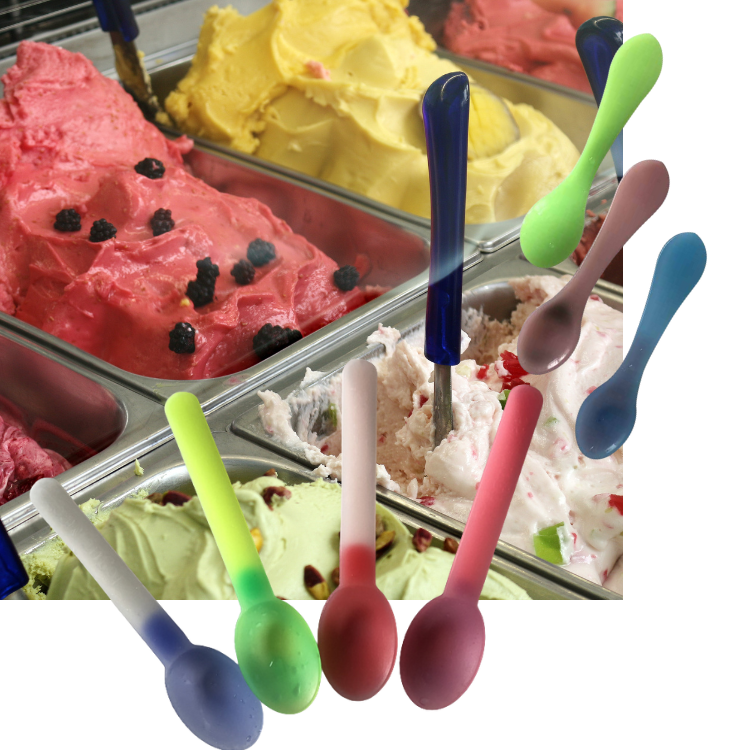
Everfine is a relevant candidate for foodservice buyers purchasing cold-changing dessert spoons alongside other disposable tableware.
Its official company information states that operations began in early 2014 and describes two manufacturing sites. Its portfolio includes plastic cutlery, straws, cups, and other single-use products supplied internationally.
- Establishment: Early 2014, according to the company.
- Core advantage: A broad tableware portfolio and multiple published color-changing spoon variants.
- Main markets: The company describes worldwide supply; a current regional sales breakdown was not verified.
- OEM/ODM scope: Published spoon listings explicitly accept custom colors and packaging.
- Product evidence: Listings identify PP spoons weighing approximately 2.3 g or 2.5 g, with several cold-activated color combinations.
One listing advertises production capacity of 300 million pieces per month and an MOQ of 50 boxes. These are supplier-published figures, not audited spoon-specific capacity. Buyers should clarify whether the capacity covers the whole factory, all cutlery products, or the quoted model. The number of pieces per orderable box also needs confirmation.
Listings display "FDA" and "LFGB" claims. Request the underlying reports rather than treating those labels as verified certificates.
Wenzhou Haocheng is worth considering for customized plastic spoons and coordinated color-changing consumer-product ranges.
Its company profile gives an establishment date of May 7, 2019, and a location in Longgang, Wenzhou. It identifies the business as a manufacturer and trading company.
- Establishment: 2019.
- Core advantage: Publicly described customization from samples and designs.
- Main markets: A current market breakdown was not established from the reviewed profile.
- OEM/ODM scope: Sample-based customization, design-based customization, and broader custom development are advertised.
- Published production information: The profile lists ten production lines, without demonstrating their spoon-specific output.
- Published MOQ: A color-changing spoon listing shows 10,000 pieces.
Some listings use terms such as "degradable," "biodegradable," or "dishwasher safe." Those claims should be treated as verification questions, not accepted product attributes.
Request the precise material formulation, applicable test method, conditions of degradation, and repeated-use evidence before incorporating such wording into retail packaging.
Tianmei is a relevant candidate for buyers developing a coordinated ice cream or frozen-yogurt packaging program.
Its public profile lists plastic spoons, ice cream cups, yogurt cups, and customized plastic items. Product pages explicitly advertise color changing plastic spoons.
- Establishment: A third-party profile reports 2007; confirm the date against the current business license.
- Core advantage: A spoon-and-cup product range suited to dessert-service purchasing.
- Main markets: Its profile lists North America, Eastern and Western Europe, Southeast Asia, Oceania, and the Middle East.
- OEM/ODM scope: Custom disposable spoons, cups, and plastic items are advertised.
- Logistics: Its profile identifies Ningbo as the nearest port and lists several commercial delivery terms.
Public profiles are not fully consistent about business type and background. Buyers should therefore verify the contracting entity, molding location, and whether development work is performed internally.
A useful sample program would assess the spoon and cup together, including packaging fit, presentation, and actual dessert-use performance.
Kingsun is more relevant to infant-feeding projects than to novelty frozen-dessert spoons.
Its published color-changing baby spoon listing describes PP and TPE construction and advertises BPA-free materials.
- Establishment: A reliable legal establishment date was not confirmed in the reviewed sources.
- Core advantage: Product relevance to the baby-feeding category.
- Main markets: A third-party profile lists East Asia, South Asia, Central America, and the Middle East.
- OEM/ODM scope: Buyers should obtain written confirmation of custom tooling, branding, packaging, and temperature-response development.
- Compliance status: Product-specific reports and current factory certifications were not independently verified.
For this supplier category, prioritize temperature-response consistency, construction integrity, cleaning instructions, and appropriate infant-feeding product evaluation.
An attractive soft-tip sample is not enough to substantiate a safety claim.
RoRo offers a publicly listed temperature-sensing baby spoon set and a wider mother-and-baby product portfolio.
Its RR67 listing identifies PP construction, customized colors, and logo printing or embossing.
- Establishment: The company describes specialization in mother-and-baby products since 2000. This is not necessarily the incorporation date of the present legal entity.
- Core advantage: A broader infant-care product range that may support coordinated private-label collections.
- Main markets: A current regional sales distribution was not verified.
- OEM/ODM scope: Custom colors, logo printing, and embossing are explicitly advertised.
- Published MOQ: 3,000 pieces for the reviewed RR67 listing.
- Certification claim: The listing states "ISO" without sufficient detail to verify the standard, certificate number, or current status.
Ask the supplier to clarify exactly which component changes color and the corresponding temperature-response specification.
This is important because a listing titled "temperature sensing" should still be supported by a measurable test method and an approved sample.
Dexuan is a candidate for buyers seeking color-changing spoons within a wider tableware purchasing program.
Its website describes more than ten years of experience in cutlery and tableware, with products including aviation cutlery sets, disposable spoons, stirrers, and related items. It also lists customized color-changing plastic spoons.
- Establishment: A precise incorporation year was not verified.
- Core advantage: A broader cutlery and foodservice product portfolio.
- Main markets: The website references European sales, but a verified market-share breakdown was unavailable.
- OEM/ODM scope: Customized color-changing spoon offerings are advertised.
- Capacity and compliance: Current spoon-specific capacity, MOQ, and applicable test reports require a direct quotation and document review.
Confirm that the quoted sample is genuinely thermochromic. Ordinary colored plastic spoons and temperature-responsive spoons can appear within the same product category.
The table below distinguishes published claims from independently verified performance. "Not established" does not mean that a supplier lacks the capability; it means the reviewed evidence does not establish it.
| Supplier | Primary purchasing focus | Published capacity information | Published MOQ | Certification or testing information |
|---|---|---|---|---|
| Qingdao Focus On Color | Customized thermochromic products | Spoon-specific output not established | 5,000 pieces in one listing | Current product reports require review |
| Ningbo Everfine | Cold-changing foodservice spoons | Listing claims 300 million pieces/month; scope unverified | 50 boxes in one listing | Listings state FDA/LFGB; underlying reports unverified |
| Wenzhou Haocheng | Customized plastic spoons and related products | Ten production lines reported; spoon output unverified | 10,000 pieces in one listing | Applicable reports require review |
| Ningbo Haishu Tianmei | Dessert spoons and coordinated cups | Not established | Request quotation | Applicable reports require review |
| Kingsun Baby Products | Infant-feeding spoons | Not established | Request quotation | BPA-free claim; finished-product evidence required |
| Guangdong RoRo | Temperature-sensing baby spoon sets | Not established | 3,000 pieces for RR67 | Generic ISO claim; certificate details required |
| Dongguan Dexuan | Tableware and customized cutlery | Not established | Request quotation | Applicable reports require review |
Published commercial figures come from the reviewed supplier and product listings and should be reconfirmed before purchase.
Request the Chinese business license, registered company name, factory address, and the identity of the entity receiving payment.
Then establish:
- Where the spoons are molded.
- Where the color-changing material is prepared or purchased.
- Who performs printing and packaging.
- Whether any processes are subcontracted.
- Who owns the molds and technical drawings.
If the invoice entity differs from the manufacturing entity, document the relationship before paying a deposit.
Use a staged process rather than approving one attractive sample:
1. Stock sample: Confirm general size, feel, and product suitability.
2. Development sample: Evaluate the requested colors, response, and branding.
3. Pre-production sample: Use the agreed materials, tooling, and packaging.
4. Production verification: Compare randomly selected production units with the approved specification.
Keep signed reference samples with the buyer, supplier, and inspection provider where practical.
For temperature-response testing, record the starting temperature, test-medium temperature, contact duration, and observed transition. A short promotional video is not a controlled test record.
Ask for a project-specific explanation based on:
- Mold cavity count.
- Cycle time.
- Available machine hours.
- Expected yield.
- Color-changeover requirements.
- Printing or wrapping capacity.
- Existing production commitments.
A factory's total plastic output does not establish its ability to deliver your color changing spoon order on schedule.
Request carton dimensions, gross weight, packing quantity, and the proposed shipping terms.
The landed-cost comparison should include freight, destination charges, duties, testing, inspection, packaging, and expected rejects. Lightweight spoons can produce a misleadingly attractive unit price while requiring substantial shipping volume.
Have the customs broker confirm classification and current destination restrictions. Do not assume that a supplier's advertised tariff code resolves every importing question.
A report for another resin, color, factory, or product may not substantiate the item being purchased.
Compare the report's sample identification with the final specification. Where multiple colors are involved, have the laboratory determine an appropriate testing strategy rather than assuming one color covers all formulations.
Require written approval before changing resin suppliers, additive formulations, colorants, coatings, or manufacturing sites.
The purchasing contract should connect the approved specification to production batches—not merely to the original sample.
"Reusable," "biodegradable," and "recyclable" describe different characteristics. None should be inferred from a material name alone.
For EU projects, establish whether the product can lawfully be marketed before investing in packaging or tooling. Single-use plastic cutlery restrictions remain relevant even when a spoon changes color or carries an environmental claim.
One useful inspection safeguard is to prevent an approved sample from becoming the only reference for a multicavity production tool.
For a custom project, request cavity identification where feasible and a sample set covering every cavity. Specify that production inspection must sample across the full cavity range rather than relying on a small group of hand-selected pieces.
Combine this with inspection of units produced at different stages of the run.
This approach does not assume that a factory has a problem. It creates a more representative acceptance process and helps buyers investigate dimensional or performance differences if they appear.
For color-changing products, inspect functional response and physical quality together. A spoon that changes color convincingly should still meet the agreed requirements for weight, edges, handle strength, and appearance.
A successful color changing spoon program depends on more than a vivid temperature effect. The supplier must control materials, reproduce functional performance, support product-specific documentation, and deliver consistently.
Qingdao Focus On Color is a relevant starting point for buyers seeking specialized thermochromic development and personalized OEM/ODM support. Everfine and Tianmei offer useful foodservice sourcing profiles, while Kingsun and RoRo deserve consideration for infant-feeding applications. Haocheng and Dexuan provide additional customized-plastics and tableware options. Their suitability should be determined through samples, documentation, and project-specific quotations—not the order of this list.
To begin a project with Qingdao Focus On Color Industry & Trade Co., Ltd., prepare a brief covering the destination market, intended use, activation range, spoon dimensions, order quantity, branding, and packaging. Request a written development proposal, samples, and the compliance evidence needed for your product before approving production.
Request the certificate number, certified legal entity, site address, standard, scope, and issuing certification body.
Search the company or certificate through IAF CertSearch. Review the status, scope, locations, and accreditation information—not just the expiry date printed on a PDF. If the result is unclear, contact the issuing certification body directly.
An active certificate covering trading activities or an unrelated site is not equivalent to certification of the spoon manufacturing operation.
Not automatically.
The EU plastics framework regulates composition and the finished food-contact article. Buyers should therefore establish whether the tested formulation and use conditions represent the products being ordered.
Ask the laboratory to assess differences in resin, additives, colors, decorations, and intended use. A documented testing rationale is preferable to a supplier's unsupported statement that "all colors are the same."
Passing food-contact tests does not by itself establish market access.
The EU prohibition on specified single-use plastic products includes spoons. Buyers must assess product classification and applicable restrictions separately from chemical compliance.
Do not rely on simply relabeling a disposable spoon as reusable. A repeated-use product needs a design, instructions, and supporting evaluation appropriate to that intended use.
Define the acceptance method before sampling.
Specify controlled starting conditions, test-medium temperature, immersion or contact depth, observation time, transition criteria, and recovery requirements. Compare multiple samples rather than accepting one demonstration.
The documented 43°C example from the Institute of Making illustrates why a numerical threshold must be tied to a particular construction and product—not copied into every supplier's specification.
Avoid presenting the spoon as a calibrated thermometer unless evidence supports that claim.
Suspend approval of the changed version until the technical and compliance implications have been reviewed.
Require a written change notice identifying the affected materials, batches, and documents. Arrange any necessary sampling or retesting before shipment.
For EU-bound products, composition and intended-use requirements remain central to the plastics food-contact framework. A visual color-change demonstration does not establish chemical compliance.
- China Customs, "China's Major Exports by Quantity and Value, December 2025": official annual export context for plastic products. [english.customs.gov]
- European Commission, "Food Contact Materials—Legislation": the EU regulatory framework and plastics Declaration of Compliance requirements. [food.ec.europa]
- EUR-Lex, Commission Regulation (EU) 2025/351: the 2025 amendments relevant to plastic food-contact materials and repeated-use articles. [eur-lex.europa]
- European Union, "Single-use Plastics": prohibited product categories, including single-use plastic spoons. [europa]
- IAF CertSearch: verification of accredited management-system certification status, scope, and certified entities. [iafcertsearch]


