+86 18560646018

Views: 236 Author: Focus Color Publish Time: 2026-08-18 Origin: Site


Content Menu
● Why Vivarium Balance Matters
● Liquid Crystal Sheet: How It Works
>> Main Advantages of Liquid Crystal Sheets
>> Limits of Liquid Crystal Sheets
● Digital Thermo-Hygrometers: What They Measure
>> Main Advantages of Digital Monitoring
● Liquid Crystal Sheet vs. Digital Monitor
● Expert Setup: Use Both Intelligently
>> Recommended Two-Layer Monitoring System
● Sensor Placement Changes the Result
● Choosing the Right Product for Different Buyers
>> For Individual Amphibian Keepers
>> For Breeders and Multi-Enclosure Facilities
>> For Pet Brands and Vivarium Accessory Distributors
>> For Educational and Retail Environments
● Product Quality Factors to Check
● Build a Better Vivarium Monitoring Solution
>> Is a liquid crystal thermometer accurate enough for an amphibian vivarium?
>> Should I use a digital thermometer or a digital thermo-hygrometer?
>> Where should I place a digital hygrometer probe in a frog vivarium?
>> Can one monitor measure the entire vivarium?
>> Do liquid crystal sheets work on the inside of a vivarium?
>> Why does my digital hygrometer show a different result from another meter?
>> Can a liquid crystal sheet be customized for a pet-accessory brand?
Maintaining the right amphibian vivarium humidity-temperature balance is not a cosmetic detail—it is a core part of responsible habitat management. For frog, salamander, newt, and other amphibian keepers, the choice between a liquid crystal sheet and a digital thermometer hygrometer affects how quickly they can identify overheating, drying substrate, poor airflow, or an unsuitable microclimate.
At Qingdao Focus On Color Industry & Trade Co., Ltd., we have more than 13 years of manufacturing experience in thermochromic materials, liquid crystal temperature indicators, customized temperature-monitoring products, and OEM/ODM solutions. From a product-development perspective, liquid crystal sheets and digital devices should not be viewed as interchangeable. Each has a distinct purpose, installation logic, and performance profile in an amphibian vivarium.
A liquid crystal temperature sheet provides fast, visual, battery-free temperature indication. A digital thermo-hygrometer provides numerical readings, humidity monitoring, and often higher-control features such as probes, alarms, and minimum/maximum records. For most amphibian keepers, the strongest setup is not "one or the other," but a properly placed digital monitor supported by a liquid crystal sheet for rapid visual checks.
Amphibians depend heavily on their surrounding environment because they do not regulate body temperature internally in the way mammals do. Temperature influences activity, feeding, digestion, immune response, breeding behavior, and dehydration risk. Humidity affects skin health, hydration, shedding, substrate moisture, and the condition of planted or bioactive enclosures.
The correct range is always species-specific. A cool-adapted salamander, a tropical dart frog, and a White's tree frog should not be managed to the same target temperature or humidity level. Husbandry guidance commonly emphasizes building gradients rather than pursuing one uniform number across the entire enclosure. Cooler and warmer zones, damp and less-damp zones, and suitable hides allow the animal to choose its preferred microclimate.
A monitoring device should therefore help answer practical questions:
- Is the warm side becoming dangerously hot?
- Is humidity dropping after lights or ventilation start?
- Is the substrate area wetter than the upper foliage?
- Does the vivarium cool sufficiently overnight?
- Are misting, heating, and airflow creating stable conditions?
- Can the keeper spot a problem before it affects the animal?
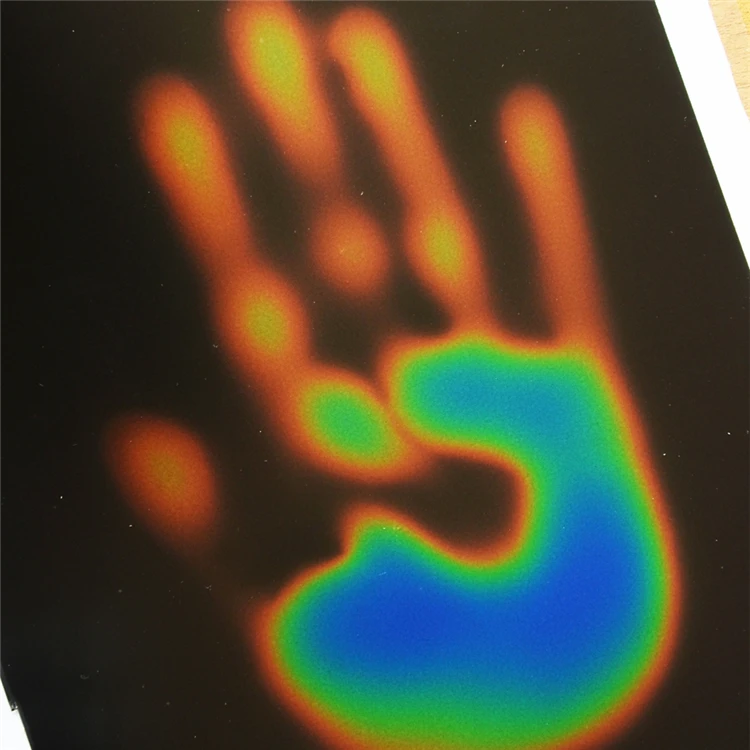
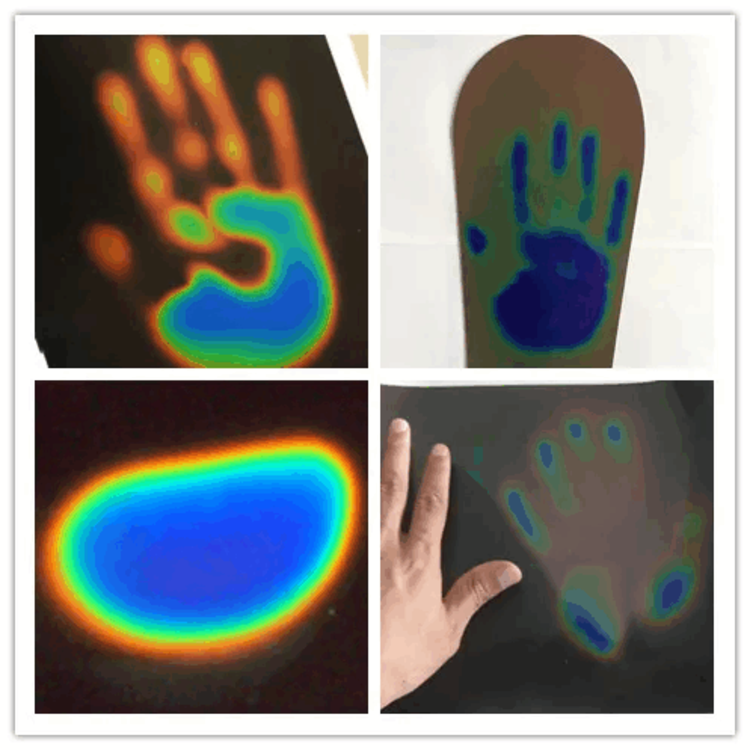
A liquid crystal sheet is a temperature-sensitive display material. It contains thermochromic liquid crystal formulations that change reflected color within a defined temperature range. The visible color corresponds to the approximate surface temperature being measured.
For vivarium use, the sheet is usually applied to the outside of glass or acrylic. The keeper reads the color scale through the front, side, or rear panel without opening the enclosure.
No battery or wiring required. The sheet works passively. It does not require power, charging, cables, or a separate sensor probe.
Instant visual status check. A keeper can see an approximate temperature condition from several steps away. This is helpful in retail displays, breeding rooms, classrooms, and multi-tank collections.
Low-profile installation. A thin liquid crystal strip or sheet takes up almost no usable enclosure space and does not create a cable-management issue.
Excellent for custom branding. Manufacturers and distributors can customize the size, printed scale, logo, packing, temperature range, adhesive method, and color presentation. This makes liquid crystal sheets suitable for private-label vivarium accessory programs.
Resistant to routine handling. When designed with appropriate lamination and adhesive materials, an external sheet avoids direct moisture, mist, animal contact, and substrate contamination.
The key limitation is that a liquid crystal sheet is primarily a surface-temperature indicator, not a complete environmental monitoring system. When attached to the exterior glass, it reflects the temperature at or near that panel. It does not necessarily represent the temperature inside a humid hide, close to the substrate, beneath a canopy, or near the heat source.
It also does not measure relative humidity. For amphibian habitats, this is a major consideration because a temperature-only indicator cannot confirm whether the enclosure is becoming too dry or overly saturated.
Liquid crystal technology is best understood as a quick reference tool. It is useful for spotting trends and confirming that a glass panel is within an expected range, but it should not be the only measurement method for sensitive species, breeding projects, quarantine systems, or high-value collections.
A digital thermo-hygrometer uses electronic sensors to display temperature and relative humidity as numerical values. Models may include an integrated sensor, a remote probe, dual probes, wired displays, wireless transmission, alarm settings, or minimum/maximum memory.
For amphibian vivariums, a probe-based digital unit is particularly useful because the display can remain outside the enclosure while the sensor is positioned in the actual zone being evaluated.
Temperature and humidity in one device. This is the most important benefit. Amphibian care requires attention to both variables, not temperature alone.
Numerical readings. A display such as 23.6°C and 78% RH gives a more actionable reference than an approximate color band.
Remote sensor placement. A probe can be placed near the substrate, in the middle zone, near a plant canopy, or close to a hide—depending on the question being tested.
Minimum and maximum tracking. Many units record daily highs and lows. This helps reveal problems that occur while the keeper is away, such as a heat spike at midday or a humidity drop overnight.
Alarm capability. Certain models allow high/low alarms, which can provide an early warning before a dangerous condition persists.
Better management of gradients. Digital sensors make it easier to map different areas in a large enclosure or a rack system.
Specialized digital terrarium products often offer temperature ranges suitable for vivarium work and humidity measurement across a broad relative-humidity range. Some probe units state temperature accuracy around ±1°C and humidity accuracy around ±5% RH, although actual specifications vary by manufacturer and model.
Digital units require more care than a liquid crystal sheet. Batteries can fail, probes can be misplaced, condensation can affect sensors, and inexpensive models may drift or respond slowly in saturated conditions. A display placed outside the enclosure may also measure room air rather than the animal's actual environment unless its remote sensor is correctly positioned.
A digital device is only as reliable as its installation. If the probe is directly under a misting nozzle, pressed against a warm glass wall, touching wet substrate, or placed beside a heat emitter, the reading may not represent the habitat zone you intend to monitor.
| Feature | Liquid Crystal Sheet | Digital Thermo-Hygrometer |
|---|---|---|
| Primary measurement | Approximate surface temperature | Temperature and relative humidity |
| Power requirement | None | Battery, USB, or external power |
| Humidity reading | No | Yes |
| Display style | Color-changing visual scale | Numerical LCD or electronic display |
| Best location | Outside glass or acrylic panel | Sensor positioned inside the target zone |
| Installation complexity | Very simple | Moderate, especially with probes |
| Trend visibility | Fast visual indication | Better with min/max history |
| Alarm functions | No | Available on selected models |
| Suitable for multi-tank scanning | Very good | Good, but each unit needs setup |
| Best use | Quick visual temperature reference | Primary environmental monitoring |
| OEM/ODM flexibility | Excellent for size, printing, range, packaging | Depends on electronics and firmware |
| Recommended role | Secondary visual indicator | Main measurement device |
The practical conclusion is clear: a digital thermo-hygrometer is the stronger primary instrument for maintaining amphibian vivarium humidity-temperature balance. A liquid crystal sheet adds value as an easy-to-read, battery-free supplementary temperature indicator.
From a manufacturing and product-application viewpoint, the most effective monitoring strategy uses each technology for what it does best.
1. Install a digital thermo-hygrometer with a remote probe inside the vivarium.
2. Place the probe in the zone that matters most for the species: typically mid-level air, a humid hide area, or near the substrate surface.
3. Add a second digital probe or meter when the enclosure has a strong heat gradient, dense planting, a waterfall, or a large footprint.
4. Apply a liquid crystal sheet externally to the warm-side glass panel for quick visual temperature scanning.
5. Record morning and evening readings for at least several days after changing heating, lighting, misting, substrate, ventilation, or seasonal room conditions.
6. Compare readings with the species' established care requirements rather than using a universal target.
This setup improves both speed and depth. The liquid crystal sheet helps staff or keepers notice a visible temperature change immediately. The digital instrument provides the exact temperature-humidity information needed to decide whether to adjust misting, ventilation, insulation, thermostat settings, or heat-source distance.
A common mistake is purchasing a good device but installing it in the wrong location. In vivariums, microclimates can differ significantly within a short distance.
- Directly below a misting nozzle
- Directly beneath a heat lamp or ceramic heat emitter
- Pressed against heated glass
- Buried in saturated substrate unless the sensor is designed for it
- Immediately beside a water feature
- Outside the enclosure when measuring internal conditions is the goal
- At the very top of a tall planted enclosure only
- Mid-height center zone: useful for general ambient monitoring.
- Near the animal's preferred hide: useful for assessing a primary resting area.
- Cool side: essential when preventing overheating is the main priority.
- Warm side: useful for checking the intended thermal gradient.
- Substrate-adjacent zone: useful for terrestrial species that rely on moist substrate conditions.
For sensitive species, use at least two measuring points. One reading cannot describe a complex planted vivarium. Husbandry resources also recommend monitoring environmental parameters repeatedly for several days before animals are introduced, particularly to identify maximum temperatures and prevent overheating.
Choose a digital thermo-hygrometer as the main monitor. Look for a clear display, a reliable probe, temperature and humidity readout, and minimum/maximum memory. Add a liquid crystal strip if you want a simple external visual reference.
Use digital monitoring for each enclosure or critical zone, with a standardized inspection schedule. Liquid crystal sheets can be used as color-coded visual checks on enclosure fronts, especially where staff need to scan many units quickly.
A customized liquid crystal sheet can be a differentiated accessory because it is thin, low-cost, lightweight, easy to package, and suitable for logo printing. It works well as part of a starter kit, educational kit, or bundled monitoring solution.
For a more complete product line, combine:
- Customized liquid crystal temperature strips
- Digital thermometer-hygrometers
- Branded probe holders or suction cups
- Care instruction cards
- Custom blister cards, header cards, labels, and retail packaging
Liquid crystal sheets are particularly useful where users need fast visual understanding without touching equipment or opening the enclosure. However, staff should still rely on digital temperature and humidity readings for routine husbandry decisions.
Whether you source liquid crystal temperature sheets or digital vivarium monitors, product consistency matters.
For liquid crystal sheets, evaluate:
- Active temperature range and readable scale
- Color response clarity
- Adhesive compatibility with glass or acrylic
- Resistance to UV exposure and ambient humidity
- Printing durability
- Thickness and edge finishing
- Batch-to-batch color consistency
- Custom scale, logo, and packaging options
For digital thermo-hygrometers, evaluate:
- Temperature and humidity accuracy specifications
- Response time
- Probe construction and cable length
- Condensation resistance
- Display readability
- Battery compartment quality
- Minimum/maximum memory
- Alarm function, if required
- Calibration and quality-control process
A low price alone does not confirm suitability for an amphibian enclosure. The best product is the one that provides reliable information in the intended humidity range, can be installed correctly, and fits the keeper's daily monitoring routine.
For dependable amphibian vivarium humidity-temperature balance, use a digital thermo-hygrometer as the primary monitoring tool and a liquid crystal sheet as a quick, visible temperature reference. This approach gives keepers both precise data and fast daily visibility.
Qingdao Focus On Color Industry & Trade Co., Ltd. provides customized liquid crystal temperature sheets, thermochromic products, temperature-indicating solutions, OEM/ODM services, and tailored packaging options for global pet, terrarium, promotional, educational, and specialty-product brands. Contact our team to develop a customized liquid crystal temperature indicator that fits your target temperature range, branding needs, and market requirements.
A liquid crystal thermometer can provide a useful approximate temperature reference, especially for external glass panels. However, it does not measure humidity and may not reflect the temperature in the animal's actual microhabitat. Use it as a supplementary visual indicator rather than the only monitoring device.
For most amphibian vivariums, choose a digital thermo-hygrometer. Amphibians are affected by both temperature and humidity, so a combined device provides more useful daily information.
Place the probe in a representative area where the frog spends time, often around mid-height or near the preferred resting zone. Keep it away from direct misting, direct heat, and standing water unless the product is designed for those conditions.
Usually not. Large, tall, planted, heated, or heavily misted vivariums can contain different microclimates. Two or more measurement points are recommended when the enclosure has a meaningful temperature or humidity gradient.
They are generally more practical on the outside surface. External placement avoids direct water exposure, animal contact, cleaning chemicals, and substrate contamination while keeping the scale easy to read.
Differences can result from sensor accuracy tolerances, sensor location, response time, calibration, airflow, condensation, and exposure to mist or heat. Compare devices in the same stable location before deciding that one is faulty.
Yes. Liquid crystal sheets can be customized by size, temperature range, printed design, logo, language, packaging, adhesive format, and retail presentation. This makes them suitable for OEM and ODM vivarium accessory programs.
1. Oxford Academic. [Amphibian Biology and Husbandry].
2. Purdue University. [Equipment Quality Assurance for Animal Facility Equipment: Husbandry Care of Amphibians].
3. Royal Veterinary College. [White's Tree Frog Care Sheet].
4. Amphibian Ark. [Amphibian Husbandry Resource Guide].
5. Northwest Regional Wildlife Center. [Amphibian Medicine Part 1].
6. Thermometer World. [Digital Thermometer Hygrometer with Remote Probes].
7. TFA Dostmann. [Digital TerraCheck Thermo-Hygrometer Product Information].


