+86 18560646018

Views: 261 Author: Focus Color Publish Time: 2026-08-24 Origin: Site


Content Menu
● Why China for Thermometer Cards?
● Top 10 Thermometer Card Suppliers in China
>> 1. Qingdao Focus On Color Industry & Trade Co., Ltd.
>> 2. Hangzhou Universal Electronic Co., Ltd.
>> 3. Shenzhen Meibang Precision Technology Co., Ltd.
>> 4. Good Idea Promotion Limited
>> 5. Taizhou Harsoul Imp. & Exp. Co., Ltd.
>> 6. Shanghai Brother Medical Manufacturer Co., Ltd.
>> 7. Focus On Color Co., Ltd.
>> 9. Guangdong Color-Changing Product Specialists
>> 10. Zhejiang Promotional and Gift-Product Suppliers
● Supplier Comparison: Capacity, MOQ, and Documentation
● Technical Requirements Buyers Should Specify
>> 1. "Same appearance" does not mean same performance
>> 2. The quoted temperature range is not the usable range
>> 3. Low-cost substrate can distort the product
>> 4. Artwork can interfere with readability
>> 5. "CE compliant" may be used too loosely
● Internal Sourcing Tip: Test the Transition, Not Only the Number
● Buyer's Guide: From Inquiry to Shipment
>> Step 1: Send a technical RFQ
>> Step 2: Request a specification confirmation
>> Step 3: Approve a physical sample
>> Step 4: Verify factory and documentation
>> Step 5: Conduct pre-shipment inspection
>> Step 6: Plan logistics and storage
● FAQ
>> 1. How can I verify whether a supplier's ISO certificate is still valid?
>> 2. What accuracy should I expect from a liquid crystal Thermometer Card?
>> 3. Can a supplier customize both the temperature range and the printed artwork?
>> 4. Why do some samples show more than one color or activate adjacent temperature windows?
>> 5. Is RoHS or CE always required for Thermometer Cards sold in Europe?
China remains an important sourcing base for Thermometer Cards, including liquid crystal forehead thermometers, baby bath cards, aquarium thermometer strips, wine thermometer cards, room-temperature cards, and promotional temperature indicators. Buyers benefit from mature printing, packaging, color-changing material, and export-logistics capabilities—provided they distinguish specialist manufacturers from general trading listings.
A liquid-crystal thermometer is a passive indicator: heat-sensitive liquid crystals change reflected color across a specified temperature range, allowing the user to identify the approximate current temperature without batteries or electronics.
This article is designed for procurement teams looking for long-term partners—not simply the lowest unit quote.

The companies below are presented as a practical sourcing shortlist rather than a laboratory-certified ranking. Thermometer Card projects vary substantially by application, temperature range, accuracy increment, substrate, packaging, and regulatory destination. Buyers should validate every claim through documentation, samples, and factory communication before issuing a purchase order.
Key assessment dimensions include:
- Product specialization: Experience with liquid-crystal thermometer cards, temperature strips, thermochromic materials, printing, or related color-changing products.
- Customization capability: Ability to support private label graphics, custom temperature ranges, shapes, adhesive backings, multilingual instructions, retail packaging, and brand-specific artwork.
- Quality-control process: Incoming inspection of liquid-crystal material, color-transition checks, print registration control, lamination inspection, adhesion testing, and batch traceability.
- Compliance readiness: Ability to provide relevant material declarations, RoHS documentation where applicable, REACH-related information for EU-bound products, packaging compliance files, and product-specific test reports.
- Communication and delivery stability: Clear specification confirmation, sample approval workflow, realistic production scheduling, export experience, and response speed.
- MOQ flexibility: Suitability for both established importers and smaller brands testing a new product category.
Thermometer Card production often depends on more than temperature-sensitive liquid crystal. A finished product may require precision screen printing or offset printing, PET/PVC/paperboard selection, transparent protective films, pressure-sensitive adhesive, die cutting, retail packaging, and export carton engineering.
China's advantage comes from the ability to combine these processes within established manufacturing networks. Qingdao supports export-oriented printing and consumer-product supply chains through its port access, while Zhejiang and Guangdong offer dense ecosystems for promotional products, electronic accessories, packaging, and precision processing. China Customs maintains official trade-statistics resources that buyers can use when evaluating broader import and export conditions.
The wider Chinese temperature-sensor market was valued at approximately US$1.49 billion in 2025 and is projected to reach about US$1.87 billion by 2030, according to MarketsandMarkets. That figure covers a much broader category than Thermometer Cards, but it illustrates the scale of the country's temperature-related supply ecosystem.
| Supplier | Location | Core focus | Suitable buyer profile | OEM/ODM emphasis |
|---|---|---|---|---|
| Qingdao Focus On Color Industry & Trade Co., Ltd. | Qingdao, Shandong | Liquid crystal thermometers and color-changing products | Small and mid-sized brands, promotional buyers, customized projects | Strong support for graphics, product format, temperature-related color-change applications |
| Hangzhou Universal Electronic Co., Ltd. | Hangzhou, Zhejiang | Electronic and thermometer-related products | Buyers seeking larger catalog sourcing | Product and packaging customization |
| Shenzhen Meibang Precision Technology Co., Ltd. | Shenzhen, Guangdong | Precision and customized thermometer-related items | Buyers with technical or compact-format requirements | Engineering-oriented customization |
| Good Idea Promotion Limited | Zhejiang | Promotional merchandise and temperature-indicator products | Promotional and gift-market buyers | Logo, packaging, and campaign customization |
| Taizhou Harsoul Imp. & Exp. Co., Ltd. | Taizhou, Zhejiang | Export-oriented gift and promotional products | Buyers needing mixed promotional-product sourcing | Private-label and packaging support |
| Shanghai Brother Medical Manufacturer Co., Ltd. | Shanghai | Medical and personal-care thermometer products | Medical-adjacent and baby-care purchasers | Product labeling and export-market documentation |
| Qingdao Focus On Color / Focus On Color Co., Ltd. | Qingdao, Shandong | Thermochromic, photochromic, fragrance and LCD thermometer products | Brands requiring color-changing specialty products | Custom applications and promotional formats |
| Two Changing Co., Ltd. | Taiwan, China | Encapsulated liquid-crystal and Chromicolor applications | Buyers prioritizing liquid-crystal specialization | TLC format, consumer-use and promotion applications |
| Shenzhen-based color-changing product specialists | Guangdong | Thermochromic and liquid-crystal product development | Projects requiring fast design iteration | Custom print, shape, and color-change effects |
| Zhejiang promotional-product suppliers | Zhejiang | Thermometer strips, cards, labels, and related promotional items | High-volume standard-format purchasing | Branding, retail pack, and assortment customization |
Qingdao Focus On Color Industry & Trade Co., Ltd. is a practical option for buyers looking for Thermometer Cards combined with color-changing material expertise. Its product scope includes liquid crystal thermometers, photochromic products, thermochromic products, fragrance-related products, printing, packaging, and promotional products. Public supplier listings also identify applications such as forehead, bath, room, milk-bottle, aquarium, wine, urine, and clothing thermometers.
For procurement teams, the company's value is not limited to supplying a standard liquid crystal thermometer strip. It is particularly relevant for projects requiring custom graphics, branded cards, promotional use, packaging adaptation, or a combined color-changing product concept.
Core strengths
- More than 13 years of manufacturing experience, based on company-provided information.
- Broad familiarity with liquid-crystal, thermochromic, photochromic, and scented-product applications.
- Suitable for customized Thermometer Card formats, including branded card layouts, retail-ready packaging, and promotional concepts.
- Qingdao location offers export convenience through proximity to Qingdao Port.
- Flexible communication model that can suit small and medium-sized brands developing custom products or testing initial market demand.
Recommended for
- Baby-care, household, beverage, aquarium, pharmacy, educational, and promotional-product brands.
- Buyers who need a supplier to discuss artwork, temperature range, packaging, and material selection together.
- Importers who prefer a more flexible OEM/ODM process rather than a strictly catalog-based purchasing model.
A reliable supplier should be willing to clarify the reading range, scale interval, substrate structure, adhesive requirement, product storage conditions, and visual approval standard before quoting. This is especially important for custom Thermometer Cards because the appearance of the color transition can vary according to design, viewing angle, and environmental conditions.
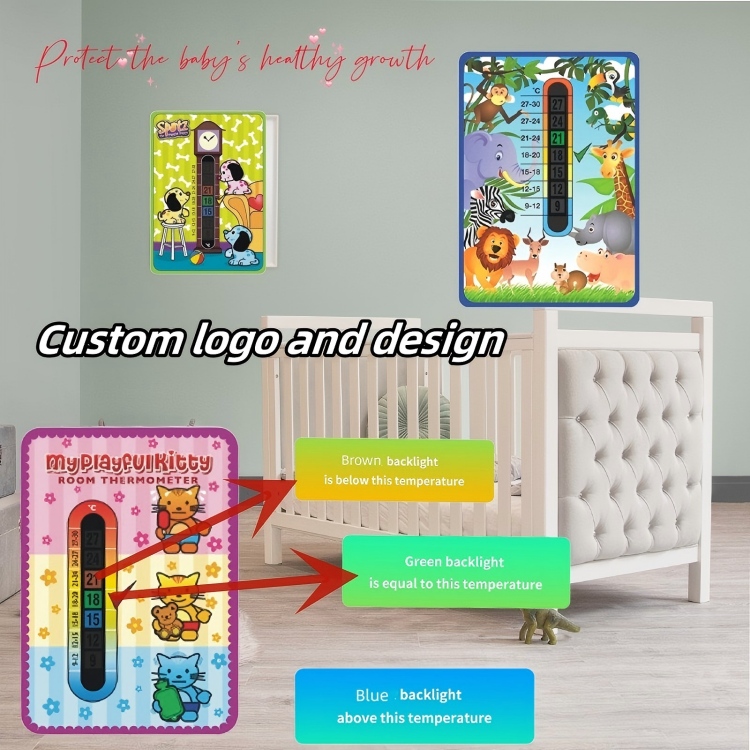
Hangzhou Universal Electronic is listed among Chinese suppliers offering wholesale liquid crystal thermometer products. It may be relevant for buyers looking for broader thermometer-related sourcing from Zhejiang, a region with mature export manufacturing and promotional-product supply chains.
Core strengths
- Potential fit for buyers seeking standard thermometer formats at commercial volume.
- Zhejiang location can be useful for buyers consolidating gifts, household products, and consumer accessories.
- Suitable for evaluating catalog-based models alongside custom packaging requirements.
Buyer checks
- Confirm whether the company is the direct producer of the liquid-crystal display element, the finished card converter, or an integrated sourcing supplier.
- Request lot-specific temperature-response test data, not only catalog images.
- Confirm if temperature increments are 1°C, 0.5°C, or customized.
Shenzhen Meibang Precision Technology is listed as an audited supplier for liquid-crystal thermometer products, with published listings indicating lower MOQ possibilities than some promotional-product suppliers.
Shenzhen's manufacturing environment is particularly useful when a Thermometer Card project overlaps with electronic accessories, precision converting, compact plastic components, or product-development requirements.
Core strengths
- Potential suitability for compact, precision-oriented, or more engineered product formats.
- Guangdong sourcing ecosystem supports rapid development cycles.
- May suit buyers requiring smaller initial quantities, subject to product specifications.
Buyer checks
- Determine whether temperature-indicator films are produced in-house or sourced externally.
- Ask for dimensional tolerances for die-cut cards and strip products.
- Confirm adhesive compatibility for the final use surface, such as glass, plastic, paperboard, metal, or curved containers.
Good Idea Promotion Limited is listed as a Zhejiang supplier for wholesale liquid-crystal thermometer products, with a published MOQ example of 5,000 pieces.
This type of supplier can be useful when Thermometer Cards are used as promotional inserts, branded gifts, campaign items, or value-added packaging components.
Core strengths
- Promotional-product orientation.
- Better fit for graphics-led projects, event giveaways, educational cards, and branded consumer gifts.
- Potentially efficient for standard designs at higher volumes.
Buyer checks
- Ensure the selected liquid-crystal temperature range fits the actual use case, rather than treating the card as a generic giveaway.
- Ask whether the quoted price includes custom printing, back-card instructions, individual sleeves, and barcode labels.
- Confirm whether the MOQ applies to the entire order or to each individual artwork and temperature range.
Taizhou Harsoul Imp. & Exp. is listed among suppliers of wholesale liquid-crystal thermometer products in Zhejiang.
For buyers purchasing Thermometer Cards as part of a wider promotional, educational, home-use, or gift-product assortment, an export-focused supplier may offer sourcing consolidation benefits.
Core strengths
- Potential sourcing option for importers managing multi-SKU purchase orders.
- Zhejiang supply-chain access for packaging, gifts, consumer goods, and export logistics.
- Suitable for evaluating mixed-product consolidation opportunities.
Buyer checks
- Identify the actual manufacturing site for the temperature-sensitive component.
- Require a written product specification sheet before sampling.
- Clarify who owns the approved artwork files and custom die-cut tooling.
Shanghai Brother Medical Manufacturer appears in marketplace listings for liquid crystal thermometer products, including baby bath thermometer card formats.
Medical-adjacent product suppliers can be relevant for buyers developing baby-care, hygiene, wellness, or pharmacy-channel products. However, a liquid crystal forehead or bath card should not automatically be described or marketed as a medical diagnostic device unless the applicable regulatory pathway and supporting evidence are in place.
Core strengths
- Potential relevance for baby-care and personal-wellness applications.
- Shanghai location may offer convenient export coordination and access to healthcare-related supply resources.
- Useful comparison point for buyers whose project requires health-oriented packaging or product presentation.
Buyer checks
- Clearly define whether the product is intended as a screening aid, general indicator, wellness product, or regulated medical device.
- Confirm the applicable destination-market labeling requirements.
- Verify whether temperature accuracy claims are based on validated tests and under what measurement conditions.
Focus On Color is also publicly listed as a Qingdao-based manufacturer/factory and trading company with liquid-crystal thermometer products and color-changing promotional items. Its public profile describes product coverage including scratch-and-sniff stickers, liquid crystal thermometers, UV color-changing cards, color-changing apparel, spoons, cups, and promotional gifts.
For buyers, this demonstrates the relevance of a specialized color-changing material supplier when a Thermometer Card project requires a broader branded experience rather than a standard strip alone.
Core strengths
- Cross-category color-changing expertise.
- Suitable for educational, promotional, and consumer-engagement applications.
- Potential to combine Thermometer Cards with scent printing, heat-sensitive effects, or UV-reactive promotional concepts.
Buyer checks
- Separate performance specifications for each effect: liquid-crystal temperature response, thermochromic color-change point, and photochromic response should not be assumed to follow the same test method.
- Request sample approval under defined lighting and temperature conditions.
- Confirm whether decorative thermochromic inks are reversible and whether they are suitable for the intended exposure conditions.
Two Changing Co., Ltd. has focused on encapsulated liquid crystals and Chromicolor color-changing product applications since 1983, according to its public company profile. Its listed applications include TLC thermometers for medical and home use, baby care, wine accessories, promotions, and color-changing plastics.
Although located in Taiwan, China, it is relevant for buyers comparing Chinese-speaking liquid-crystal product specialists in the wider regional supply base.
Core strengths
- Long-term specialization in encapsulated liquid-crystal applications.
- Relevant experience in consumer, promotion, wine, baby-care, and home-use temperature indicators.
- Useful benchmark supplier for buyers with demanding liquid-crystal application requirements.
Buyer checks
- Confirm manufacturing location, lead time, currency terms, and export arrangement for the target market.
- Compare sample transition consistency against mainland China options.
- Request storage-life guidance and recommended product shelf-life conditions.
Guangdong, especially Shenzhen and Dongguan, is a logical sourcing region for projects that combine printing, plastics, labels, packaging, and color-changing effects. Marketplace listings show specialized mainland suppliers offering thermochromic, hydrochromic, and photochromic materials alongside liquid-crystal thermometer products.
Core strengths
- Fast product-development environment.
- Suitable for customized shapes, packaging formats, novelty products, and promotional-card development.
- Potential access to precision printing, converting, and electronic-product supply chains.
Buyer checks
- Do not assume a supplier's expertise in thermochromic ink means equivalent expertise in calibrated liquid-crystal thermometer cards.
- Request a reference sample with the same temperature range, substrate, and product structure.
- Test the production sample after transport simulation and after exposure to realistic storage conditions.
Zhejiang has a large ecosystem of promotional-product and export suppliers offering liquid crystal thermometer strips, cards, and related consumer items. Published marketplace listings include suppliers in Zhejiang with different MOQ structures and business models.
Core strengths
- Efficient for standardized promotional-format Thermometer Cards.
- Wide access to printing, packaging, gift, and private-label services.
- Appropriate for mature designs with clear specifications and medium-to-high order volumes.
Buyer checks
- Confirm whether a supplier is a manufacturer, converter, exporter, or trading company.
- Ensure the same approved liquid-crystal source is maintained for repeat orders.
- Avoid approving products solely from a digital artwork proof; require physical samples.
Actual capacity, MOQ, and certifications vary by product specification, artwork count, temperature range, packaging, and season. The table below should be treated as a sourcing discussion framework, not as a guaranteed supplier quotation.
| Supplier type | Typical order fit | Indicative MOQ approach | Capacity discussion | Documentation to request |
|---|---|---|---|---|
| Color-changing specialist | Custom OEM/ODM and branded cards | Often project-based | Ask for monthly output by card format and production line | Material declaration, QC plan, sample test record |
| Promotional-product supplier | Standard or campaign-based cards | Often 2,000–5,000+ pieces | Ask about peak-season availability and artwork capacity | Packaging specs, artwork approval process, carton details |
| Precision-processing supplier | Compact, engineered, or special-format products | May allow lower MOQ for selected items | Ask about die-cutting, lamination, and adhesive converting capacity | Dimensional tolerance and inspection plan |
| Medical-adjacent supplier | Baby-care and wellness products | Product-dependent | Ask for batch traceability and labeling controls | Relevant test reports, declarations, labeling review |
| Export trading supplier | Multi-product consolidation | Depends on source factory | Ask who controls production scheduling and final QC | Factory identity, third-party inspection access, export records |
Published marketplace examples show MOQ levels such as 2,000 pieces for some baby bath thermometer card listings and 5,000 pieces for some wholesale liquid-crystal thermometer offerings. These figures are useful benchmarks only; custom artwork, special ranges, and retail packaging can raise the practical MOQ.
A Thermometer Card quotation is incomplete unless the buyer provides measurable requirements. "Liquid crystal thermometer card" is a category, not a complete technical specification.
Include the following in your RFQ:
| Requirement | What to define |
|---|---|
| Temperature range | For example: 10–40°C, 20–30°C, 35–40°C, or application-specific range |
| Scale interval | 0.5°C, 1°C, 2°F, 1°F, or custom interval |
| Reading indication | Single active color, multi-color scale, numerical window, or arrow-based guide |
| Accuracy expectation | Define expected tolerance and the test condition |
| Response behavior | Required response speed and recovery time |
| Liquid-crystal type | Reversible or irreversible indicator; most reusable cards use reversible materials |
| Substrate | PET, PVC, PP, coated paperboard, composite card, or customized construction |
| Adhesive | No adhesive, removable adhesive, permanent adhesive, or custom backing |
| Printing | CMYK, Pantone, white ink, spot varnish, metallic effect, multilingual instruction |
| Product format | Strip, card, circle, rectangle, bottle label, wristband, hang tag, or custom shape |
| Packaging | Bulk pack, individual OPP sleeve, paper envelope, blister card, retail box, or kit |
| Storage conditions | Temperature, humidity, shelf-life, and protection from direct sunlight |
| Compliance file | RoHS, REACH-related declarations, packaging compliance, country-specific requirements |
For general liquid crystal thermometer products, the temperature-sensitive layer changes color as temperature changes. It is important to define the exact visible reading rule: for example, whether the green segment indicates the current temperature while adjacent tones indicate nearby values.
Two cards may use identical artwork yet perform differently. The liquid-crystal formulation, encapsulation quality, lamination method, protective film, and storage history affect transition behavior.
How to avoid it: Request samples from the actual planned production construction, not merely a visually similar stock card.
A supplier may quote a broad range, but only a narrow portion may be clearly readable under actual lighting conditions.
How to avoid it: Define the normal operating range and ask for a video or test record showing the card across the entire range.
Thin or unstable substrates can warp after humidity exposure, curl near adhesive edges, or make the liquid-crystal area difficult to read.
How to avoid it: Specify substrate thickness, lamination structure, and flatness standard. Test samples after heat, humidity, and transit simulation.
Dark backgrounds, glossy reflections, overly dense graphics, or poor window placement can reduce visibility of the temperature indicator.
How to avoid it: Reserve adequate contrast around the active display area. Approve physical color proofs, not only PDF artwork.
CE marking is not a universal quality certificate for every consumer item. Its relevance depends on the product classification and applicable EU legislation. A general-purpose temperature indicator card should not be assumed to require or qualify for CE marking simply because it measures temperature.
How to avoid it: Ask the supplier which regulation supports any CE claim, obtain the declaration and test basis, and review the product's intended use with your importer or compliance adviser.
A frequently overlooked issue in liquid-crystal thermometer sourcing is that buyers inspect whether a number becomes visible, but do not evaluate the transition pattern between adjacent temperature segments.
A usable Thermometer Card should provide a clear, repeatable visual interpretation at the target temperature. If several neighboring segments activate in a confusing way, or if the color remains ambiguous after temperature stabilizes, end users may misread it even when the nominal range appears correct.
Before mass production, test at least three conditions:
1. Cold-side approach: Bring the sample slowly from below the operating range upward.
2. Warm-side approach: Bring the same sample slowly from above the operating range downward.
3. Stabilized condition: Hold the product at each target temperature long enough to verify a consistent reading.
This process can reveal hysteresis, weak color contrast, unstable lamination, or poorly defined reading guidance. It is often more valuable than simply checking whether the printed scale is present.
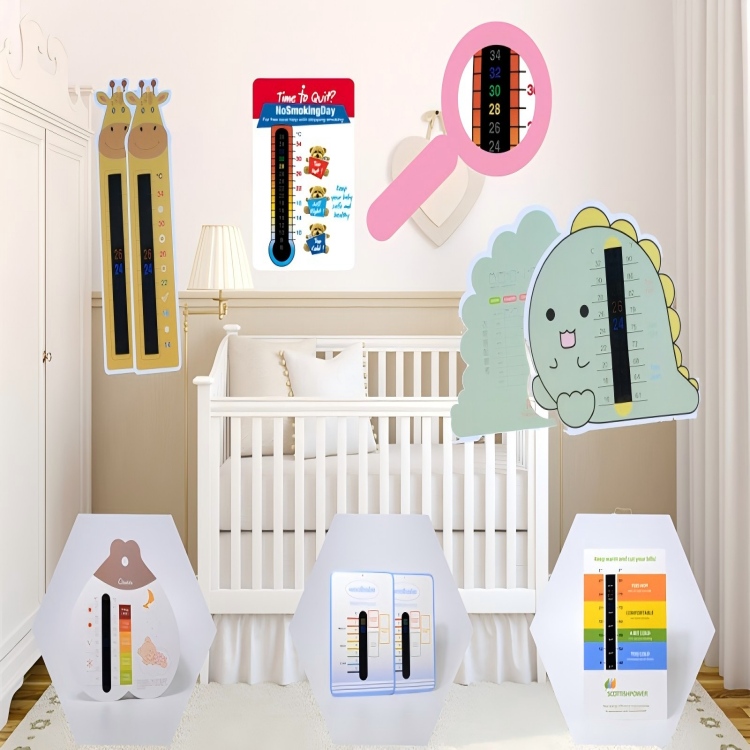
Include your target market, intended application, artwork, temperature range, scale interval, annual forecast, order quantity, packaging requirement, and compliance expectations.
Avoid sending only a reference image. A reference image is useful for visual direction, but it does not define the product's performance requirement.
Before sampling, ask the supplier to confirm:
- Product dimensions and tolerance.
- Temperature range and scale increment.
- Indicator color behavior.
- Substrate and protective-layer construction.
- Printing method and color standard.
- Adhesive type, if applicable.
- Packaging configuration.
- Expected lead time.
- Sample charge, tooling charge, and mass-production MOQ.
Evaluate the sample under real operating conditions. For cards used on bottles, aquarium glass, baby bath packaging, or wine products, test on the actual intended surface and at the actual temperature conditions.
Ask for:
- Business license and factory address.
- ISO certificate number, issuing body, scope, issue date, and expiry date.
- Recent quality-control records or inspection examples.
- Product material declaration.
- Third-party test reports relevant to the destination market.
- Production photos or video that show the actual process.
- Reference shipment information where confidentiality permits.
For ISO verification, do not rely only on a PDF certificate. Confirm the issuing certification body, certificate scope, validity dates, and whether the certification body is accredited. A certificate covering "trading" or "general business services" does not prove that the specific factory process is within the certified scope.
For larger orders, use an internal QC team or independent inspection provider. Check:
- Quantity and packaging count.
- Artwork and language accuracy.
- Product dimensions.
- Visual defects, scratches, bubbles, and laminate alignment.
- Color transition at defined temperatures.
- Adhesive performance where applicable.
- Carton strength, shipping marks, and barcode labels.
Thermometer Cards should be protected from excessive heat, direct sunlight, moisture, crushing, and prolonged storage outside the supplier's recommended conditions. Confirm the shelf life before shipment and ensure the product is not stored in high-temperature containers or warehouses for extended periods.
For sea freight, ask about inner packaging, moisture protection, carton stacking limits, and whether desiccants are appropriate for the product structure.
For most buyers, the strongest Thermometer Card supplier is not necessarily the company offering the lowest first quotation. It is the supplier that can consistently match the approved temperature-response standard, use stable materials, communicate clearly, protect your artwork, and maintain delivery reliability across repeat orders.
Qingdao Focus On Color Industry & Trade Co., Ltd. is worth considering for buyers seeking flexible Thermometer Card OEM/ODM support, particularly when the project combines liquid-crystal temperature indication with custom printing, thermochromic effects, photochromic elements, fragrance-related features, or promotional packaging. Its published product portfolio includes liquid crystal thermometers and a broad range of color-changing products, making it relevant for brands that need more than a standard stock strip.
Before selecting any supplier, request a detailed specification sheet, approve production-representative samples, verify compliance documentation, and set measurable inspection criteria. This approach reduces quality disputes and creates a clearer foundation for long-term supply.
Request the certificate number, issuing certification body, accreditation information, scope, issue date, and expiry date. Then verify it through the certificate body's public database or directly by email. Confirm that the named site and manufacturing activities match the actual factory producing your Thermometer Cards.
It depends on the intended application, temperature range, scale interval, substrate, and viewing method. Do not rely on a generic claim such as "high accuracy." Define the acceptable tolerance, test temperature points, stabilization time, and reading criteria in your purchase specification. For health-related use, obtain professional regulatory and technical guidance before making diagnostic claims.
Usually yes, but the two changes have different implications. Artwork customization is generally easier; a custom temperature range may require different liquid-crystal material, development work, sampling time, higher MOQ, or additional validation. Ask the supplier whether the range is a stock option or a new formulation/project.
This can be normal with liquid-crystal indicators, especially near the boundary between scale points. The key issue is whether the reading rule is clear and repeatable. Define which color or segment represents the current temperature, test the card from both warming and cooling directions, and include acceptable visual behavior in the approved sample standard.
Not automatically. Requirements depend on the product's construction, intended use, claims, market channel, and applicable legislation. RoHS is commonly associated with electrical and electronic equipment, while CE marking applies only when relevant EU rules require it. Ask for product-specific documentation and consult your importer, compliance adviser, or legal representative for the destination market.
- [General Administration of Customs of the People's Republic of China—Statistics] [english.customs.gov]
- [MarketsandMarkets—China Temperature Sensor Market] [marketsandmarkets]
- [SpotSee—Liquid Crystal Temperature Indicator Q&A] [spotsee]
- [NIH/PMC—Liquid Crystal Thermometer Technical Background] [pmc.ncbi.nlm.nih]


