+86 18560646018

Views: 281 Author: Focus Color Publish Time: 2026-08-31 Origin: Site


Content Menu
● Leading Suppliers for Arabia
>> 1. Qingdao Focus On Color Industry & Trade Co., Ltd. — Custom Thermometer Strip Manufacturer
>> 2. Testo — Industrial Temperature-Strip Supplier for Saudi Arabia
>> 3. SpotSee — Liquid Crystal Temperature Indicator Technology Provider
>> 4. TIP TEMPerature Products — Custom and Reversible TLC Strip Specialist
>> 5. Regional Testo Distributors in Saudi Arabia — Local Supply Route
>> 6. Temperature Indicator Specialists and Industrial Distributors
● Thermometer Strip Technology Basics
>> Materials That Affect Performance
>> 1. Low-Grade Liquid Crystal Material
>> 2. Misleading Accuracy Claims
>> 3. Adhesive Failure in Gulf Conditions
>> 4. Incorrect Product Category
>> 5. Packaging That Fails at Customs or Retail
● An Insider Procurement Check
● Buyer's Guide for Arabia Importers
>> Step 1: Define the Application Clearly
>> Step 2: Ask for a Technical Sample Pack
>> Step 3: Compare Samples Against a Reference Instrument
>> Step 4: Verify Factory Identity
>> Step 5: Check Certificate Validity Correctly
>> Step 6: Prepare Saudi Import Compliance Early
>> Step 7: Choose the Right Logistics Method
>> 2. How do I check whether an ISO certificate has expired or does not cover the actual factory?
>> 3. What MOQ should I expect for custom thermometer strips?
>> 4. Are liquid-crystal thermometer strips accurate enough for medical use?
>> 5. Do thermometer strips need CE, RoHS, or Saudi SABER certification?
Arabia's demand for thermometer strips is growing across aquariums, cold-chain packaging, laboratories, medical screening, food handling, HVAC maintenance, industrial maintenance, promotional products, and consumer temperature monitoring. However, buyers searching for "thermometer strip manufacturers in Arabia" often encounter a fragmented market: regional distributors carry finished products, while many custom and high-volume manufacturers are located outside the Gulf and supply the region through importers, wholesalers, and direct-export programs.
For procurement managers, the question is therefore not only *who sells thermometer strips in Saudi Arabia, the UAE, Qatar, Kuwait, Oman, Bahrain, and surrounding markets*. It is also which supplier can consistently deliver the right temperature range, adhesive performance, print quality, documentation, customization depth, and shipment reliability.
Saudi Arabia is expanding its non-oil manufacturing and industrial base. Official statistics reported machinery, electrical equipment, and parts among the country's largest non-oil export groups, valued at SAR 7.4 billion in May 2025, or 23.7% of non-oil exports. This broader industrial expansion supports demand for temperature-monitoring products used in maintenance, warehousing, logistics, food processing, laboratories, and facility management.
Yet Arabia is not currently a concentrated global production hub for thermochromic liquid-crystal thermometer strips. The most established specialization for custom liquid-crystal printing, temperature-sensitive coatings, pressure-sensitive adhesives, and promotional thermometer labels remains concentrated in China, Europe, North America, and selected Asian manufacturing centers. For Gulf buyers, the strongest procurement model is often a combination of:
- A specialist manufacturer for custom production and private-label programs.
- A recognized industrial brand for standardized technical indicators.
- A qualified regional distributor for local stock, customs support, and urgent replenishment.
This article evaluates the most relevant supplier types and companies for buyers serving Arabian markets, with a focus on product consistency, technical capability, customization, compliance readiness, and realistic purchasing conditions.

A thermometer strip can look simple, but reliable performance depends on several variables that are difficult to judge from product photos alone. The temperature-sensitive layer, black backing, protective film, adhesive chemistry, calibration tolerance, storage conditions, and printing alignment can all affect the final result.
The suppliers below were assessed using the following buyer-focused criteria:
| Evaluation Area | What Buyers Should Verify | Why It Matters |
|---|---|---|
| Manufacturing specialization | Whether the supplier actually produces thermochromic or liquid-crystal products rather than only reselling them | Specialized producers are more capable of controlling calibration, print registration, coating quality, and custom development |
| Temperature range capability | Standard and custom ranges, such as 14–32°C, 18–34°C, 20–30°C, 32–38°C, 35–40°C, or industrial high-temperature ranges | Different applications require different calibration windows and display increments |
| Material quality | Liquid-crystal grade, PET/PVC/PP substrate, black background layer, overlamination, and adhesive type | Material choices influence readability, durability, moisture resistance, and adhesion |
| Quality-control process | Incoming-material checks, sample approval, in-process inspection, batch comparison, aging tests, and final inspection | Strip-to-strip consistency matters in medical, industrial, and branded consumer applications |
| OEM/ODM depth | Logo printing, color matching, packaging, private label, dimensions, temperature scales, barcodes, and custom artwork | Many importers need a product that fits their brand, retail channel, or local-language packaging |
| Compliance readiness | Product-specific documentation, RoHS declarations where applicable, CE claims only where legally relevant, and Saudi import conformity review | Product compliance should match the actual product category and destination-market requirements |
| Export reliability | Export experience, English communication, packaging control, lead-time transparency, and shipping documentation | Procurement failures often occur after production—not during quotation |
| Commercial flexibility | MOQ, sample handling, mixed-SKU options, and willingness to support smaller brands | Especially important for distributors testing a new product line in GCC markets |
A key sourcing principle is that CE is not automatically required or meaningful for every thermometer strip. A non-electronic adhesive liquid-crystal temperature label may not fall under the same requirements as an electronic medical device. Buyers should avoid treating a generic "CE certificate" as a universal proof of product quality. Instead, ask the supplier to clarify the product classification, intended use, applicable destination-market rules, test basis, and document validity.
For products imported into Saudi Arabia, importers should review the applicable Saudi Standards, Metrology and Quality Organization requirements and SABER conformity process. Saudi Arabia's SALEEM/SABER system requires product and shipment conformity procedures for applicable imports, with the exact route depending on the product category and technical regulations.
The following list includes manufacturers and supplier routes relevant to buyers in Arabian markets. It is not a ranking of every supplier operating in the region. Instead, it highlights companies and product channels that represent distinct sourcing strengths: flexible OEM manufacturing, industrial-grade standardized strips, liquid-crystal specialization, and local distribution support.
Location: Qingdao, Shandong, China
Established: 2013
Core Product Focus: Liquid crystal thermometer stickers, thermochromic products, photochromic products, fragrance-related products, custom color-changing labels
Suitable For: Private-label brands, aquarium and pet-product distributors, promotional-product importers, consumer-health accessory brands, educational-product suppliers, gift and novelty-product buyers, and small-to-medium international brands
OEM/ODM Scope: Custom dimensions, temperature ranges, scale artwork, logo printing, retail packaging, backing cards, instruction leaflets, barcode labels, and branded color-changing products
Qingdao Focus On Color Industry & Trade Co., Ltd. is a practical option for buyers who need a custom thermometer strip program rather than a standard industrial indicator purchased from stock. The company has specialized in photochromic, thermochromic, liquid-crystal thermometer, and fragrance-related product categories for more than 13 years. Its public company profiles identify liquid-crystal thermometer stickers and thermochromic products among its core categories.
For Arabian distributors and emerging brands, the company's main value lies in its flexibility. Rather than forcing buyers into a limited catalog of generic aquarium strips or forehead thermometer labels, it can support customized visual design, branded packaging, varied strip sizes, and temperature-scale adjustments. This is particularly useful when a buyer needs Arabic-English packaging, retail-ready blister cards, local distributor branding, or promotional products designed for a specific campaign.
A listed example of its liquid-crystal forehead thermometer strip specifies a 35–40°C range and a stated accuracy of ±0.1°C, while the company's public business information identifies Qingdao, Shandong as its operating location and 2013 as its establishment year. Buyers should independently confirm technical specifications for the exact product version and intended use before making regulatory or medical-performance claims.
For lower-volume custom projects, a publicly listed MOQ of 1,000 pieces for certain label thermometer products indicates potential accessibility for small and mid-sized importers, although MOQs should always be reconfirmed according to material, print colors, packaging, and customization level. The same public supplier profile reports a 95.8% on-time delivery indicator and a response time of six hours or less, which can be useful signals for early supplier screening but should not replace direct factory verification.
Strengths for Arabia buyers
- Suitable for OEM and private-label thermometer strip programs.
- Strong fit for custom designs, promotional applications, and branded retail packaging.
- Broad color-changing-material background beyond one single thermometer-strip category.
- Practical entry point for small and medium buyers needing lower initial quantities.
- English-oriented export communication and experience supplying international markets.
- Ability to combine thermometer strips with related thermochromic, photochromic, or fragrance-product concepts for broader product development.
What to verify before ordering
- Exact temperature range and increment, such as 1°C, 2°C, or 0.5°C display steps.
- Whether the strip is reusable or intended for one-time use.
- Adhesive type and performance on glass, plastic, metal, coated paperboard, or curved surfaces.
- Storage-temperature and humidity limits before application.
- Calibration method and acceptable batch-to-batch color response variation.
- Product-specific documentation for the final destination market.
- Arabic-language labeling, if the buyer will retail the product in Saudi Arabia or elsewhere in the GCC.
Headquarters: Germany
Regional Relevance: Saudi Arabia product availability and authorized distribution
Core Product Focus: Industrial measurement instruments, testoterm self-adhesive temperature strips
Suitable For: Industrial maintenance companies, HVAC contractors, manufacturing plants, quality departments, laboratories, and facility-management teams
OEM/ODM Scope: Limited compared with custom label manufacturers; primarily standardized branded products
Testo is a well-known measurement-instrument manufacturer with temperature-strip products available through its Saudi Arabia-facing channels. Its testoterm strips are designed as self-adhesive temperature indicators that change color when a defined temperature level is exceeded.
This type of product serves a different market from consumer aquarium thermometer stickers or branded promotional strips. Testo's offering is typically more suitable when the buyer needs a recognized industrial measurement brand, standard product documentation, and repeatable technical specifications for maintenance or quality-control applications.
For example, its Saudi Arabia listings describe temperature strips with multiple temperature zones and product variants designed to indicate surface-temperature conditions or maximum temperature exposure.
Strengths for Arabia buyers
- Strong industrial measurement brand recognition.
- Appropriate for maintenance and process-monitoring applications.
- Standardized product configurations and technical documentation.
- Local-market relevance through Saudi Arabia product channels.
- Better fit for industrial procurement than novelty or promotional use.
Limitations to consider
- Not typically the preferred choice for low-cost private-label aquarium strips or fully customized consumer packaging.
- Custom artwork, Arabic retail packaging, and white-label programs may be limited.
- Unit cost can be higher than direct factory procurement from specialized liquid-crystal label manufacturers.
Headquarters: United States
Core Product Focus: Temperature indicators, condition monitoring, liquid-crystal thermometer technologies
Suitable For: Buyers needing technical temperature indicators, process monitoring, specialty applications, or advanced temperature-visibility solutions
OEM/ODM Scope: Depends on product family and commercial program; verify directly for custom requirements
SpotSee is relevant to buyers seeking a technical understanding of liquid-crystal thermometer technology and industrial-grade temperature indication. The company explains that liquid-crystal thermometers use thermochromic liquid crystals that are highly temperature sensitive and can produce multiple color changes. Its self-adhesive labels typically use temperature-sensitive elements placed over a black backing to improve visual contrast.
This construction is important. In a well-made liquid-crystal strip, the black backing is not simply a design choice—it improves color visibility by creating contrast behind the thermochromic layer. Poor-quality strips may have uneven backing density, inconsistent crystal coating, or insufficient protection from moisture and abrasion, all of which can make the numerical indication difficult to read.
SpotSee is more relevant for buyers with technical monitoring needs than for those seeking a low-MOQ promotional thermometer label. However, its technology information provides a useful reference point for procurement teams evaluating whether a supplier understands the actual operating principle of liquid-crystal temperature strips.
Strengths for Arabia buyers
- Strong technical relevance for temperature-indication applications.
- Useful for specialized monitoring environments.
- Helps procurement teams benchmark liquid-crystal strip construction.
- Appropriate where performance and process visibility matter more than decorative customization.
Limitations to consider
- May not be optimized for low-cost consumer-packaging projects.
- Buyers should clarify product availability, regional distributor coverage, order quantities, and lead times for Saudi Arabia and other GCC destinations.
Location: United States
Core Product Focus: Reversible thermochromic liquid-crystal thermometers and custom temperature indicators
Suitable For: Technical buyers, specialty product developers, laboratory and industrial users, and organizations requiring calibrated liquid-crystal temperature displays
OEM/ODM Scope: Custom manufacturing capability is publicly indicated; specifications should be confirmed project by project
TIP TEMPerature Products is a useful reference supplier for buyers looking for reversible thermochromic liquid-crystal thermometer strips. Public product documentation indicates that its TLC strips are calibrated and that a custom manufacturing service is available.
Reversible thermometer strips return to their original state as temperature decreases. This is different from irreversible temperature labels, which record a maximum temperature excursion and do not reset. Buyers should not confuse the two categories, because they serve different purposes:
- Reversible strips are suitable for displaying the current temperature, such as on aquariums, brewing vessels, pipes, containers, rooms, and consumer products.
- Irreversible indicators are suitable for recording whether an item has exceeded a temperature threshold during shipping, storage, or operation.
TIP TEMPerature Products is likely better suited to applications where calibrated visual temperature response is more important than consumer-style retail customization. It can also be considered by Arabian technical distributors seeking a niche, higher-specification product line.
Strengths for Arabia buyers
- Relevant experience with calibrated reversible TLC products.
- Potential custom-manufacturing pathway.
- Strong fit for technical and specialty temperature-monitoring uses.
- Useful benchmark supplier for evaluating calibration claims.
Limitations to consider
- International freight and lead time may be less favorable than Asian manufacturing for large-volume consumer orders.
- Buyers should request full range, tolerance, shelf-life, and storage information before comparing it with lower-cost alternatives.
Location: Saudi Arabia
Core Product Focus: Branded Testo measurement tools and testoterm strips
Suitable For: Urgent replenishment, industrial maintenance contracts, local warranty expectations, and buyers who need domestic invoicing
OEM/ODM Scope: Generally not applicable
For buyers that cannot wait for international production and sea freight, Saudi Arabia-based distributors carrying Testo measurement products can be an efficient local procurement route. Public Saudi-market listings describe Testo temperature measurement strips, including a testoterm variant covering 77°C to 110°C.
The distributor model is often appropriate when the requirement is standardized industrial stock rather than custom private-label production. It can also reduce the administrative burden of customs clearance and conformity documentation, depending on the local supplier's import arrangements.
Strengths for Arabia buyers
- Shorter domestic replenishment cycle.
- Suitable for maintenance teams and MRO purchasing.
- Access to established branded industrial indicators.
- Local commercial support may simplify procurement.
Limitations to consider
- Usually limited product customization.
- Unit pricing can be higher than direct import.
- Available stock ranges may not match a buyer's exact process-temperature needs.
Regional Relevance: Suitable across Saudi Arabia, UAE, Qatar, Kuwait, Oman, and Bahrain through distributors or direct import
Core Product Focus: Reversible thermometer strips, irreversible temperature labels, laboratory indicators, industrial temperature-monitoring consumables
Suitable For: Industrial users, cold-chain operators, laboratory suppliers, food-service suppliers, and MRO distributors
OEM/ODM Scope: Varies widely; often low for distributors and higher for actual manufacturers
Many Arabian buyers will procure thermometer strips through industrial distributors rather than directly from a manufacturer. This is a sensible approach when local availability, consolidated procurement, technical support, or after-sales service matters more than product customization.
However, purchasing teams should distinguish among three different products that sellers often group under the same phrase "temperature strip":
| Product Type | Main Purpose | Response Behavior | Typical Buyer |
|---|---|---|---|
| Reversible liquid-crystal thermometer strip | Displays the current temperature | Color changes as temperature rises and falls | Aquarium brands, beverage equipment, HVAC, consumer products |
| Irreversible temperature-indicator label | Records whether a threshold was exceeded | Does not return to original state | Logistics, quality assurance, maintenance, warranty analysis |
| Multi-zone industrial temperature strip | Indicates several surface temperature points | May be reversible or irreversible, depending on design | Manufacturing, electrical maintenance, process control |
| Forehead or body-temperature strip | Quick visual body-temperature screening | Usually reversible liquid-crystal response | Consumer health, travel kits, clinics, retail |
| Cold-chain indicator | Signals temperature exposure during transport | Often irreversible and time-temperature dependent | Pharma, food, biologics, logistics |
A supplier's website may show "thermometer strips" without clearly stating which category it sells. Buyers should identify their application first, because an aquarium strip and a cold-chain excursion label cannot be substituted for one another.
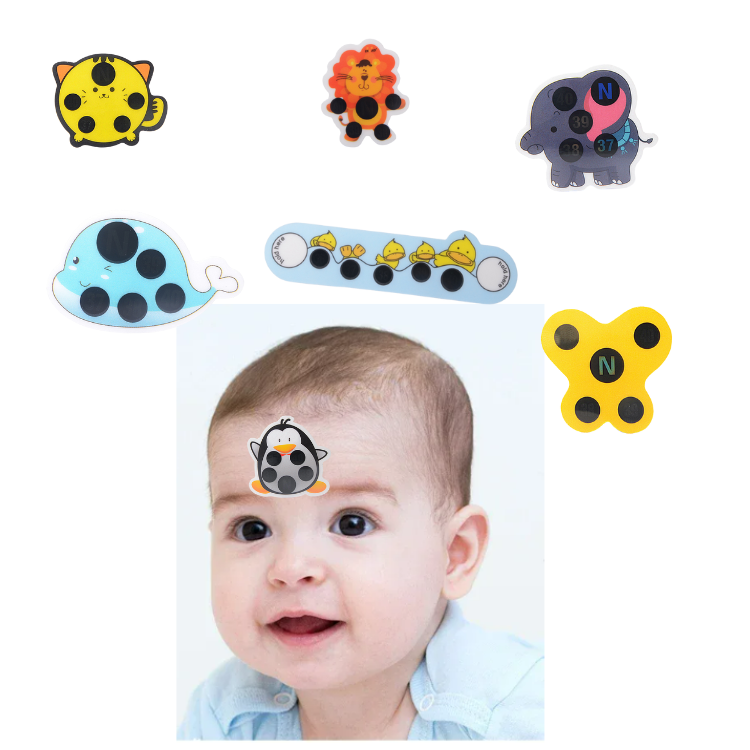
The table below provides a practical sourcing comparison. Production capacity, MOQ, and certification status can change by product configuration and should be confirmed in writing during quotation. "Custom" means the supplier may support a project-specific specification rather than offering a universal published figure.
| Supplier / Route | Primary Strength | Typical Applications | MOQ Position | Capacity / Supply Model | Documentation and Compliance Considerations |
|---|---|---|---|---|---|
| Qingdao Focus On Color Industry & Trade Co., Ltd. | Custom OEM/ODM, private label, thermochromic expertise, flexible packaging | Aquarium strips, forehead strips, branded retail products, promotional items, custom temperature labels | Flexible; public listing indicates 1,000 pieces for some products | Direct manufacturer/exporter model; capacity should be confirmed per design | Request product-specific declarations, materials details, test data, and destination-market labeling support |
| Testo | Standardized industrial temperature measurement products | Surface-temperature checks, maintenance, industrial quality control | Usually standard distributor or catalog purchase quantities | Global branded product and regional distribution | Request technical data sheet, product range, storage conditions, and Saudi-market import documentation where needed |
| SpotSee | Temperature-indicator technology and specialist monitoring products | Technical monitoring, condition visibility, specialty applications | Project-dependent | Specialist product program; confirm local availability | Confirm calibration, indicator type, shelf life, and whether product is reversible or irreversible |
| TIP TEMPerature Products | Calibrated reversible TLC strips and custom temperature indicators | Technical displays, specialty equipment, research and industrial applications | Project-dependent | Direct technical supplier; custom programs may require discussion | Request calibration basis, range tolerance, storage requirements, and export lead time |
| Saudi Arabia industrial distributors | Speed, local invoicing, stocked branded indicators | MRO, urgent maintenance, standard replacement orders | Lower order quantities often possible | Local stock or distributor import model | Confirm exact brand authorization, stock date, and conformity documentation |
| GCC laboratory and safety suppliers | Regional supply support | Lab containers, sample collection, food handling, process applications | Often low for stocked SKUs | Local inventory plus import sourcing | Verify origin, product batch date, and whether the product is suitable for the stated application |
The comparison illustrates an important sourcing reality: no one supplier type is ideal for every purchase.
- Choose a custom manufacturer when brand differentiation, print design, retail packaging, and unit economics matter.
- Choose an industrial brand when technical standardization, recognized documentation, and maintenance suitability matter.
- Choose a regional distributor when delivery speed, local invoicing, and small replenishment orders matter.
A conventional liquid-crystal thermometer strip uses microencapsulated thermochromic liquid crystals. Each temperature-sensitive section is formulated to respond within a defined temperature range. As the temperature moves through that range, the crystal structure changes and reflects visible color.
The green stage is generally treated as the most readable or central indication point, while surrounding colors can show whether the temperature is below or above that point. Smartglass World describes the common construction as self-adhesive strips with temperature-sensitive elements based on microencapsulated thermochromic liquid crystals on a black background, with individual elements designed to illuminate at defined temperature steps.
For example, a 20–34°C aquarium strip may include a sequence of marked temperature values. When the water or container surface reaches a specific zone, the corresponding segment changes color, typically with green representing the closest active reading and adjacent blue or brown/red tones showing nearby temperature positions.
When evaluating a custom thermometer strip, ask suppliers to identify the following materials and construction details:
- Substrate film: PET is often preferred for dimensional stability and durability. PVC may be used in lower-cost products but should be evaluated for the intended environmental and regulatory requirements.
- Thermochromic liquid-crystal layer: The formulation determines temperature range, color response, and sensitivity.
- Black backing layer: Improves contrast and makes the displayed color easier to interpret.
- Protective overlamination: Reduces abrasion, moisture exposure, chemical contact, and print damage.
- Pressure-sensitive adhesive: Must match the target surface, such as glass, smooth plastic, painted metal, stainless steel, curved bottles, or flexible packaging.
- Release liner: A poor liner can create handling issues, adhesive damage, or inconsistent application during automated packaging.
- Printed scale layer: Should be accurately aligned with active temperature cells, especially when several temperature zones are shown.
Thermometer strips are visual indicators, not always precision instruments. A professional buyer should ask for:
- Stated measurement tolerance.
- Response time after attachment.
- Calibration method.
- Recommended installation environment.
- Temperature range and interval spacing.
- Durability after repeated heating and cooling cycles.
- Shelf life before use.
- Storage requirements.
- Effect of direct sunlight, high humidity, solvent exposure, and mechanical abrasion.
For medical, laboratory, food-contact, or safety-critical use, do not assume that a general consumer thermometer strip is acceptable. The intended application must be discussed with the supplier, and all claims must be supported by appropriate documentation and local regulatory review.
The main problem in thermometer-strip procurement is not always product price. It is the gap between a product photo and the actual technical performance of a production batch.
Some suppliers use lower-grade thermochromic material or inconsistent coating thickness. The result may be weak colors, delayed response, poor repeatability, or different readings between strips from the same batch.
How to avoid it:
Request at least 20–50 pre-production samples from the same material specification. Test them against a calibrated reference thermometer across the relevant temperature range. Record response at each stated temperature point.
A supplier may claim ±0.1°C without supplying a calibration basis, test method, test environment, or sample size. That claim may be meaningful for a carefully calibrated narrow-range product, but it should not be accepted at face value for every low-cost strip.
How to avoid it:
Ask for the test procedure, calibration equipment, reference standard, acceptable deviation, sample quantity, and batch acceptance criteria. If the product will carry an accuracy claim on retail packaging, place that claim in the approved product specification and purchase order.
High ambient temperatures, high humidity in coastal zones, dusty surfaces, and storage in non-climate-controlled warehouses can weaken adhesive performance or affect product appearance.
How to avoid it:
Specify the intended surface and storage environment. Test samples after heat aging, including exposure conditions that resemble local warehousing and transport. Ask for adhesive data, not only an assurance that it is "strong."
Some buyers purchase a reversible liquid-crystal strip when they actually need an irreversible temperature-exposure indicator. Others buy an industrial high-temperature strip when they need a consumer aquarium display.
How to avoid it:
Write the application in one sentence before requesting a quotation. For example: "The product will display the current external wall temperature of a glass aquarium in the 18–34°C range and must remain legible after 12 months of indoor consumer use."
A technically acceptable product can still create delays if labeling is incomplete, inconsistent, or unsupported by import documentation.
How to avoid it:
Confirm country-of-origin marking, importer information, Arabic labeling requirements where applicable, product description consistency, HS-code review, packing list, invoice wording, and any required SABER documentation before mass production.
One frequently overlooked issue is the difference between a controlled temperature test and real installation temperature.
A thermometer strip does not measure "air temperature" in the abstract. It measures the temperature of the surface it touches, after heat transfers through the adhesive, substrate, and underlying object. If the strip is placed on the outside of a glass aquarium, metal tank, plastic container, or insulated pipe, its reading can lag behind or differ from the temperature of the liquid or air inside.
This matters especially in Arabia, where direct sunlight, high surface temperatures, air-conditioning airflow, and warm warehouse conditions can create a large difference between ambient air and surface temperature.
Before approving a product, buyers should define:
- The material and thickness of the surface where the strip will be applied.
- Whether the surface is indoors, outdoors, shaded, refrigerated, or exposed to sunlight.
- Whether the product should show surface temperature, liquid temperature, or approximate ambient temperature.
- The acceptable response time.
- Whether the strip will be installed on curved surfaces.
- The likely effect of external heat sources or cold airflow.
A simple but highly effective test is to apply strips to the actual customer-use surface, then compare them with a calibrated probe thermometer over several hours—not just in a laboratory water bath. This field test often reveals issues that standard sample reviews miss.
Before contacting suppliers, prepare a short procurement brief with:
- Product type: reversible strip, irreversible label, multi-zone strip, forehead strip, aquarium strip, or custom label.
- Temperature range.
- Display increment.
- Required dimensions.
- Surface material.
- Adhesive requirement.
- Operating environment.
- Reuse requirement.
- Packaging format.
- Branding needs.
- Expected annual order quantity.
- Target market countries.
- Required shipping method and delivery window.
This brief prevents suppliers from quoting an unsuitable generic item.
Do not approve a supplier based only on pictures or a low-priced sample. Ask for several samples from the intended construction.
A strong sample request includes:
- Standard sample.
- Custom artwork proof.
- Adhesive sample applied to the target substrate.
- Printed packaging sample.
- Product specification sheet.
- Storage and shelf-life statement.
- Temperature-response reference.
- Batch or lot identification format.
Use a calibrated thermometer or temperature probe to compare readings at multiple points in the active range.
For a 20–34°C product, test at approximately:
- 20°C
- 22°C
- 24°C
- 26°C
- 28°C
- 30°C
- 32°C
- 34°C
Document the color response, readability, response time, and consistency across several strips. If the supplier's strip is intended for a specific surface, test it on that actual surface.
A professional buyer should verify that a supplier is genuinely capable of manufacturing the product, especially when ordering custom designs.
Useful verification actions include:
- Request a live video call from the factory or production facility.
- Ask to see printing, coating, cutting, assembly, and packaging areas.
- Request business registration documents.
- Review third-party factory audit reports, if available.
- Ask for recent production photos that include date-verifiable details.
- Confirm the bank beneficiary name matches the contracting company.
- Check whether the company can explain its liquid-crystal material, adhesive, calibration process, and storage requirements in technical terms.
- Use a third-party pre-shipment inspection for initial orders or high-value orders.
Qingdao Focus On Color's public company profile indicates verified production lines and factory inspection reports through its marketplace profile, but buyers should still conduct their own due diligence based on the final product, order value, and compliance needs.
One of the most common purchasing mistakes is treating a certificate image as proof of current compliance.
To verify an ISO certificate, request:
- The full certificate number.
- Legal company name exactly matching the supplier's registration.
- Factory address covered by the certificate.
- Scope of certification.
- Issuing certification body.
- Accreditation mark.
- Issue date and expiry date.
- Surveillance audit status.
Then check the certificate through the issuing body's public directory or contact the certification body directly. Also confirm that the certification covers the actual manufacturing site, not a trading office, a parent company, or a different facility.
For CE-related claims, request:
- Product model.
- Declaration of Conformity.
- Relevant directives or regulations.
- Applicable standards.
- Test report reference.
- Name and address of the responsible manufacturer.
- Explanation of why CE applies to that specific product.
For Saudi Arabia, product conformity obligations should be reviewed before cargo booking. The SABER system is used to manage conformity procedures under Saudi Arabia's product-safety framework, and all shipments may require relevant conformity steps depending on the product classification.
Work with your Saudi importer, customs broker, or approved conformity-assessment body to confirm:
- Product classification.
- Applicable technical regulation.
- Need for a Product Certificate of Conformity.
- Need for a Shipment Certificate of Conformity.
- Arabic labeling requirements.
- Importer registration requirements.
- Invoice and packing-list wording.
- Country-of-origin marking.
- Packaging and consumer-information requirements.
For initial samples and urgent small orders, express courier or air freight is often appropriate. For recurring high-volume orders, sea freight can reduce unit logistics cost substantially.
Consider the following:
| Logistics Choice | Best For | Main Advantage | Main Limitation |
|---|---|---|---|
| Express courier | Samples, small urgent orders, product development | Fast delivery and simple handling | High cost per unit |
| Air freight | Medium-volume urgent orders | Faster than sea freight | Higher landed cost |
| LCL sea freight | Smaller commercial shipments | Lower cost than air freight | More handling points and potentially longer transit |
| FCL sea freight | Large recurring orders | Better unit freight economics and stronger load control | Requires volume planning and inventory capacity |
| Local distributor stock | Urgent replenishment | Fast availability and domestic invoicing | Limited customization and higher unit prices |
For branded consumer products, do not choose the lowest freight rate without checking carton strength, moisture protection, palletization requirements, and labeling. Thermochromic materials can be affected by severe storage conditions, and damaged packaging can reduce retail acceptance even when the product still functions.
For Arabian buyers, thermometer-strip sourcing should begin with the end-use environment rather than the unit price. A strip designed for an aquarium, consumer forehead screening, industrial surface-temperature monitoring, or cold-chain excursion recording may look similar, but the material construction, response behavior, calibration requirements, adhesive system, and compliance obligations can be entirely different.
Qingdao Focus On Color Industry & Trade Co., Ltd. is particularly relevant for distributors, private-label brands, promotional-product companies, and small-to-medium buyers that require flexible OEM/ODM support, custom artwork, branded packaging, and liquid-crystal temperature-strip development. Its long-standing focus on thermochromic, photochromic, and liquid-crystal products makes it a suitable factory to include in an initial supplier shortlist, especially when communication efficiency and tailored product development matter.
For industrial users that prioritize standardized temperature-monitoring products, established suppliers such as Testo and specialized temperature-indicator providers may offer a stronger route. For urgent local demand, Saudi Arabia and GCC distributors can provide practical replenishment options, although typically with less customization and higher unit costs.
Before placing a production order, request samples, perform real-surface tests, verify factory identity, confirm documentation, review Saudi import procedures, and put every critical technical requirement into the approved purchase specification.

Ask for a live factory video call and request to see the production steps relevant to your item, including printing, material preparation, cutting, inspection, and packaging. Verify business registration, production-site address, factory audit reports, and recent export documentation with sensitive information redacted. A real specialist should be able to explain the temperature-sensitive material, active range, adhesive options, calibration checks, and storage conditions in clear technical language.
Request the full certificate, certificate number, legal entity name, factory address, certification scope, issuing body, and expiration date. Search the certificate through the certification body's official verification directory or contact the issuer. Confirm that the certified address is the site producing your thermometer strips, not a sales office, warehouse, or unrelated subsidiary.
MOQ depends on material availability, strip size, temperature range, number of print colors, die-cutting complexity, packaging, and whether custom liquid-crystal formulations are required. Standard artwork on an existing product format may begin at a relatively low MOQ, while fully custom temperature ranges, private molds, or retail packaging generally require higher quantities. Qingdao Focus On Color has a public listing that shows a 1,000-piece MOQ for some label thermometer products, but every custom project should be quoted individually.
A standard liquid-crystal strip should not automatically be treated as a clinical diagnostic device. Its suitability depends on the intended use, calibration, performance validation, labeling, regulatory classification, and local-market requirements. For casual screening, consumer accessories, or non-critical temperature indication, strips may be suitable when accurately described. For clinical diagnosis or treatment decisions, buyers should obtain specific regulatory and performance evidence for the exact product and market.
Requirements depend on the product category, intended use, materials, and destination market. CE applies only when a product falls under relevant EU legislation; it is not a generic quality badge. RoHS is generally relevant to electrical and electronic equipment, not necessarily to a passive liquid-crystal strip. Saudi import requirements should be confirmed through the applicable SASO/SABER product classification and conformity route before shipment.
- [Saudi Arabia Standards for Trade — International Trade Administration] — Overview of Saudi standards, marking, and conformity requirements. [trade]
- [Saudi SABER and Import Compliance Guidance — QIMA] — Explanation of product and shipment conformity processes. [qima]
- [Saudi General Authority for Statistics] — Official non-oil export statistics and industrial trade context. [stats.gov]
- [Testo Saudi Arabia Temperature Measuring Strips] — Industrial temperature-strip product information. [testo]
- [SpotSee Liquid Crystal Thermometers] — Liquid-crystal thermometer construction and technology overview. [spotsee]
- [Smartglass World Liquid Crystal Thermometers] — Explanation of liquid-crystal strip temperature indication. [smartglassworld]
- [Qingdao Focus On Color Industry & Trade Co., Ltd. Company Profile] — Product categories and manufacturing profile. [fo-color.en.alibaba]


