+86 18560646018

Views: 243 Author: Focus Color Publish Time: 2026-08-26 Origin: Site


Content Menu
● What Is a Sticker Thermometer?
● How Does a Liquid Crystal Sticker Thermometer Work?
>> Why Green Usually Shows the Reading
● Sticker Thermometer Structure Explained
● How to Read a Sticker Thermometer Correctly
>> Example: Reading an Aquarium Temperature Strip
● What Affects Sticker Thermometer Accuracy?
>> Calibration and Temperature Range
● Where Are Sticker Thermometers Used?
● Choosing the Right Thermometer Sticker for Your Product
● Custom Sticker Thermometer Manufacturing Solutions
● Request a Custom Temperature Indicator Solution
● FAQ
>> 1. Are sticker thermometers accurate?
>> 2. Does a sticker thermometer measure liquid temperature?
>> 3. Which color shows the correct temperature?
>> 4. Can sticker thermometers be reused?
>> 5. Can I customize the temperature range?
>> 6. Can a thermometer sticker be used outdoors?
>> 7. Can I put a thermometer strip inside water?
A sticker thermometer, also called a liquid crystal thermometer strip, measures temperature through a reversible color change. Instead of using batteries, wires, or a digital sensor, it uses specially formulated liquid crystals that respond to the temperature of the surface beneath the label.
For product designers, packaging buyers, aquarium brands, medical-container suppliers, and promotional-product companies, sticker thermometers offer a simple way to make temperature visible at a glance. A properly designed strip can be applied to a bottle, tank, cup, container, pipe, package, or other smooth surface and display a temperature range through changing colors.
Qingdao Focus On Color Industry & Trade Co., Ltd. has more than 13 years of manufacturing experience in photochromic, thermochromic, liquid crystal thermometer, fragrance, and customized color-changing products. We provide OEM, ODM, and tailored solutions for customers who need reliable temperature-indicating labels for global markets.

A sticker thermometer is a thin, self-adhesive temperature indicator that changes color when the temperature of the attached surface changes. Most versions use thermochromic liquid crystal technology.
The common structure includes:
- A printed temperature scale in Celsius, Fahrenheit, or both
- Multiple temperature-sensitive liquid crystal segments
- A dark backing layer that improves color visibility
- A protective transparent film
- A pressure-sensitive adhesive layer
- A release liner for easy application
Each color segment is calibrated to react at a specific temperature or within a small temperature interval. When the surface reaches that range, the segment changes color and reveals the corresponding temperature value.
Unlike electronic thermometers, a sticker thermometer does not need charging, batteries, wiring, or an external power source. This makes it a practical option for low-cost temperature monitoring, visual guidance, product interaction, and promotional applications.
The working principle is based on thermochromic liquid crystals. These materials have a molecular structure that reacts to changes in temperature.
Inside the thermometer strip, the liquid crystals are typically microencapsulated and placed above a dark background. As temperature changes, the internal molecular arrangement shifts. That shift changes which wavelengths of visible light are reflected back to the viewer.
The reflected light appears as a color change.
In many liquid crystal thermometer strips, colors move through a sequence such as:
- Brown, red, or orange: The temperature is approaching the active range
- Yellow: The temperature is near the indicated value
- Green: The displayed number is usually the closest actual temperature
- Blue: The temperature is moving beyond that indicator's active point
- Black or dark: The temperature is outside that segment's working range
The exact color sequence can vary according to the liquid crystal formulation, printing design, background color, and intended temperature range.
In many standard designs, the green segment indicates the actual temperature. At the calibrated temperature point, the liquid crystal structure reflects green light most strongly while absorbing more red and blue light.
As the temperature rises or falls, the molecular pitch changes. The reflected wavelength changes with it, causing the visible color to shift. This process is reversible: when the surface cools, the colors move back through the range in the opposite direction.
For example, if the 24°C segment turns green, the surface temperature is approximately 24°C. If one number appears blue and the next higher number appears tan or orange, the actual temperature may fall between those two marked values.
A high-quality sticker thermometer is more than a printed label. Its performance depends on material selection, liquid crystal calibration, adhesive quality, protective construction, and print clarity.
2222
For OEM projects, each layer can be adapted to the intended use. A bottle thermometer, for example, may require stronger moisture resistance. A children's product may prioritize soft edges, clear graphics, and lower-risk material choices. A technical container label may require a custom temperature range, tighter visual tolerances, or dual Celsius/Fahrenheit markings.
Reading a sticker thermometer is easy, but proper use matters. The label measures the temperature of the surface it touches, not necessarily the exact temperature inside the object.
Follow these steps for a more reliable reading:
1. Apply the strip to a clean, smooth, dry surface. Oil, dust, condensation, and uneven textures can reduce adhesion and affect contact.
2. Press the full strip firmly onto the surface. Good contact helps the temperature-sensitive layer respond more consistently.
3. Allow the strip to stabilize. Do not read it immediately after application, moving the container, adding hot or cold material, or exposing it to strong airflow.
4. View it under normal ambient light. Direct glare, a very dark environment, or an extreme viewing angle can make colors harder to interpret.
5. Read the green indicator first. In conventional liquid crystal designs, the green number normally represents the closest temperature.
6. Use neighboring colors when green is not visible. A blue lower-temperature segment and a tan, yellow, or orange higher-temperature segment generally indicate that the actual temperature lies between them.
Imagine an aquarium thermometer strip displays:
- 24°C in blue
- 25°C in green
- 26°C in orange
The most likely reading is 25°C.
If 25°C is blue and 26°C is orange, the water temperature may be between 25°C and 26°C. Because the strip is attached outside the aquarium glass, it is best viewed as an external-surface indication. For sensitive environments, users should compare it periodically with a properly calibrated internal probe or digital thermometer.
Sticker thermometers are useful visual indicators, but they are not all designed for the same level of precision. Performance depends on the product's temperature range, construction, installation conditions, and use environment.
Thermochromic liquid crystal strips can be formulated for broad ranges, from low-temperature applications to high-temperature industrial uses. Their practical accuracy varies by formulation and temperature range. Some technical liquid crystal strips are specified around ±1°C in lower and mid-temperature ranges, while wider high-temperature ranges may have larger tolerances.
The most important factors are listed below.
The strip responds to the surface temperature where it is attached. A poorly bonded label, curved wall, textured surface, air gap, or partially lifted edge can slow heat transfer and cause unstable readings.
Glass, metal, plastic, ceramic, and paperboard transfer heat differently. A thin metal vessel may respond quickly, while a thick plastic container may react more slowly. When monitoring internal contents, wall thickness and material insulation should be considered.
Strong sunlight, radiant heat, wind, cooling fans, air-conditioning outlets, and rapid changes in room temperature can influence the outer surface. In outdoor or highly variable environments, a protective placement position can improve repeatability.
Liquid crystal colors depend on reflected light. Users should read the strip from a straightforward angle under adequate light. A custom design with a high-contrast black background and a clear instruction icon can reduce interpretation errors.
A thermometer strip works best when its temperature range matches its actual application. A 16–38°C strip may be suitable for room-temperature or aquarium-related uses, but it is not the right choice for a hot beverage warning label or industrial process surface.
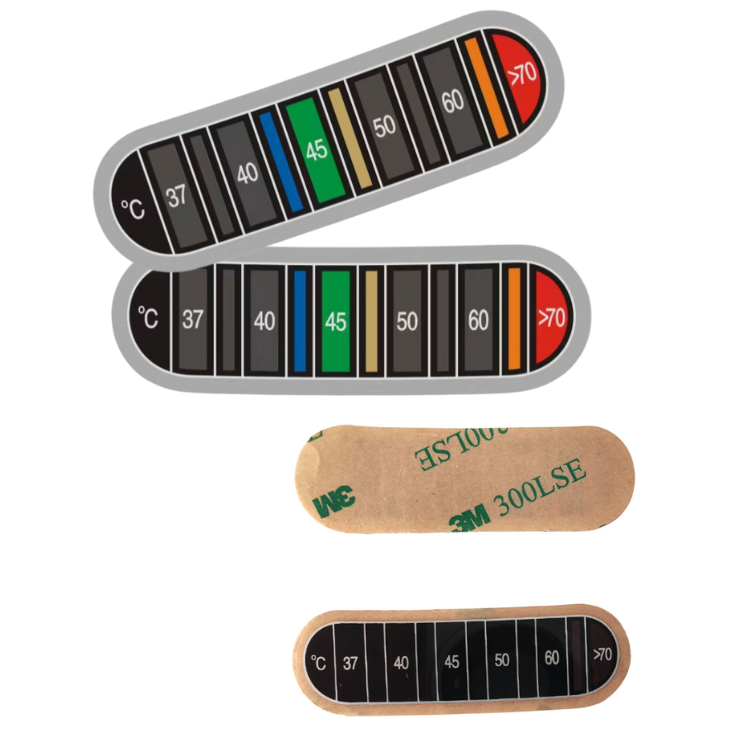
Sticker thermometers are widely used because they are thin, low-cost, easy to apply, and visually engaging. They can turn an ordinary product surface into an instant temperature-display interface.
Common applications include:
- Aquariums and terrariums: Monitoring external glass temperature as a quick visual reference
- Baby-care and nursery products: Supporting room, bath, bottle, or sleeping-environment guidance when designed for the appropriate range
- Beverage containers: Showing whether a cup, bottle, or wine product is near a preferred serving range
- Home brewing and fermentation: Providing a quick external reading on fermentation vessels
- Medical and specimen containers: Helping indicate relevant handling temperature ranges where product specifications permit
- Cold-chain packaging: Providing a visual indication for selected temperature events or ranges
- Industrial containers and equipment: Monitoring drums, tanks, pipes, motors, or process surfaces
- Promotional products: Adding interactive color-changing features to cups, cards, labels, and branded gifts
Liquid crystal thermometers can be supplied as self-adhesive labels with multiple temperature-sensitive elements, usually positioned over a black backing to create a clear color display.
The best sticker thermometer is not simply the one with the widest temperature scale. It is the one engineered around the real user, surface, environment, and decision the label needs to support.
Before developing a custom project, define these points:
| Layer | Main Function | Why It Matters |
|---|---|---|
| Protective film | Shields the printed surface and liquid crystal layer | Helps resist abrasion, moisture, and handling damage |
| Printed scale | Shows temperature numbers, units, branding, and instructions | Makes readings fast and understandable |
| Liquid crystal layer | Responds to temperature changes with visible colors | Determines sensitivity and display range |
| Black backing | Enhances color contrast | Makes color transitions easier to read |
| Adhesive layer | Attaches the strip to the target surface | Affects installation stability and thermal contact |
| Release liner | Protects adhesive before use | Supports clean, efficient application |
A practical design starts with the use case rather than the artwork. For example, a 5°C–40°C aquarium strip, a 20°C–35°C baby-bath indicator, and a 40°C–90°C hot-drink warning label require very different liquid crystal formulations and user instructions.
Even a well-manufactured liquid crystal thermometer can produce misleading results if it is used incorrectly.
Avoid these common mistakes:
- Applying the label to a dirty, wet, oily, or rough surface
- Using a temperature range that does not fit the product's actual conditions
- Reading the strip immediately after a sudden temperature change
- Treating the strip as an internal liquid temperature measurement without accounting for container-wall effects
- Installing the label under direct sunlight or close to a heat source
- Expecting one generic strip to meet laboratory, medical-diagnostic, and industrial-control requirements
- Ignoring storage conditions before application
- Using a damaged, faded, scratched, or delaminated strip
For critical monitoring, sticker thermometers should be used as a convenient visual indicator alongside a calibrated instrument that matches the required accuracy, response time, and documentation standard.
For brand owners and product developers, customization can make a thermometer strip more functional, easier to read, and more valuable to the end user.
At Qingdao Focus On Color Industry & Trade Co., Ltd., custom development can include:
- Custom temperature ranges and temperature intervals
- Celsius, Fahrenheit, or dual-scale layouts
- Custom sizes, shapes, and die-cut formats
- Brand logos, color systems, icons, and product instructions
- Different adhesive options for glass, plastic, metal, or specialty surfaces
- Packaging customization for retail, bulk supply, kits, and promotional campaigns
- Thermochromic, photochromic, fragrance, and liquid crystal effects within one product concept
- OEM and ODM support from concept development through mass production
A custom thermometer sticker can also improve the customer experience. A clear scale, simple "green = current temperature" instruction, and application-specific visual design help users understand the product within seconds.
For instance, a beverage brand may use a custom strip to signal the preferred serving temperature. An aquarium brand may pair a thermometer strip with clear tank-placement instructions. A children's product can use friendly icons and a simplified safety message while maintaining a readable temperature scale.
A sticker thermometer works by converting surface-temperature changes into visible color changes through thermochromic liquid crystals. Its simplicity is its strength: no batteries, no wiring, and no complicated setup.
However, the final result depends on the right temperature range, material construction, adhesive selection, artwork, and quality control.
If you are developing a temperature-sensitive label, color-changing product, aquarium accessory, beverage indicator, promotional item, or customized packaging solution, contact Qingdao Focus On Color Industry & Trade Co., Ltd. to discuss your OEM, ODM, and tailored manufacturing requirements. Share your application surface, target temperature range, dimensions, artwork, and destination market, and our team can help develop a suitable solution.
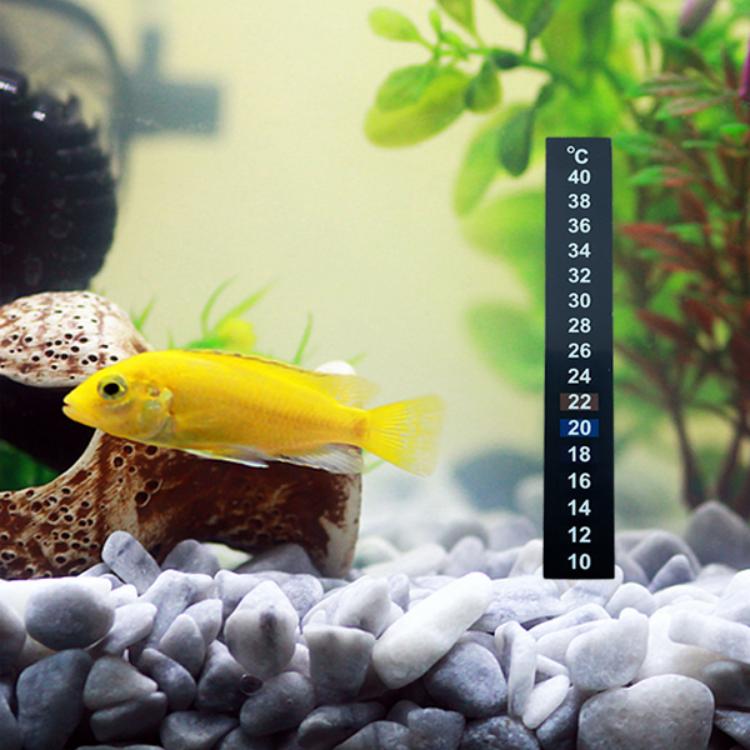
Sticker thermometers can provide a useful temperature indication when the product is correctly selected and applied. Accuracy depends on the liquid crystal formulation, temperature range, installation quality, surface material, and surrounding conditions. For critical measurement, verify readings with a calibrated instrument.
It measures the temperature of the outer surface where it is applied. If the strip is attached to the outside of a bottle, aquarium, or container, the displayed value may differ slightly from the liquid inside, especially when the wall is thick, insulated, or exposed to changing ambient air.
For many liquid crystal thermometer strips, green indicates the closest actual temperature. If green is not visible, the actual temperature is often between the neighboring active colors. Always follow the reading instructions printed on the specific product.
Many liquid crystal thermometer strips are reversible and continue to change color as temperature rises and falls. Their usable life depends on the protective construction, adhesive performance, storage conditions, UV exposure, moisture, abrasion, and handling.
Yes. A manufacturer can develop custom temperature ranges, scales, sizes, shapes, printed designs, adhesive options, and packaging. Custom ranges should be selected according to the real operating conditions of the product.
It can, but outdoor use requires careful material selection. Sunlight, rain, condensation, UV exposure, wind, and rapid ambient changes can influence both durability and reading stability. A protective film and application-specific adhesive are often necessary.
Most standard self-adhesive thermometer strips are designed to be placed on the outside of a container. Unless the product is specifically engineered and tested for immersion, it should not be placed directly in water or other liquids.
1. [SpotSee — Liquid Crystal Thermometers]
Technical overview of microencapsulated thermochromic liquid crystal labels, color transitions, reading guidance, temperature range, and stated accuracy ranges.
2. [Digi-Temp Reversible Thermochromic Liquid Crystal Thermometers]
Product technical information covering label construction, molecular color-change mechanism, reading method, reversibility, and accuracy guidance.
3. [Smartglass World — Liquid Crystal Thermometers]
Explanation of liquid crystal pitch, reflected color behavior, reversible temperature response, and common self-adhesive strip construction.
4. [Stellar Scientific — Liquid Crystal Thermometer Strips]
Example of self-adhesive liquid crystal strips with Celsius and Fahrenheit scales for container-related applications.
5. [Qingdao Focus On Color Industry & Trade Co., Ltd. — Manufacturer Profile]
Public manufacturer profile describing product categories including liquid crystal thermometers, thermochromic products, photochromic products, and promotional color-changing products.
6. [Qingdao Focus On Color Industry & Trade Co., Ltd. — Supplier Profile]
Public supplier profile describing the company's establishment and export experience.


