+86 18560646018

Views: 237 Author: Focus Color Publish Time: 2026-10-14 Origin: Site


Content Menu
● Introduction: Understanding Korea's Thermometer Strip Supply Chain
● How We Selected the Suppliers
>> 1. Product and Application Fit
>> 2. Manufacturing and Distribution Transparency
>> 3. Development and Customization Capability
>> 4. Quality-Control Evidence
>> 5. Compliance and Certification Scope
>> 6. Delivery and Commercial Reliability
● Korea's Market Position: What the Available Data Actually Shows
● Six Thermometer Strip Manufacturers and Supply Options to Evaluate
>> 1. Qingdao Focus On Color Industry & Trade Co., Ltd.
>>> A China-Based OEM/ODM Option for Private-Label Buyers
>>> Core Strengths and Suitable Projects
>>> Establishment, Markets, and Customization
>> 2. SAMKWANG Corporation, Korea
>>> An Authorized Korean Channel for NiGK Temperature Indicators
>>> Core Strengths and Suitable Projects
>>> Establishment, Markets, and Customization
>>> A Catalog Purchasing Option for Standard Industrial Labels
>>> Core Strengths and Suitable Projects
>>> Establishment, Markets, and Customization
>> 4. Samwon Instruments, Korea
>>> A Local Instrumentation Supplier to Qualify
>>> Core Strengths and Suitable Projects
>>> Establishment, Markets, and Customization
>> 5. NiGK Corporation, Japan, Through Korean Distribution
>>> An Original Manufacturer for Industrial Temperature Indicators
>>> Core Strengths and Suitable Projects
>>> Establishment, Markets, and Customization
>> 6. SpotSee, Including LCR Hallcrest and TMC Hallcrest Technologies
>>> A Global Manufacturer Relevant to Liquid Crystal Strip Development
>>> Core Strengths and Suitable Projects
>>> Establishment, Markets, and Customization
● Comparison Table: Capacity, MOQ, and Certification Transparency
● Technical Buyer's Guide: Specify Performance Before Price
>> Choose Reversible or Irreversible Technology First
>> Define the Material Construction
>> Separate Scale Resolution from Accuracy
>> Treat CE and RoHS Correctly
● The Easily Missed Procurement Trap: Approving the Artwork Instead of the Thermal System
● Common Sourcing Problems and How to Avoid Them
>> Undisclosed Material Changes
>> Incomplete Sample Evaluation
>> Ambiguous Manufacturing Origin
>> Unsupported Lead-Time Promises
● Factory Verification, Sampling, and Logistics
>> Verify the Legal and Operational Entity
>> Use a Three-Stage Sample Process
>> Plan Shipping Around Product Sensitivity
● Conclusion: Select the Supply Model That Fits the Application
>> 1. How Can I Check Whether a Supplier's ISO Certificate Is Expired or Suspended?
>> 2. Can a Forehead Thermometer Strip Replace a Clinical Thermometer?
>> 3. Why Might the Same Strip Give Different Results on Different Products?
>> 4. How Should I Compare Custom MOQs Across Suppliers?
>> 5. Does Buying Through a Korean Supplier Mean the Product Is Made in Korea?
Finding a dependable thermometer strip supplier in Korea requires more than comparing prices. Professional buyers need to establish who manufactures the temperature-sensitive material, who converts it into finished labels, and who provides local distribution and technical support.
South Korea offers a developed industrial and medical-device procurement environment. Its advantages include established purchasing channels, access to international temperature-indicator brands, and medical-device infrastructure associated with locations such as Wonju. However, a medical-device cluster should not automatically be described as a liquid crystal thermometer strip manufacturing cluster: these are different levels of industrial specialization.
The distinction matters because suppliers appearing in Korean searches may be local distributors of Japanese products, catalog platforms, or overseas manufacturers offering direct export services.
This guide therefore separates Korean purchasing channels from international manufacturing options. Qingdao Focus On Color Industry & Trade Co., Ltd. appears first as a China-based OEM/ODM alternative, not as a Korean factory. The remaining entries include Korean suppliers and overseas technology manufacturers relevant to procurement in Korea.
A credible supplier evaluation should assess six areas before commercial negotiations begin.
A supplier should distinguish between:
- Reversible liquid crystal thermometer strips that display current surface temperature.
- Irreversible temperature labels that record whether a threshold has been exceeded.
- Other temperature-sensitive products with different response mechanisms.
These products are not interchangeable. SpotSee's published range, for example, includes both reversible liquid crystal indicators and irreversible Thermax labels.
Buyers should know whether they are dealing with:
- The original material manufacturer.
- A finished-product converter.
- An authorized distributor.
- A catalog reseller.
An authorized distributor may offer better local purchasing support than a remote factory. However, its presence does not establish Korean manufacturing origin.
For private-label projects, the evaluation should cover temperature-range development, graphic design, adhesive selection, die-cutting, packaging, and sample approval.
A company that can print a logo is not necessarily able to reformulate the temperature-sensitive layer.
The supplier should explain how it verifies temperature response, appearance, adhesion, lot consistency, and shelf life.
For procurement purposes, a written test method is more useful than an unsupported claim of "high accuracy."
Management-system certificates, material declarations, and product-specific regulatory documents serve different purposes.
Certificate status, certified location, and scope should be checked independently. IAF CertSearch provides tools for reviewing these details rather than relying solely on a certificate image.
Capacity, MOQ, and lead time should be confirmed for the actual specification being purchased.
Where these figures are not publicly disclosed, this guide marks them as quotation-dependent. It does not substitute estimated factory capacity for verified information.
Korea's wider medical-device industry provides useful context, but it does not establish the size of the thermometer strip market.
The U.S. International Trade Administration's South Korea medical-device guide reports a 2024 market size of approximately $7.7 billion and exports of approximately $5.264 billion, using Ministry of Food and Drug Safety data. These figures cover medical devices broadly, not thermometer strips specifically.
A 2026 regulatory-industry summary of the MFDS "2025 Medical Device Approval Report" reports 7,675 approvals, certifications, and notifications in 2025, up 7.9%. This is a registration measure—not a production, export, or thermometer strip sales figure.
More directly relevant to regulated manufacturers, MFDS's September 2025 regulatory update describes the introduction of combined KGMP and MDSAP audits from April 7, 2025. Buyers sourcing products marketed for medical use should investigate the applicable pathway rather than assuming industrial-label documentation is sufficient..pdf)
No Korea-specific 2025/2026 thermometer strip market-size report was verified for this article. Accordingly, broad medical-device statistics should not be presented as evidence of strip demand or supplier market share.
Qingdao Focus On Color Industry & Trade Co., Ltd. is included as an overseas manufacturing alternative for buyers evaluating Korean supply channels alongside direct factory sourcing.
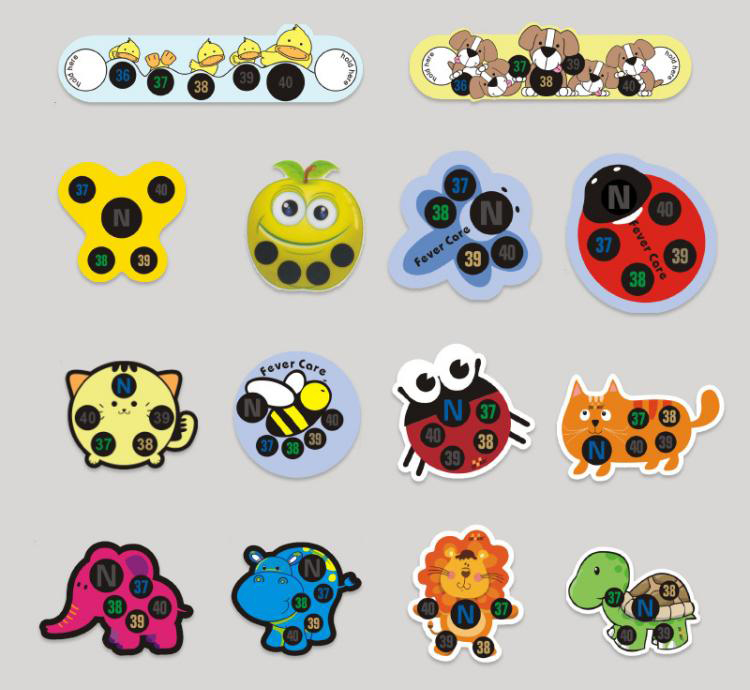
Its public supplier profile lists liquid crystal thermometer stickers or cards, thermochromic products, photochromic products, scratch-and-sniff stickers, and air freshener cards. This portfolio makes the company relevant to brands combining temperature-sensitive products with promotional or sensory merchandise.
Company-provided information states more than 13 years of production experience and availability of OEM/ODM and personalized customization. Its exact establishment year, annual thermometer strip capacity, MOQ, and current certification scope were not independently verified. The supplied company About Us page could not be retrieved during research.
The company is positioned for small and midsize brands seeking direct discussions about customized thermometer strips rather than purchasing only standard catalog products.
Its practical appeal should be evaluated through:
- Willingness to develop a specification around the buyer's application.
- Flexibility in artwork, dimensions, and packaging.
- Depth of technical support during OEM development.
- Communication efficiency during sample revisions.
- Competitiveness of the total delivered cost.
These are evaluation priorities, not independently measured performance claims.
Potential projects include branded liquid crystal thermometer cards, adhesive temperature strips, and temperature-sensitive promotional products, subject to technical confirmation.
- Establishment year: Not independently verified; the company states more than 13 years of production experience.
- Market orientation: Global customers, according to company-provided information; country-level sales distribution is not disclosed.
- OEM/ODM scope: Company-stated personalized product development and customization.
- Procurement qualification: Request temperature-response data, material specifications, sample terms, current certificates, and production lead times.
For a Korean private-label buyer, Qingdao Focus On Color is most appropriately considered a value-oriented factory candidate whose flexibility and technical communication should be tested through a structured sample project.

SAMKWANG Corporation offers particularly useful evidence of its supply-chain role. NiGK's official global-partner page identifies the Bucheon-based company as an authorized distributor of its temperature-indicator materials.
This confirmation is stronger than a marketplace listing alone because it comes from the original manufacturer.
SAMKWANG's Korean product page lists Thermo Label 5E products with five temperature steps. For the displayed combinations, it publishes a stated accuracy of ±2°C and a white-to-black color change. Buyers should verify the exact model and current datasheet before applying those specifications to an order.
SAMKWANG is a relevant option for buyers wanting a Korean purchasing channel for established Japanese temperature-indicator products.
Its principal documented advantage is manufacturer-confirmed distribution authorization. It is not evidence that SAMKWANG manufactures the indicators itself.
- Establishment year: Not verified from the reviewed sources.
- Market orientation: Korean distribution of NiGK temperature-indicator materials.
- OEM/ODM scope: Custom manufacturing capability was not established; special requirements should be referred to the original manufacturer.
- Procurement qualification: Confirm model origin, batch identification, storage conditions, pack quantity, and whether customization is available through NiGK.
Buyers should avoid confusing this company with other businesses named Samkwang. An unrelated company's founding date or certifications cannot be transferred to this distributor.
MISUMI Korea's official company information states that the Korean business was established in 1999. Its Korean catalog includes Nichiyu Giken temperature labels with four- and five-point irreversible indication, including a listing supplied in packs of 20.
This makes MISUMI relevant for buyers sourcing defined industrial-label models rather than commissioning a new thermometer strip design.
The main advantage is a structured local catalog purchasing route. Buyers can identify an existing product and compare its specified temperature steps with an equipment-monitoring requirement.
However, MISUMI's wider capabilities in industrial components should not be interpreted as proof that its thermometer-label listings support private-label manufacturing.
- Establishment year: 1999 for MISUMI Korea.
- Market orientation: Korean industrial automation and related procurement.
- OEM/ODM scope: No thermometer-strip-specific private-label service was established from the reviewed listing.
- Procurement qualification: Confirm stock availability, shipping date, package quantity, original manufacturer, and current technical documentation.
A 20-piece sales pack is not necessarily a manufacturing MOQ. That distinction is important when comparing catalog purchasing with direct OEM sourcing.
Samwon Instruments publishes a Korean temperature-label category and identifies its headquarters in Goyang, Gyeonggi-do, with a Busan office also listed. This establishes a local supplier lead worth investigating.
The available evidence is less detailed than the manufacturer-confirmed relationship documented for SAMKWANG.
Samwon may be relevant where a buyer prefers to discuss temperature labels with a Korean instrumentation supplier.
Before shortlisting it for a long-term strip program, buyers should obtain the actual product catalog and clarify:
- Whether the offered labels are reversible or irreversible.
- The original manufacturer.
- Whether the company is an authorized distributor.
- Available temperature ranges and stated tolerances.
- Whether stock products or custom products are available.
- Establishment year: Not verified.
- Market orientation: Korean instrumentation procurement; broader sales distribution was not established.
- OEM/ODM scope: Not verified.
- Procurement qualification: Treat the published category as a sourcing lead, not proof of liquid crystal strip manufacturing capability.
This entry is useful for local supplier discovery, but it requires more qualification than the other documented purchasing channels.
NiGK Corporation's official history dates its establishment to December 1980. Its global-partner page confirms SAMKWANG as a Korean distributor, giving buyers a documented connection between the original manufacturer and local supply.
NiGK's Thermo Label Mini illustrates its product-specific documentation. The published page identifies a 50–125°C range, ±2°C accuracy for the listed models, irreversible white-to-red indication, and RoHS compliance. It also specifies indoor-use limitations and storage precautions. These details apply to that product family, not automatically to every NiGK label.
NiGK is relevant for industrial buyers who need documented threshold indicators and clear application restrictions.
The reviewed Mini product is a single-threshold label, not a multi-step liquid crystal thermometer strip. Buyers should select the correct family rather than treating all temperature-sensitive labels as equivalent.
- Establishment year: 1980.
- Market orientation: International distribution, including a documented Korean channel.
- OEM/ODM scope: Private-label and custom-development availability must be confirmed directly.
- Procurement qualification: Obtain the exact product datasheet, environmental limitations, conformity evidence, and authorized-channel quotation.
NiGK and SAMKWANG are separate commercial entities, but they are not two independent manufacturing sources for the same NiGK product.
SpotSee's official history traces its business origins to ShockWatch in 1974. Its portfolio now incorporates LCR Hallcrest and TMC Hallcrest, companies associated with color-changing temperature products, thermal labels, and thermometer strips. The 1974 date describes the group's history, not the establishment date of every acquired operation.
SpotSee's published liquid crystal range includes self-adhesive reversible indicators. It states ±1°C accuracy and availability of custom sizes, shapes, temperature ranges, and graphics for the described product line. Its broader published liquid crystal range extends from −30°C to 120°C, although individual products must be selected against their own specifications.
SpotSee is relevant for buyers seeking direct access to temperature-indicator technology and established liquid crystal product development.
It also offers irreversible Thermax labels that permanently record threshold exposure. These serve a different purpose from reversible current-temperature strips.
- Establishment year: Group origins in 1974.
- Market orientation: Global condition-monitoring applications.
- OEM/ODM scope: Published customization includes dimensions, shapes, temperature ranges, and graphic designs.
- Procurement qualification: Confirm the supply route into Korea, current MOQ, production-site documentation, and application-specific performance.
A Korean office or dedicated local stocking arrangement was not verified for this article, so buyers should confirm the commercial route before planning delivery.
The table distinguishes disclosed information from items requiring a quotation or documentary review. "Not disclosed" does not mean a supplier lacks capacity or certification.
| Supplier | Supply role | Main product focus | Published strip capacity | MOQ or pack information | Certification or compliance evidence |
|---|---|---|---|---|---|
| Qingdao Focus On Color | China-based manufacturer; company-stated OEM/ODM | Liquid crystal stickers/cards and related color-changing products | Not verified | Custom MOQ requires quotation | Current certificates and product reports require review |
| SAMKWANG Corporation | Authorized Korean NiGK distributor | Industrial temperature-indicator labels | Not applicable to its distributor role | Confirm by model | Authorization confirmed by NiGK; product documents are model-specific |
| MISUMI Korea | Korean catalog purchasing channel | Standard irreversible labels | Not applicable to catalog distribution | Reviewed listing: 20-piece pack; not an OEM MOQ | Confirm original-manufacturer documents for the selected SKU |
| Samwon Instruments | Korean instrumentation supplier | Published temperature-label category | Not verified | Requires quotation | Manufacturer identity and current documents require confirmation |
| NiGK Corporation | Japanese original manufacturer | Industrial threshold indicators | Not disclosed in reviewed sources | Reviewed Mini family: 200 pieces per package; not a custom MOQ | Mini page states RoHS compliance |
| SpotSee | Global technology manufacturer | Reversible liquid crystal strips and irreversible labels | Not disclosed in reviewed sources | Standard/custom quantities require quotation | Product- and manufacturing-site-specific documentation required |
Product and channel details in this comparison derive from the suppliers' published profiles, catalogs, and manufacturer documentation. No independently audited capacity figures or current supplier-wide certification sets were verified.
A reversible liquid crystal thermometer strip indicates current temperature and changes as the monitored surface warms or cools.
An irreversible indicator records whether a temperature threshold has been reached. It does not subsequently function as a current-temperature display.
For each quotation, define:
1. What needs to be measured.
2. Whether the required result is current temperature or historical threshold exposure.
3. The expected temperature range.
4. Acceptable tolerance.
5. How the user will interpret the indicator.
This prevents a low-cost but technically unsuitable product from entering the purchasing comparison.
Request a layer-by-layer specification covering:
- Face film and protective layer.
- Temperature-sensitive coating.
- Background and printed graphics.
- Adhesive.
- Release liner.
- Packaging.
Terms such as "premium film" or "industrial adhesive" are insufficient without measurable requirements.
Ask suppliers to identify material grades and demonstrate performance on the intended surface. A label approved on a flat, clean test surface may not be suitable for a curved, contaminated, wet, or chemically exposed application. NiGK's published instructions explicitly warn about these conditions for its Mini labels.
A strip displaying temperature steps of 1°C does not automatically have ±1°C accuracy.
The buyer should request a test method that defines:
- Reference instrument and calibration status.
- Test surface and mounting method.
- Stabilization time.
- Heating and cooling sequence.
- Color interpretation.
- Pass/fail criteria.
For liquid crystal indicators, the readout convention matters. SpotSee describes the progression through visible colors and identifies green as the temperature indication for its stated system. That convention should not be assumed for an unrelated product without confirmation.
CE marking is not a universal quality certificate. European Commission guidance states that it is required only where applicable harmonized legislation mandates it; products outside those requirements must not carry it.
RoHS principally concerns electrical and electronic equipment. A battery-free passive strip should not automatically be treated as legally subject to RoHS solely because it is a thermometer. Nevertheless, buyers may require restricted-substance evidence as part of their material specification.
For products marketed for medical purposes, investigate the applicable classification and regulatory documentation separately. Industrial-label test reports do not establish suitability for clinical claims.
A particularly important failure mode is treating the approved sample as a graphic reference only.
For a liquid crystal strip, the temperature-sensitive layer, optical background, protective construction, and interpretation method work together. SpotSee's description of microencapsulated liquid crystals on a black backing demonstrates that the backing is part of the functional construction, not merely decoration.
The procurement implication is straightforward: two labels can carry identical artwork without having equivalent thermal performance.
A practical control plan should therefore include:
- A retained approved sample.
- A controlled material specification.
- Written approval before material substitution.
- Lot identification.
- Thermal-response checks on production samples.
- Defined lighting and readout conditions.
- Agreed acceptance limits.
This is an engineering purchasing precaution, not a claim that any listed supplier substitutes materials.
Specify which layers and materials require change notification. Do not accept "equivalent material" without testing and approval.
Test samples on the actual application surface and under representative conditions.
Assess adhesion, readability, temperature response, environmental exposure, and packaging after transport—not only appearance on arrival.
A Korean seller's invoice does not establish Korean origin.
Request the original manufacturer, production location, and origin documentation needed for the shipment. Distributor authorization and product origin are separate questions.
Ask for available capacity for your specific strip construction and order period.
A factory's total label output is not necessarily its available capacity for custom temperature-sensitive products.
Separate:
- Development time.
- Sample production.
- Buyer approval.
- Mass production.
- Inspection.
- Shipping.
Require the supplier to identify which materials or approvals could delay the schedule.
Before paying a deposit, match the quotation, contract, invoice, bank beneficiary, and business registration.
For a manufacturer, request evidence of the processes performed in-house. For a distributor, request original-manufacturer identification and authorization where relevant.
1. Evaluate standard samples to confirm the technology is suitable.
2. Approve customized samples covering graphics, materials, and performance.
3. Inspect pilot-production samples made using the intended production process.
Record the acceptance criteria before the pilot order.
Request storage and transport limits from the manufacturer rather than assuming all temperature labels tolerate the same conditions.
NiGK's Mini instructions, for example, advise dark, room-temperature storage and avoidance of excessive heat and humidity. Those instructions are product-specific.
For irreversible indicators, agree how unused stock will be protected from unintended activation and how questionable deliveries will be inspected.
Also confirm Incoterms, importer responsibilities, customs classification, origin documents, and remaining shelf life at delivery with the supplier and logistics adviser.
For established industrial threshold indicators, a documented Korean distribution route can simplify purchasing. For custom liquid crystal thermometer strips, buyers should assess direct manufacturing partners against their development support, material control, sample performance, and commercial terms.
Qingdao Focus On Color Industry & Trade Co., Ltd. provides a relevant China-based OEM/ODM candidate for buyers seeking personalized products. Its suitability should be established through a documented sample project rather than assumed from broad company claims.
Send a defined specification—including temperature range, tolerance, dimensions, mounting surface, artwork, annual quantity, and destination requirements—and request a quotation with sample terms, test methods, and applicable documentation.
A disciplined qualification process makes the supplier comparison more useful than a price-only ranking.
Obtain the complete certificate, including its number, legal entity, certified address, standard, scope, issuing body, and dates.
Use IAF CertSearch to review the status and issuing-body information. The database distinguishes active, suspended, withdrawn, and expired certificates. If a certificate cannot be located, seek direct confirmation from the certification body rather than immediately concluding it is fraudulent.
Check the scope carefully. Certification covering trading activities does not necessarily cover temperature-strip manufacturing.
Do not make that claim based solely on a liquid crystal strip datasheet.
Liquid crystal indicators respond to the temperature of the monitored surface. A clinical-performance claim requires application-specific evidence and an appropriate regulatory assessment; industrial accuracy figures cannot establish clinical equivalence. The reviewed supplier descriptions distinguish surface indicators and application-specific products, while MFDS maintains separate medical-device approval and regulatory processes.
The installation and surface conditions can affect the result.
Confirm that the label is properly attached, that the surface is suitable, and that the reading is taken according to the supplier's instructions. NiGK warns that contamination, uneven surfaces, and unsuitable mounting conditions can cause detachment or abnormal color change in its Mini products.
Validate the complete application rather than transferring a result from one surface to another.
Ask each supplier to separate the minimums associated with:
- Temperature formulation.
- Artwork setup.
- Die-cutting.
- Packaging.
- Total order value.
Then calculate the delivered cost for your expected annual demand.
A small catalog pack and a custom manufacturing MOQ answer different questions. MISUMI's reviewed 20-piece pack and NiGK Mini's 200-piece package are sales configurations, not verified private-label production minimums.
No. A local purchasing channel and manufacturing origin are separate.
NiGK's official partner page identifies SAMKWANG as its Korean distributor, while MISUMI Korea lists Nichiyu Giken temperature labels in its catalog. These are examples of Korean procurement channels connected to an overseas manufacturer.
When origin affects customs treatment or customer requirements, obtain the relevant documentation before shipment.
1. Qingdao Focus On Color — Public Company Profile: Listed product categories; not an independent factory audit.
2. Qingdao Focus On Color — Company About Us Page: User-supplied company page; it could not be retrieved during this research.
3. NiGK — Official Global Partners: Manufacturer confirmation of SAMKWANG’s Korean distribution role.
4. SAMKWANG — Thermo Label 5E: Korean product listing and displayed specifications.
5. MISUMI Korea — Company Information: Korean establishment year and business overview.
6. MISUMI Korea — Nichiyu Giken Temperature Labels: Irreversible-label catalog listing.
7. Samwon Instruments — Temperature Labels: Local supplier category and contact information.
8. NiGK — Corporate History: Establishment history.
9. NiGK — Thermo Label Mini: Product specifications, restrictions, and handling guidance.
10. SpotSee — Applied Temperature Technologies: Liquid crystal products and published customization options.
11. SpotSee — Company History: Group origins and development.
12. U.S. International Trade Administration — South Korea Medical Equipment and Devices: Government-published market and export data based on MFDS statistics.
13. MFDS — September 2025 Regulatory Update, Hosted by IMDRF: Official medical-device regulatory developments.
14. Cisema — Summary of the 2025 MFDS Medical Device Approval Report: Secondary regulatory-industry reporting; not thermometer-strip market research.
15. Invest KOREA — Wonju Medical Device Industry Cluster: Official investment-promotion material on the cluster.
16. IAF CertSearch — Certificate Verification: Accredited management-system certificate checking.
17. European Commission — CE Marking Guidance: Official guidance on when CE marking applies.


