+86 18560646018

Views: 218 Author: Focus Color Publish Time: 2026-08-21 Origin: Site


Content Menu
● What Is the Difference Between UV Ink and Regular Ink?
● How to Identify UV Ink Stickers
>> 1. Check Whether the Ink Is Dry Immediately
>> 2. Look for a Dense Surface Finish
>> 3. Perform a Tape Adhesion Test
>> 4. Test Scratch and Rub Resistance
>> 5. Feel for Tackiness or Residue
● Why UV Ink Can Be Difficult to Identify Visually
● UV Ink Sticker Inspection Checklist
● Common Problems That Can Be Mistaken for Regular Ink
>> Poor Adhesion on Plastic Labels
>> Confusing UV Ink With UV Varnish
● Selecting the Right Sticker for Your Application
● Expert Advice for Buyers and Product Developers
● Request a Customized UV or Functional Sticker Solution
● FAQ
>> Can I identify UV ink only by looking at a sticker?
>> Does UV ink always feel raised?
>> Is a glossy sticker always UV printed?
>> Why does UV ink peel off plastic stickers?
>> Is UV ink better than regular ink for waterproof stickers?
>> Can UV ink be used for food packaging labels?
>> What test should I ask my supplier to perform?
UV ink stickers can often be identified by their instant-dry, hard-wearing printed surface, strong scratch resistance, and crisp surface color. However, appearance alone is not enough to confirm the ink system. The most reliable way to tell UV-cured ink from regular ink is to combine visual inspection with controlled rub, adhesion, and curing-performance checks.
For brand owners, label converters, packaging buyers, and promotional-product suppliers, identifying the print method matters. It affects durability, lead time, substrate compatibility, finishing options, compliance requirements, and long-term product performance.

UV ink is a specially formulated printing ink that cures when exposed to ultraviolet light. Instead of relying mainly on evaporation, absorption, or oxidation to dry, UV ink undergoes a rapid chemical reaction that converts the liquid ink film into a solid coating.
Regular ink is a broad term. It may include water-based ink, solvent-based ink, oil-based offset ink, or other conventional systems. These inks usually dry through one or more slower mechanisms:
- Absorption into paper or porous materials
- Solvent or water evaporation
- Oxidative drying after exposure to air
- Heat-assisted drying in industrial production
The practical result is simple: UV ink typically sits and cures on the surface, while many regular inks partly penetrate the substrate or need additional time to dry completely.
| Feature | UV Ink Sticker | Regular Ink Sticker |
|---|---|---|
| Drying method | UV-light curing | Evaporation, absorption, oxidation, or heat |
| Handling time | Usually ready immediately after proper curing | May require minutes, hours, or longer |
| Surface feel | Often smooth, dense, hard, or slightly raised | Can feel softer, flatter, or more absorbed |
| Scratch resistance | Often high after full cure | Depends heavily on ink type and drying time |
| Color appearance | Usually sharp, dense, and highly defined | Can range from matte and absorbed to glossy |
| Suitable materials | Paper, coated stock, PET, PVC, BOPP, metalized films, and more | Depends on ink chemistry and substrate |
| Common risk | Poor adhesion or tackiness if under-cured | Smudging, blocking, fading, or incomplete drying |
A UV sticker is not automatically better in every application. The right choice depends on the label material, end-use environment, printing volume, required finish, and safety or compliance needs.
The best approach is to use several checks rather than relying on one sign. A glossy surface, for example, may come from a varnish or laminate rather than UV ink itself.
A properly cured UV ink sticker should generally be dry enough for immediate handling after it leaves the curing unit. The printed surface should not smear when lightly touched with a clean finger.
By contrast, conventional inks may require time before they become fully dry. Some oil-based or solvent-based inks can feel dry on the surface but remain vulnerable to pressure, stacking, or rubbing before complete drying.
Quick field check:
1. Choose an inconspicuous printed area.
2. Press a clean white tissue or cotton swab lightly against the print.
3. Rub gently in one direction.
4. Check for visible color transfer, smearing, or tackiness.
No transfer does not prove that the ink is UV-cured. It does, however, indicate that the print surface is sufficiently dry or cured for handling.
UV ink frequently creates a more continuous surface film because it generally does not soak deeply into the material. On coated paper, film, synthetic labels, and non-porous packaging, this can create a highly defined appearance.
Common visual signs include:
- Strong edge definition around small text and graphics
- Dense solid colors
- Clear detail in fine lines
- A smooth or slightly raised print layer
- Glossy, satin, or matte effects that remain consistent across the design
- Strong opacity when white ink is printed on dark or transparent material
Regular ink printed on uncoated paper often looks more absorbed. Fine details may appear softer because the ink spreads slightly into the fibers. This is not a defect; it can be the intended result for natural paper labels, cartons, books, or other paper-based products.
A tape test is one of the most useful practical ways to evaluate whether a cured ink film is securely attached to the sticker material. This is especially relevant for plastic films, coated labels, metallic surfaces, and other non-porous substrates.
ASTM D3359 is a recognized standard for assessing coating adhesion with tape. In production settings, printers may use a cross-hatch pattern and controlled tape procedure to evaluate whether a coating or ink layer lifts from the substrate.
For a basic in-house screening check:
1. Allow the sample to stabilize at room temperature.
2. Apply a consistent piece of high-tack tape to a printed area.
3. Press it down firmly without trapping air.
4. Pull it back quickly at a consistent angle.
5. Inspect both the tape and sticker surface.
A well-cured and well-adhered UV ink surface should show minimal or no visible ink removal. If significant ink transfers to the tape, the issue may be incomplete curing, inadequate surface treatment, incorrect ink-substrate matching, contamination, or poor material quality.
Important: A failed tape test does not automatically mean the sticker uses regular ink. It may indicate that a UV ink was not fully cured or was printed on a poorly prepared substrate.
A fully cured UV ink film is commonly valued for its resistance to rubbing and abrasion. This makes it useful for labels that may be touched frequently, transported through distribution channels, exposed to handling, or used on promotional items.
Try a gentle fingernail scratch test in a hidden area. A properly cured surface should resist obvious scratching under moderate pressure. If the print marks easily, flakes, feels soft, or releases color, the surface may be under-cured or unsuitable for the application.
For more consistent quality control, a solvent-rub test can help reveal cure quality. Industry practice may use a cloth and a specified solvent, such as methyl ethyl ketone, for repeated rubs. However, this type of test should be handled only by trained personnel with proper safety controls because industrial solvents can be hazardous.
For routine buyer inspections, a dry-rub test using a clean cloth is safer:
- Rub the same printed area 20 times using moderate, consistent pressure.
- Check whether color transfers to the cloth.
- Check whether gloss changes, the surface becomes dull, or print edges break down.
- Compare the result with an approved reference sample.
UV ink should form a dry, solid surface after adequate curing. A sticky, greasy, soft, or strongly odorous print surface can be a warning sign of incomplete cure.
Incomplete curing may lead to:
- Fingerprint marks
- Dust attraction
- Reduced abrasion resistance
- Weak adhesion
- Color transfer during handling
- Unreacted chemical residues
A practical thumb-rub check can identify obvious under-cure. Rub the printed area back and forth 10 to 15 times with moderate pressure. A stable print should remain smooth and intact without residue on the finger.
Do not use odor as the only test. Some printing systems have noticeable odors for reasons unrelated to cure quality, while some under-cured products may not smell strongly.
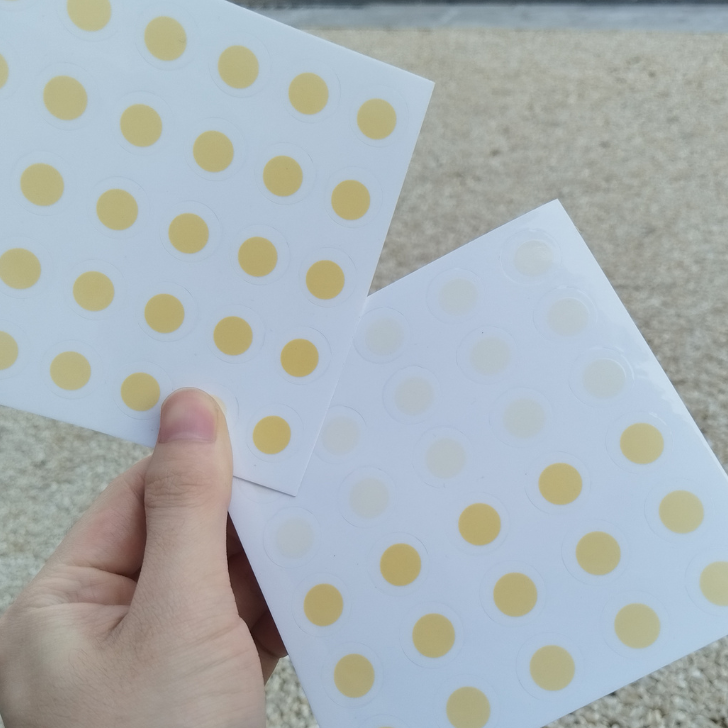
Many buyers assume that a glossy label is UV printed. That assumption is unreliable.
A regular ink sticker can look glossy when it includes:
- Gloss lamination
- UV varnish applied over conventional ink
- Water-based or solvent-based gloss coating
- High-gloss label stock
- Metallic, holographic, or clear film material
Similarly, UV ink can be printed with a matte finish. A matte UV-cured label may look understated while still offering fast curing and excellent durability.
The correct question is not simply, "Does this label look glossy?" A better question is: "How does the printed layer perform on this specific material under the conditions it will face?"
Use this checklist when comparing a suspected UV ink sticker with a regular ink sample:
| Inspection Point | What to Check | What It May Indicate |
|---|---|---|
| Surface dryness | No smearing after handling | Fast curing or complete drying |
| Print sharpness | Clean text and fine graphic edges | Low ink spread and stable print film |
| Scratch resistance | No major damage from a light controlled scratch | Strong cured surface |
| Dry-rub resistance | Little or no color transfer to a cloth | Good surface durability |
| Tape adhesion | Minimal ink lifting | Strong bonding to the substrate |
| Flex performance | No cracking on bent film labels | Suitable ink flexibility |
| Odor and tack | No sticky feel or strong residual odor | More complete curing |
| Comparison sample | Match against approved production reference | Better consistency evaluation |
For critical applications, use documented acceptance criteria rather than subjective descriptions such as "looks good" or "feels durable."
A UV-printed sticker can perform poorly if the process is not controlled correctly. In other words, poor UV print quality does not mean that the printer used conventional ink.
Under-cure is one of the most common causes of soft, tacky, easily damaged UV print. It can result from insufficient UV energy, excessive printing speed, lamp aging, poor lamp positioning, excessive ink coverage, or an ink formula not matched to the curing system.
Typical symptoms include:
- Sticky or oily surface feel
- Smearing or color transfer
- Poor scratch resistance
- Visible ink pickup during tape testing
- Surface whitening after rubbing
- Strong residual monomer-like odor
UV inks can be tested immediately after UV exposure, unlike many conventional inks that need time to finish oxidative drying. This makes rapid quality checks especially valuable in production.
PET, PVC, PP, BOPP, and other film labels can be challenging because they are non-porous. UV ink remains largely on the surface, so adhesion depends heavily on surface energy, cleanliness, treatment, and ink compatibility.
If a plastic sticker fails a tape test, investigate:
- Whether the film was corona-treated or otherwise prepared
- Whether treatment levels declined during material storage
- Whether silicone, oil, dust, or anti-static additives contaminated the surface
- Whether the UV ink was designed for that specific film
- Whether the curing unit delivered sufficient energy across the full print width
A UV ink layer may shrink slightly as it cures, which can make adhesion control particularly important.
UV varnish is a clear coating. It can be applied over either UV ink or conventional ink to create gloss, matte contrast, texture, protection, or spot effects.
If only selected areas of a sticker look glossy or raised, you may be seeing spot UV varnish, not necessarily UV-printed color. Examine the colored image separately from the clear finished area.
Instead of choosing only by print method, start with the product's real operating conditions.
| Application | Key Requirement | Suitable Questions to Ask |
|---|---|---|
| Outdoor labels | UV exposure, water resistance, color stability | Has the complete label construction been tested outdoors? |
| Cosmetic packaging | Premium appearance, rubbing resistance, chemical contact | Is the ink compatible with oils, alcohol, and repeated handling? |
| Food-related packaging | Controlled material selection and migration management | Is the print on the non-food-contact side and is the system appropriate for the intended package? |
| Promotional stickers | Strong color and attractive finish | Does the label resist scratching during shipping and use? |
| Industrial labels | Adhesion, solvent resistance, temperature durability | Has the label been tested on the actual surface and environment? |
| Temperature indicators | Reliable color-change function | Has the thermochromic or liquid-crystal layer been protected from abrasion and unsuitable chemicals? |
For food-contact packaging, ink selection requires special caution. Photoinitiators are used in UV-cured inks, and certain substances can migrate from the exterior of packaging under some conditions. The full package structure, intended use, print location, curing quality, and applicable market requirements must be assessed together.
As a manufacturer of color-changing materials, temperature indicators, and customized functional products, we recommend evaluating stickers as a complete system rather than treating ink as an isolated component.
A reliable label depends on the interaction between:
- Face material
- Adhesive
- Ink or coating
- Surface treatment
- Curing conditions
- Protective finish
- Storage conditions
- Real-world use environment
For example, a UV-printed label may pass a simple warehouse test but fail after repeated contact with hand sanitizer, cosmetic oil, humidity, high heat, or curved packaging. A thermochromic label requires even more care because the functional color-changing layer must remain visible while being protected from friction, excessive heat, and incompatible chemicals.
Before approving mass production, request a pre-production sample and test it on the final product. Check adhesion, color, rubbing resistance, bend performance, exposure to moisture, and the actual temperature range if the product includes a temperature-sensitive feature.
If you need a sticker that does more than display a logo, choose a supplier that understands both print performance and functional material behavior.
Qingdao Focus On Color Industry & Trade Co., Ltd. has more than 13 years of experience producing photochromic, thermochromic, liquid-crystal temperature-indicator, fragrance, and customized functional products. We support OEM, ODM, and tailored development for customers seeking reliable visual effects, responsive color-change performance, and application-specific solutions.
Contact our team today to discuss your substrate, artwork, intended use environment, required color effect, and performance targets. We can help you evaluate whether UV printing, conventional printing, protective coatings, or a customized functional layer is the right solution for your project.
No. UV ink often has a dense, sharp, durable appearance, but gloss, texture, and color alone cannot confirm the print method. Use a combination of handling, rub, adhesion, and supplier-documentation checks.
No. Some UV prints may have a slightly raised surface, especially with heavy ink coverage or textured effects. Many UV-printed labels feel flat and smooth.
No. A glossy finish can come from lamination, varnish, glossy label stock, or various non-UV printing and coating systems.
Possible causes include poor surface treatment, contamination, incompatible ink, insufficient cure, excessive ink thickness, or unsuitable substrate selection. A controlled tape adhesion test helps identify the problem.
Not automatically. A waterproof label requires the right combination of film material, adhesive, ink, coating, and production controls. UV ink can provide good durability, but the whole label construction must be tested.
It can be used in packaging applications, but the design must consider the printed side, intended food contact, curing quality, migration risk, applicable regulations, and the complete package structure. Standard UV systems may contain substances with higher migration potential, so specialized material selection is important.
Ask for an agreed specification covering visual quality, tape adhesion, dry-rub resistance, scratch resistance, color consistency, and application-specific testing such as heat, moisture, chemical contact, or outdoor exposure.
1. U.S. Food and Drug Administration. "[Hazard Identification of Printing Ink Substances Used on the Exterior of Food Packaging]."
2. Ink World Magazine. "[Testing and QC for UV Inks]."
3. Siegwerk. "[Selection of Migration Optimized UV Systems for Food Packaging]."
4. Seaton. "[How to Determine if UV Varnish and UV Ink Are Cured?]."
5. ASTM International. "[ASTM D3359: Standard Test Methods for Rating Adhesion by Tape Test]."
6. ASTM International. "[ASTM D5264: Standard Practice for Abrasion Resistance of Printed Materials]."


